Best Switch Box for Speakers: Top 5 Picks for Home Audio
Running multiple audio zones without stressing your amplifier is easier with a high-quality switch box. This guide highlights five top options designed to simplify switching between amps and speaker pairs, while preserving sound quality. All models listed are passive or compatible with common home theater and stereo setups, offering reliable control, clear connections, and straightforward operation for American homes.
| Product | Brand | Channel Support | Speaker Pairs | Power | Notes |
|---|---|---|---|---|---|
| Pyle 4-Zone Switch Box (PSS4) | Pyle | 2–4 zones | 4 pairs | Passive | High power handling, multi-zone |
| SOLUPEAK P2 2(1)-in-1(2)-Out | SOLUPEAK | 2 in / 1 out or 1 in / 2 out | 2 pairs | Passive | Flexible 2×1 or 1×2 switching |
| PROZOR 2-Zone Speaker Switch Box | PROZOR | 2 zones | 2 pairs | Passive | Independent A/B controls, two zones |
| Pyle Premium 6-Channel (PSPVC6.5) | Pyle | 6 channels | 6 pairs | Passive | Individual volume control |
| ADWITS 2-Channel Switcher | ADWITS | 2 channels | 2 pairs | Passive | Low-cost, compact distribution |
Pyle 4-Zone Channel Switch Box (PSS4)
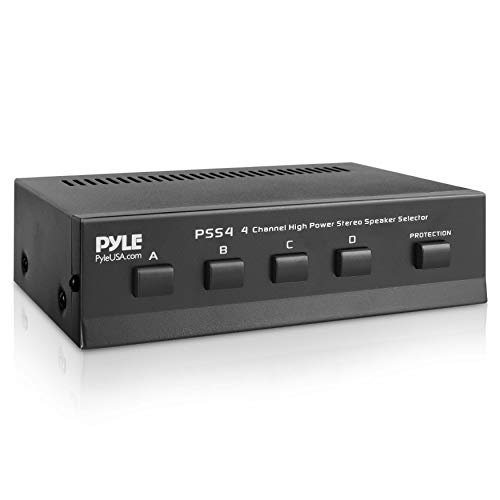
The PSS4 from Pyle is designed for multi-zone distribution, supporting up to four speaker pairs. Its four-zone layout enables independent routing for several rooms or listening areas. As a passive device, it relies on the connected amplifier for power and is built to integrate with high-powered stereo systems. This model emphasizes straightforward wiring with clear connections for each zone, making it a practical choice for larger home audio configurations where centralized control is desired.
SOLUPEAK P2 2(1)-in-1(2)-Out
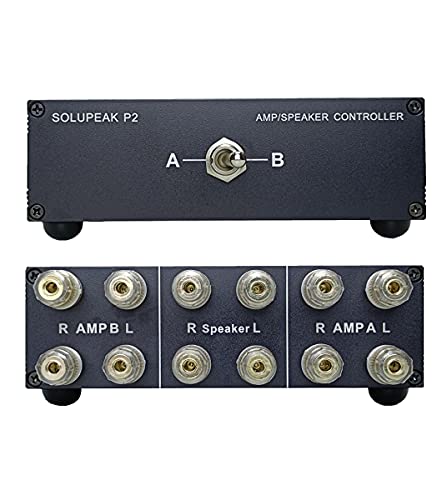
The SOLUPEAK P2 offers versatile 2-in-1-out switching, allowing two amplifiers to feed a single pair of speakers or one amplifier to two speaker pairs. It’s a passive, plug-and-play switch with high-quality banana jacks that accommodate up to 12-gauge wire. This flexibility is ideal for comparing two amps or two speaker sets without purchasing a powered distribution unit. It’s compact enough for desktop setups while delivering reliable, lossless switching.
PROZOR 2-Zone Speaker Switch Box

The PROZOR 2-Zone model provides independent A/B control across two zones, letting you switch between Zone A, Zone B, or both simultaneously. It’s a passive device, designed for easy plug-and-play use with spring clip terminals. This setup works well for users who want quick access to two separate listening areas or two amplifier inputs without a power supply, maintaining sound integrity with minimal signal loss.
Pyle Premium 6 Zone Switch (PSPVC6.5)

The PSPVC6.5 model supports up to six speaker pairs with a hub-style distribution approach. It includes individual volume controls per zone, which is useful for fine-tuning audio across multiple rooms without visiting the amplifier. This configuration is particularly suitable for larger homes or commercial spaces where separate listening areas require tailored levels while keeping the main control centralized.
ADWITS 2-Channel Switcher

The ADWITS 2-Channel Switcher is a compact, budget-friendly option for two-channel applications. It supports two pairs of speakers and two inputs, enabling straightforward distribution in smaller setups. Its simple design favors ease of use and immediate switching, making it a practical entry point for basic multi-room audio needs without external power requirements.
Buying Guide
- Channel and zone setup: Consider how many speaker pairs and how many independent zones you need. Multi-zone models (like 4- or 6-zone options) are ideal for larger homes or small commercial spaces, while 2-channel units suit compact rooms.
- Power handling and impedance: Check RMS power per channel and compatible impedance (commonly 4–8 ohms). Passive switches rely on your amplifier’s output; ensure your amp can drive the chosen speaker load without distortion or heat.
- Isolation and signal integrity: Look for devices with good mechanical isolation and quality banana/plated connections to minimize crosstalk and maintain clean sound when switching between sources.
- Wired vs. wireless considerations: All listed options are wired passive switches. If you need wireless convenience, pair with a wireless audio hub, but note potential latency and latency-related issues in some setups.
- Ease of installation: Plug-and-play designs with clear labeling reduce wiring mistakes. Spring clip terminals and clearly marked inputs/outputs help during setup and reconfiguration.
- Physical footprint and layout: Larger multi-zone units may require rack or shelf space. Consider where the amp and speakers are located to minimize wire length and preserve signal quality.
- Future proofing: If you anticipate expanding to more zones or more inputs, choose a switch with extra ports or modular design to avoid replacing the unit later.
- Build quality and brand support: Reputable brands tend to offer better connectors, durable housings, and user manuals. Check for warranty terms and customer support availability.