Best 12 Volt Golf Cart Battery Chargers for Reliable Power
When you need a dependable 12-volt charger for golf carts, you want models that protect the battery while keeping the cart ready to roll. This guide highlights five chargers well-suited for golf carts, including maintenance-minded smart chargers and desulfators. Each pick targets common buyer needs: everyday maintenance, faster charging, cold-weather performance, and smart diagnostics. The top choices are best for golf-cart owners who want simple, automatic charging without manual tweaks, or for technicians maintaining fleets of carts.
Summary Table of Selected Products
- NOCO GENIUS1: Best for compact all-in-one maintenance and desulfation for general 6V/12V lead-acid and LiFePO4 batteries.
- YONHAN Battery Charger: Best for fast, multi-stage charging and winter mode for 12V systems.
- MOTOPOWER MP00205A: Best budget desulfator-equipped charger with automatic maintenance.
- Zustov Smart Charger: Best multi-voltage, versatile option for mixed lead-acid batteries.
- NEXPEAK 1.75-Amp: Best compact 6V/12V option with LCD status and desulfator.
NOCO GENIUS1: Compact Smart Charger and Maintainer

Best for: Golf-cart owners who want a small, automatic charger with desulfation, suitable for 6V and 12V lead-acid and LiFePO4 batteries.
The GENIUS1 supports a range of batteries (lead-acid variants and LiFePO4). It includes an integrated thermal sensor to adjust charging with ambient temperature, helping to prevent overcharge in hot weather or undercharge in cold. Its size is convenient for tight storage spaces on a golf cart, and it functions as a maintainer and desulfator. A limitation is that it charges relatively slowly at 1A, so it’s best for regular top-ups rather than rapid recovery from deep discharge.
YONHAN Battery Charger: Fast 12V/24V Auto Maintainer

Best for: Golf carts needing faster charging and robust protection during winter storage.
Key features include 20A charging up to 12V/24V, multi-stage charging, winter mode, and multiple protections (reverse, overcurrent, overcharge, overheat). It supports LiFePO4 and various lead-acid chemistries, making it suitable for fleets or multiple batteries. Caution: This unit is not a jump starter and must be plugged into an outlet to operate. It’s best used for routine maintenance or seasonal charging rather than on-the-go charging mid-ride.
MOTOPOWER MP00205A 12V 800mA Charger

Best for: Budget-conscious buyers seeking an all-in-one charger, maintainer, and desulfator for standard 12V lead-acid batteries.
This unit combines charging, maintaining, desulfation, and automatic switching to a trickle mode after charging. It supports flooded, AGM, and gel cells and is ETL safety listed. A potential limitation is its lower 800mA output, which means slower recovery from deep discharge and longer top-ups for larger batteries like some golf carts.
Zustov Smart Charger: 6V–24V, 0–15A

Best for: Users who need a single charger that can service mixed battery systems on a golf cart or a small fleet.
A multi-voltage charger with 0–15A adjustable current handles six common voltages and a broad set of lead-acid chemistries. It includes smart pulse repair and automatic maintenance. It offers multiple safety protections and temperature sensing for safe charging. Limitation: The complexity of features may require a learning curve for new users, and ensure correct voltage setting for the battery type to avoid mischarging.
NEXPEAK 1.75-Amp 6V/12V Charger
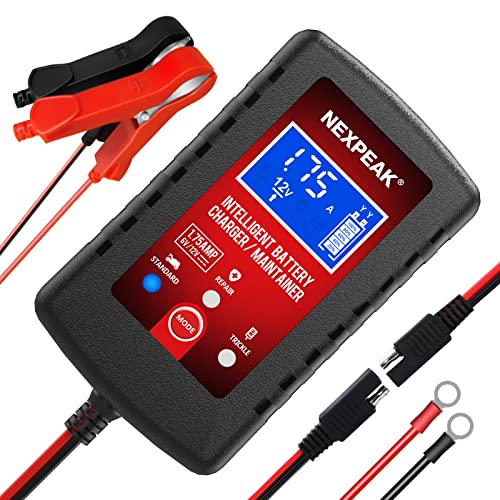
Best for: Portable, compact charging for smaller golf carts or individual batteries needing gentle maintenance.
This charger offers a 1.75A output with a 7-stage program, including desulfation and trickle charging. It features an LCD screen to display status, voltage, and charging percentage. A minor caveat is its modest power, which may not be ideal for deeply discharged or larger golf cart batteries; use it for routine maintenance or slower top-ups rather than fast recovery.
Buying Guide
What should you consider when choosing a 12V golf cart charger?
- Battery type compatibility: Most golf carts use flooded lead-acid, AGM, or Gel; some LiFePO4 options exist. Ensure the charger supports your battery chemistry.
- Charging速 and current: High current charges faster but can generate more heat. For maintenance, a lower current (0.5–2A) is common; for faster top-ups, 5–20A in appropriate systems helps.
- Temperature management: A built-in sensor helps prevent overcharge in heat or undercharge in cold. Look for temperature compensation features.
- Desulfation/repair features: Pulse or desulfation can help extend old or idle batteries. Consider whether this suits your battery condition and usage pattern.
- Safety protections: Look for reverse polarity, overcharge, short circuit, overheat, and overcurrent protections to protect both battery and charger.
- Ease of use and visibility: An LCD display or clear indicators helps monitor charging status, especially for fleet maintenance.
- Space and portability: For on-cart storage, compact designs are preferable; for a shop, larger form factors with more features may be acceptable.
FAQ
- Can these chargers work with a golf cart battery pack? Yes, most are suitable for standard 12V lead-acid packs used in golf carts; check the battery voltage and type first.
- Is a desulfator necessary for golf cart batteries? Desulfation can help older or idle batteries, but not all batteries require it. Use when sulfation is suspected and per manufacturer guidance.
- Do I need a charger with a temperature sensor? Temperature sensing helps prevent overcharging in heat and undercharging in cold, extending battery life in variable climates.
- Can I use these chargers for LiFePO4 batteries in golf carts? Some models support LiFePO4; verify battery chemistry compatibility before use.
- What is the difference between a charger and a maintainer? A charger supplies power to restore charge, while a maintainer keeps the battery at full charge over long periods without overcharging.
- Should I choose a charger with a high current rating for a golf cart? High current helps with faster charging but can heat batteries; choose a current matched to your battery size and usage pattern.