Best Power Meter With Data Logging for Real-Time Insights and Savings
Looking for a reliable power meter with data logging to track energy use and costs? This guide highlights five top options that excel at logging consumption, voltage, current, and more. Each pick suits different households and use cases—from general appliance auditing to smart home integration and RV/mobile setups.
Summary Of Chosen Products
| Product | Best For | Key Benefit | Notes |
|---|---|---|---|
| Upgraded Watt Power Meter Plug Home Electrical Usage Monitor | General households | 7 display modes, backlight, clear data readouts | Good balance of features and price |
| Poniie PN2500 | EV charging and high-precision monitoring | Class 1.0 accuracy, wide voltage range | Reliable for wall outlets and charging setups |
| Refoss Smart Home Energy Monitor | Smart homes and solar users | Local control, Open API, Home Assistant support | Privacy-focused with local data |
| KETOTEK Watt Meter Power Meter Plug | Multiple appliances and easy viewing | 5-button quick parameter access, overload alerts | Clear warnings and accumulated data |
| REED Instruments R4700SD-KIT | Professional data logging and environmental monitoring | Data logging with SD card bundle | Higher-precision and logging focus |
Upgraded Watt Power Meter Plug Home Electrical Usage Monitor
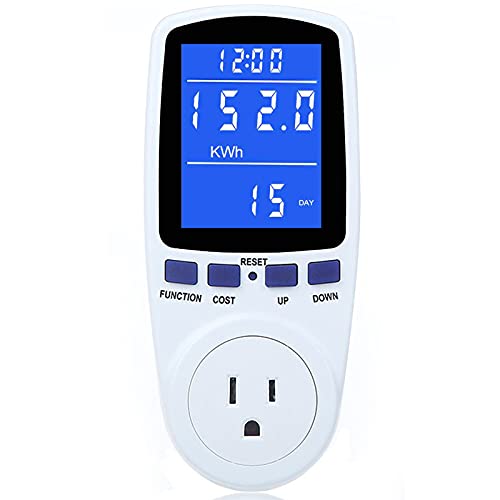
This power meter tracks power (W), energy (kWh), volts, amps, hertz, and power factor, plus cost and min/max readings. It supports seven display modes for quick parameter checks while appliances run. Best for homeowners who want straightforward audits of individual devices and a clear view of electricity costs over time. The large, backlit LCD improves readability day or night. A notable caveat is the reliance on inline measurement; for highly dynamic loads, data granularity may vary with display mode settings.
Poniie PN2500 Professional NEMA 5-15 Wi-Fi Wireless Level 1 EV Charger Pass-Through Power Usage Monitor

Designed for Level 1 EV charging and general power monitoring, the PN2500 emphasizes precision with a built-in high-precision current sensor and Class 1.0 accuracy (0.001 A resolution). It reports Watts, VA, kWh, time, amps, start-up amps, volts, PF, Hz, and estimated cost. Choose this if you need robust accuracy for charging stations or high-sensitivity appliances. It’s best for users prioritizing precise measurements over a wide voltage range and a focus on electrical testing. A limitation is that it may be more suited to dedicated connectors and settings rather than casual, single-outlet use.
Refoss Smart Home Energy Monitor
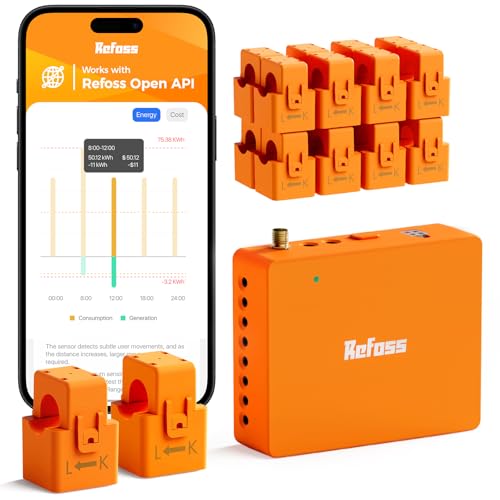
Refoss emphasizes local data control, offering 18 circuits of monitoring with ±1% precision. Its Open API, MQTT and WebSocket access let you pull data into Home Assistant without cloud reliance. This is ideal for households seeking strong privacy and automation, especially when integrating with solar or time-of-use setups. The device is ETL certified, and its local-first approach helps avoid subscription fees. A potential limitation is the setup complexity for users new to smart home ecosystems.
KETOTEK Watt Meter Power Meter Plug Electricity Usage Monitor

With quick-access parameter views via five buttons, KETOTEK lets users cycle through watt, kilowatt-hour, cost, voltage, current, frequency, PF, and more. It includes overload and alarm features to warn when consumption or cost thresholds are exceeded. Best for households needing immediate visibility and alerts across multiple devices. A caveat is the default overload threshold of 3680W, which users should adjust to their typical appliance loads to avoid frequent alarms.
REED Instruments R4700SD-KIT

This data-logging environmental meter kit includes the REED R4700SD plus an SD memory card, enabling logged electrical and environmental data capture. It suits professionals or serious hobbyists who need persistent records for audits, trend analysis, or compliance. The data logging capability makes it a strong choice for multi-location monitoring or scenarios where long-term data retention is essential. It may be more feature-rich than casual home-use meters, potentially requiring more setup knowledge.
Buying Guide: How To Choose The Right Power Meter With Data Logging
- Data scope — Consider which metrics matter: watts, kWh, volts, amps, PF, Hz, cost, start-up current, and temperature if applicable. Pick a model that logs the data you need in a usable format.
- Display and readability — Look for multiple display modes or backlight options for easy reading at a glance, including night readability for late-night monitoring.
- Accuracy and range — For high-power devices or charging stations, select meters with high accuracy (±1% or better) and an adequate current rating. If your loads vary widely, consider models with overload protection and clear warnings.
- Data storage and access — If you need long-term records, choose devices with SD cards or local data storage, and prefer those with open APIs or local Web UI for integration with smart home systems.
- Privacy vs. cloud — For sensitive setups, prioritize local data storage and control over cloud-based data collection. Open APIs and MQTT support are advantages for privacy-conscious users.
- Ease of use — For casual auditing, a straightforward plug-in meter with simple parameter switching is ideal. For advanced use, a kit with integration options and automation support may be worth the extra setup effort.
- Safety and build — ABS housing and proper overload protection help ensure durability in daily use. Check for proper certifications if relevant to your region.
Frequently Asked Questions
- What is a power meter with data logging used for? A power meter with data logging records energy usage and electrical parameters over time, enabling you to track consumption, identify energy waste, and estimate costs for appliances or entire circuits.
- How accurate do these meters need to be? For most home audits, ±1% to ±2% accuracy is sufficient. Higher accuracy is beneficial for EV charging, solar optimization, or professional audits.
- Can I use these meters with smart home systems? Some models offer Open API, MQTT, or native Home Assistant compatibility, allowing automation and integration with other devices. Check specific compatibility before buying.
- Is local data storage safer than cloud storage? Local data storage reduces exposure to cloud breaches and subscription requirements, but it requires your own data management. Cloud options can enable remote access but may involve privacy considerations.
- Do these meters support high-power appliances? Select meters with higher current ratings and overload protections suitable for the devices you monitor. If in doubt, choose a model designed for higher wattage and robust alarms.
- What’s the best option for RVs or mobile use? A compact meter with a wide voltage range (e.g., 120–240V) and clear data logging is ideal. The Poniie PN2500 is a strong example for mobile and charging contexts.