Best Solar Panel Roof Vents for Attics and Sheds
Answering the need for energy-efficient attic and roof ventilation, these solar-powered vents provide automatic cooling with no electrical hookup. They’re ideal for homeowners, gardeners, and workshop owners who want to reduce heat buildup in attics, garages, greenhouses, and storage spaces. The top five options below balance performance, durability, and ease of installation.
Summary table of selected products
- HNRLOY 25W Solar Roof Vent Fan — Best overall efficiency for small to medium spaces.
- Chtoocy 25W Solar Fan — Best for wire-free installation and portable setups.
- Kfonla 25W Solar Powered Fan — Best for heavy airflow in larger areas.
- DC HOUSE Solar Attic Fan — Best for higher airflow and all-weather use.
- VEVOR 42W Solar Attic Fan — Best for smart control and humidity sensing.
HNRLOY 25W Solar Roof Vent Fan

Features a 25W/22V single-crystal solar panel with an IP68 waterproof brushless DC motor, delivering efficient ventilation for cooler indoor spaces. The unit uses a galvanized steel housing with a polyester powder coating and an aluminum mesh to deter small animals. Tempered glass and an aluminum frame optimize solar absorption for long-term energy savings. Best for small-to-medium attics, garages, or shops that need consistent solar-powered cooling. A limitation to note is the 25W panel capacity, which may be less effective in persistently overcast conditions.
Chtoocy 25W Solar Fan

Offers a robust 430 CFM at 2500 RPM with a 25W monocrystalline panel and IP67 waterproof rating. It runs fully solar with no wiring, making it ideal for remote sheds, chicken coops, or greenhouses. Best for high airflow needs in sun-drenched spaces. A caveat: some users may prefer a model with remote monitoring for large deployments.
Kfonla 25W Solar Powered Fan

This unit delivers 430 CFM at 2500 RPM with optimized blades and an IP67/ IP68-rated design, suited for attics, sheds, greenhouses, barns, and dog houses. It starts automatically at dawn and shuts at dusk, powered entirely by a 25W solar panel. Best for larger spaces needing strong airflow, with the note that performance depends on sun exposure and climate.
VEVOR 42W Solar Attic Fan

With a 42W MPPT regulator, this fan maximizes sunlight capture to deliver up to 2800 CFM. It includes a smart temperature and humidity controller, a remote control, and all-weather construction. It is designed to reduce attic heat and humidity and can operate across seasons with solar-to-electric fallback at night. Best for larger homes or workshops that require precise climate control, though the higher capacity may be more suitable for bigger spaces than compact structures.
DC HOUSE Solar Attic Fan
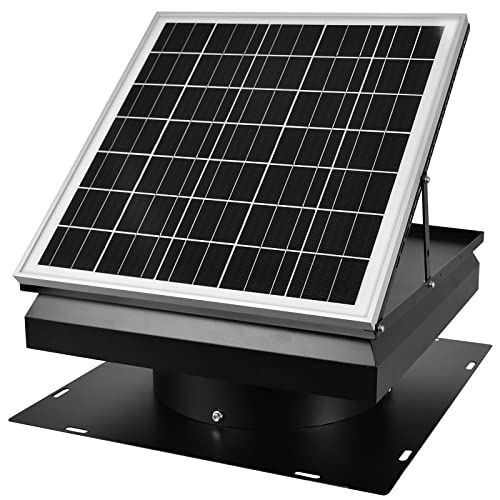
Solar-powered attic vent with 1600 CFM capacity. It claims off-grid operation with sunrise activation and dusk shutdown. The design focuses on robust airflow and universal compatibility with various roof types. Best for moderate-to-large attics or garages that require constant airflow. A limitation is that the actual performance depends on roof orientation and sunlight availability.
Buying Guide
What should you consider before buying a solar roof vent?
- Vent size and airflow: Measure the space to determine required CFM. Larger areas will benefit from higher CFM ratings, like 1600–2800 CFM, while smaller spaces can work with lower CFM models.
- Solar panel capacity: Higher-watt panels (25W, 32W, 42W) generally deliver stronger performance in sunny conditions. Ensure the panel type (monocrystalline) favors efficiency.
- Weatherproofing and durability: Look for IP ratings for motors and panels, galvanized housings, and corrosion-resistant finishes for long-term outdoor use.
- Automatic operation: Models with dawn-to-dusk cycling or intelligent temperature/humidity controls reduce manual intervention and adapt to climate changes.
- Wiring and installation: Wire-free options simplify setup but confirm mounting compatibility with your roof and the presence of appropriate seals to prevent leaks.
- Maintenance: Consider how easy it is to remove and clean components like aluminum mesh guards, and whether replacement parts are readily available.
- Weather and climate fit: Some units handle extreme temperatures and high winds better; others excel in mild climates with frequent cloud cover.
Frequently Asked Questions
- Q: Do solar attic vents work on cloudy days? A: Yes, many models operate automatically in low-light conditions but airflow may be reduced without direct sunlight. Some units switch to a back-up mode or continue operating at diminished capacity.
- Q: How do I know which CFM I need? A: For attic spaces, multiply the area (in square feet) by desired air exchanges per hour. Compare with product CFM ratings to choose.
- Q: Are solar attic fans easy to install? A: Most are designed for DIY installation with basic tools, but verify mounting requirements and sealing to prevent leaks in your roof.
- Q: Can solar attic fans replace my air conditioning? A: They help reduce attic heat and can lower cooling loads, but they do not cool living spaces directly like an AC unit.
- Q: What maintenance is required? A: Check guards for pests, clean panels periodically, and inspect mounting hardware for corrosion or loosening.
- Q: Do these systems include remote controls? A: Some models offer remote controls or smart controls; verify features in the product description.