Best Battery Operated Programmable Thermostat Options for Your Home
The best battery powered programmable thermostat helps you set schedules, save energy, and remain comfortable without wiring concerns. This guide focuses on reliable, programmable models that can operate on standard power sources or batteries, making them suitable for retrofit installs and easier DIY projects. It highlights five strong options for different households—ideal for those who want simple schedules, Wi‑Fi features, or color/display customization. The following table compares key traits of these products at a glance.
- New! Honeywell Home RTH20B — Best for quick replacement and straightforward 5-2 scheduling.
- Honeywell Home RTH7600D — Best for flexible week-long programming on a touchscreen.
- Honeywell Home RTH8560D — Best for customizable weekly patterns and clear display.
- Emerson Sensi ST55 — Best for remote access and energy usage insights.
- Honeywell Home RTH21B — Best for 7-day to 1-week flexible scheduling with color options.
| Product | Power Type | Scheduling | Display | Best For |
|---|---|---|---|---|
| RTH20B | Battery/Line-powered | 5-2 day | Large screen | Simple replacements |
| RTH7600D | Line-powered | 7-day | Touchscreen | Users wanting weekly control |
| RTH8560D | Line-powered | 7-day | Crystal-clear display | All-week scheduling |
| Sensi ST55 | Wi‑Fi (power‑dependent) | Flexible scheduling | LED/remote app | Smart home integration |
| RTH21B | Battery/Line-powered | 7-day / 5-1-1 / 5-2 | Large display | Custom weekly programs |
New! Honeywell Home RTH20B Programmable Thermostat

The RTH20B supports 5-2 day scheduling and offers a direct replacement path for older Honeywell models. It emphasizes an easy setup with a large display and clear font for daily use. This model is best for buyers seeking a straightforward device that fits existing wiring and provides basic programmable control. It is suitable for small homes or apartments where a simple, reliable programmable schedule is adequate. Caution: As a basic model, it may lack advanced smart features found on newer Wi‑Fi thermostats.
Honeywell Home RTH7600D 7‑Day Programmable Touchscreen

The RTH7600D features a large touchscreen and a 7-day programming menu with four periods per day. Its scheduling supports home/away temperature settings to optimize energy use when you’re not home. Best for households needing flexible daily routines and straightforward manual overrides. It requires standard power supply and is ideal for homeowners who want a visible, user-friendly interface and reliable automation without smart home connectivity.
Honeywell Home RTH8560D 7‑Day Programmable

The RTH8560D offers day-to-day and weekly scheduling with a crisp, backlit display. It includes a receiver in the package and focuses on easy programming for a weekly pattern, including weekend adjustments. Best for homeowners who want a reliable, dedicated programmable experience with a clear, legible interface. Limitation: It may lack built-in Wi‑Fi for remote access, depending on the model.
Emerson Sensi ST55 Wi‑Fi Smart Thermostat
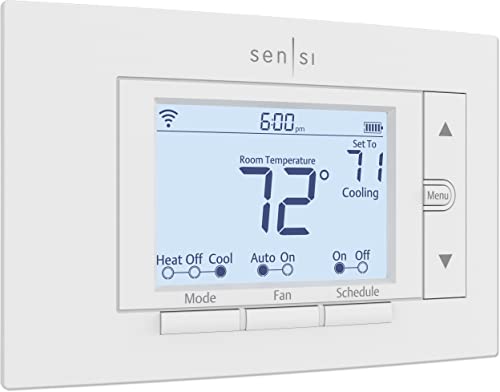
The Sensi ST55 is ENERGY STAR certified and connects to Wi‑Fi for remote access and usage reports. It advertises significant HVAC energy savings through flexible scheduling and smart features. Good for users who want smartphone control, usage insights, and easy DIY installation. Caution: Privacy protections are highlighted, but advanced features require a compatible home network and app setup.
New! Honeywell Home RTH21B 7‑Day Programmable

The RTH21B provides flexible 7-day, 5-1-1, or 5-2 day scheduling, with options to customize display and reminders. It is ideal for homeowners who want a configurable weekly program and a straightforward user experience. Best for practical households seeking reliable programmable control without complex setup. A caveat: like other non-Wi‑Fi models, remote monitoring isn’t included by default.
Buying Guide: Key Purchase Considerations
What type of power does the thermostat require? Most programmable thermostats can operate on standard line power, with some models offering battery backup. If your wiring supports it, a line-powered unit with a programmable schedule is typically the most reliable option. For retrofit projects, battery-assisted or low-power designs can simplify installation.
How flexible should the schedule be? If you need complex weekly patterns (7 days, 5-1-1, or 5-2 options), prioritize models like the RTH7600D, RTH8560D, or RTH21B. For simpler routines, the RTH20B provides straightforward 5-2 day scheduling without extra features.
Is smart connectivity important? If you want remote control, usage reports, and potential energy rebates, a Wi‑Fi model like the Emerson Sensi ST55 or a color touchscreen with app support is advantageous. For purely local control, non-smart units can be more economical and robust.
Display and usability matter. A large, backlit display with clear fonts improves daily use, especially for seniors or visually constrained users. Touchscreen interfaces tend to be easier for programming, but physical buttons can be more reliable in dusty or humid environments.
Installation considerations. Read wiring instructions carefully before purchasing. Some models require common wires (c-wire) for full functionality. If you’re uncertain about compatibility, consult a professional or check compatibility guides from the manufacturer.
Energy savings potential. ENERGY STAR certifications and utility rebates may be available for certain smart thermostats. Look for programs that reward flexible usage or demand response to maximize savings.
Frequently Asked Questions
- What is a battery operated programmable thermostat?
A thermostat designed to operate on battery power or with minimal external power, while offering programmable schedules to manage home heating and cooling.
- Do programmable thermostats save energy?
Yes. Scheduling and remote control help reduce energy use by aligning HVAC operation with occupancy patterns.
- Which thermostats work without Wi‑Fi?
Non‑Wi‑Fi programmable models, such as 5-2 or 7-day program thermostats, operate offline with built-in schedules.
- Can I install a programmable thermostat myself?
Many models support DIY installation, especially those with clear wiring guides and simple levers. Some systems may require professional help for wiring and compatibility checks.
- Are color or display features important?
Display readability and color customization aid daily use and help match home aesthetics, particularly in living areas or bedrooms.
- Will a smart thermostat require an internet connection?
Most Wi‑Fi models rely on internet access for remote features, app control, and software updates. Local control remains possible in many cases.