Best Wireless Safety Edge Kits for Secure Gate Management
Looking for a wireless safety edge kit that reliably detects gate obstructions and keeps entryways secure? This guide highlights five top options, explains who each product is best for, and helps you compare features quickly. These kits are designed for residential and commercial gates, with compatibility for monitored 10K edges, Bluetooth-enabled ranges, and transmitter/receiver configurations. Ideal buyers include homeowners upgrading an existing system, business facilities managers, and installers seeking plug-and-play wireless safety edge solutions.
| Product | Best For | Key Benefit | Notes |
|---|---|---|---|
| Linear SGEKDC Safety Edge Kit | Mid-range installations | Monitored, two-edge capability | Works with 10K monitored gate operators |
| Liftmaster LMWEKITU Monitored Wireless Edge Kit | Outdoor, rugged setups | UL325 compliant, Bluetooth range to 130 ft | NEMA 4X rated |
| Liftmaster LMWETXU Wireless Edge Transmitter | Extension to existing LMWEKITU | Transmitters for additional edges | Compatible with LMWEKITU kit |
| Miller Edge RB-G-K10 RBand Kit | RF-immunity and diagnostics | Bi-directional RF, onboard diagnostics | Monitored wireless edge kit |
| Miller Edge MWRT12 Kit | Simple, single-channel use | Monitored/non-monitored option | Non-monitored version available |
Linear SGEKDC Safety Edge Kit for Gate Openers

The Linear SGEKDC kit includes one SGET transmitter and one SGER receiver, designed to work with all 10K monitored gate operators. It uses 10K terminated edges and supports two channels for up to two edges and transmitters per receiver. A Low Battery alert helps prevent unexpected failures, and the receiver operates on 12-30 VDC with two output relays. Best for installers seeking a compact, monitored wireless edge solution compatible with standard 10K edges.
Best for: users needing a budget-friendly, two-edge monitored setup. The kit’s simplicity makes it a good fit for residential gates or light commercial entrances. Caution: ensure your operator supports 10K monitored edges for full compatibility.
Liftmaster LMWEKITU Monitored Wireless Edge Kit

This kit is UL325 compliant and features innovative low-energy Bluetooth transmission with up to 130 ft range. It includes integrated diagnostics and can protect up to eight entrapment points. The receiver accepts up to four transmitters, while the transmitter handles up to two wired resistive edges. Best for: outdoor installations requiring longer wireless range and robust diagnostics. Caution: Bluetooth-based range can be affected by physical barriers or interference in busy environments.
Liftmaster LMWETXU Monitored Wireless Edge Transmitter

Designed to work with the LMWEKITU kit, this transmitter supports sensing distances up to 130 ft and accepts up to two wired resistive edges. It is ideal for expanding an existing wireless edge system or adding additional edge sensing along a gate line. Best for: expanding coverage in larger properties. Caution: compatibility depends on using the matching LMWEKITU receiver setup.
Miller Edge RB-G-K10 RBand Monitored Kit
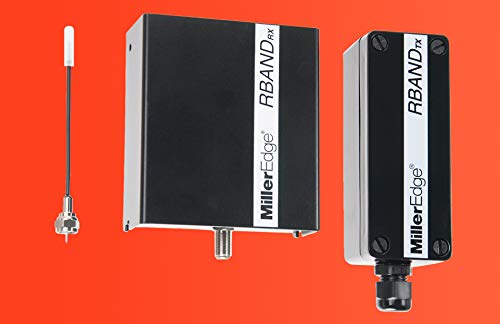
The Miller Edge RBand kit is a wireless, monitored transmitter/receiver system built specifically for automated gates. It provides bi-directional communication to improve RF immunity and includes onboard diagnostics for setup and troubleshooting. It also monitors T2(10K) sensing edges and transmits a wireless, monitored signal to operator controls. Best for: users prioritizing RF robustness and easy diagnostics. Caution: ensure the RBand supports your specific Miller Edge edge type and operator model.
Miller Edge MWRT12 Wireless Kit

The MWRT12 kit includes a single-channel receiver (MWR12) and transmitter (MWT12). Batteries are included, and the transmitter response time is nominally 30 milliseconds. The system operates at 318 MHz with a maximum range of about 100 feet under optimal conditions. Best for: straightforward, single-edge monitoring needs. Caution: consider upgrading to a multi-edge kit if your gate layout requires monitoring more than one edge.
Buying Guide: Key Considerations For Wireless Safety Edge Kits
What should you consider when selecting a wireless safety edge kit?
- Compatibility: Check operator models and edge types (10K monitored edges vs. non-monitored). Some kits are designed specifically for certain brands or edge resistances.
- Range and interference: Wireless range (RF distance and Bluetooth) matters in larger properties. Look for bi-directional signaling and robust diagnostics to troubleshoot interference.
- Monitored vs non-monitored: Monitored kits provide feedback to the operator on edge status, reducing the risk of false openings or entrapments.
- Edge capacity: Consider how many edges you need to monitor. Some kits support multiple transmitters/edges per receiver, others are single-edge.
- Weather and durability: For outdoor gates, ensure the kit is rated for exposure (e.g., NEMA ratings, weatherproof enclosures).
- Diagnostics and setup: Onboard diagnostics, quick setup, and clear signaling help reduce installation time and ongoing maintenance.
Frequently Asked Questions
- What is a wireless safety edge kit?
A wireless safety edge kit includes transmitter and receiver components that detect gate or door obstructions and communicate with the operator to stop movement. - Are wireless edge kits compatible with all gate operators?
Compatibility varies by model, edge type, and 10K monitoring requirements. Always verify operator compatibility before purchase. - What does UL325 compliance mean?
UL325 compliance indicates the product meets safety standards for gate operators, including performance during fault conditions. - Can I add more edges to my existing wireless kit?
Some kits allow extra transmitters or receivers; check the product’s edge capacity and compatibility notes. - What maintenance is required for wireless edge kits?
Regular battery checks, edge alignment verification, and diagnostic tests help maintain reliability. - Which kit is best for outdoor installations?
Kits with weather-rated enclosures (such as NEMA 4X) and longer-range wireless features are best for outdoor use.