Best Marine Solar Ventilation Fans for Boats and RVs
If you’re seeking reliable, solar-powered airflow for small living spaces on boats, yachts, RVs, or cabins, these solar ventilation fans offer hands-off operation and maintenance-free air movement. They’re best for boaters needing automatic ventilation, RV owners seeking off-grid cooling, and campers looking to reduce moisture and odors without wiring. The top picks below are evaluated for air flow, solar independence, noise level, and ease of installation. The summary table highlights key strengths to help you compare at a glance.
| Product | Best For |
|---|---|
| Marinco N20804W Day/Night Solar Vent | Boats needing reliable 24/7 operation with a rechargeable battery |
| RV Roof Vent Fan Upgraded 1440 CFH | RVs or boat cabins needing strong, dual-mode airflow |
| Besramtic 8.5-Inch Solar Fan (Battery-Optional) | Off-grid marine use with sun-powered operation |
| Pactrade Marine 8.5-Inch Ventilator II | Boats or yachts needing balanced intake and exhaust |
| RecPro RV Solar Ventilation Fan | RV interiors seeking quiet solar-powered ventilation |
Marinco N20804W Day/Night Solar Vent

The Marinco 4″ Day/Night Solar Vent circulates fresh air to reduce mold, mildew, and musty odors inside boat cabins. It moves up to 1,000 cubic feet of air per hour (4″ model) and 24,000 cubic feet per day. A rechargeable battery enables up to 24 hours of continuous operation, even without sun. Best for boaters who want steady, low-noise ventilation and a backup power option. Limitation: data emphasizes air movement rather than noise levels, so expect moderate operation during peak hours.
RV Roof Vent Fan Upgraded 1440 CFH

This 8.5-inch solar vent offers 1,440 CFH (24 CFM) and dual blades for flexible intake or exhaust. It fits standard 4-inch vent openings and includes a 2.5W solar panel with a 3,000 mAh battery, delivering up to 36 hours of operation without sun. Best for RVs or boat cabins that require strong airflow and the option to operate off-grid. Caution: installation may require careful sealing to prevent leaks around roof openings.
Besramtic 8.5-Inch Solar Powered Ventilation Fan

Besramtic’s 8.5-inch solar unit operates with a solar panel and a 1.3W panel, delivering up to 900 CFM and a quiet 45–54 dB operation. It’s designed for boats and marine vessels to remove stale air and moisture efficiently. Best for small to mid-sized boats needing silent, solar-driven ventilation. Limitation: battery support is described as not included or variable; plan for off-grid operation with a suitable battery if needed.
Pactrade Marine 7.5-Inch Ventilator II

This 7.5″ solar vent features a 3″ to 4¾” cutout diameter and dual blades for intake and exhaust. It can move up to 900 cu.ft./hr when powered by solar, plus passive ventilation at night with a light breeze. Best for smaller boats or pontoons needing balanced air movement. Limitation: external breeze helps performance; in still air, the airflow may drop without solar input.
VIHOSE Solar Ventilation Fan for RV and Marine

VIHOSE offers a self-contained solar exhaust fan in a white ABS housing, designed for RVs, campers, and marine use. It requires no wiring and operates with a built-in solar panel, delivering five-blade silent ventilation. Best for quick, maintenance-free air exchange in enclosed spaces. Limitation: some users might prefer battery backup for overcast days, as solar-only operation depends on sunlight availability.
RecPro RV Solar Ventilation Fan
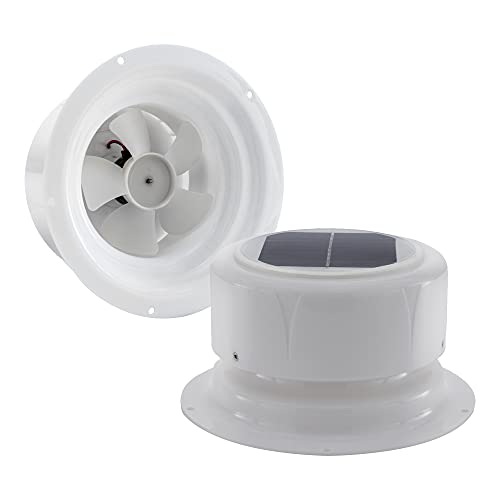
RecPro’s solar-powered vent provides quiet, reliable ventilation with a built-in solar panel to reduce odors and moisture inside RVs. Its universal installation design fits most plumbing caps and includes installation screws for quick setup. Best for RV owners prioritizing easy installation and low-maintenance operation. Limitation: noise and airflow may vary with sun exposure; consider cloudy days impacts on performance.
Buying Guide
Key purchase considerations help you pick the right solar ventilation fan for your space:
- Airflow needs: Measure the room volume in cubic feet and select fans rated to move enough air per hour for effective ventilation.
- Power source: Choose units with built-in solar panels and optional batteries if you need night-time operation or overcast-day performance.
- Installation compatibility: Check vent cutout sizes (4-inch vs 8.5-inch) and mounting options to ensure a clean fit on your boat roof or RV ceiling.
- Noise levels: For daytime living areas, quieter operation is preferable; look for descriptions in the 40–60 dB range.
- Durability: UV-resistant housings and weather-sealed designs are important for marine environments.
- Maintenance: Consider ease of cleaning, blade access, and whether the battery is rechargeable or replaceable.
- Wiring and installation: If you prefer no wiring, prioritize units marketed as off-grid or “no-wiring” installations with integrated solar panels.
- Multi-mode operation: Models with dual blades or intake/exhaust modes offer flexible ventilation strategies for different conditions.
FAQ
- What is the typical airflow range for these solar vents? Answer: Ranges vary from about 900 to 1,440 cubic feet per hour in most models, with some variants offering higher or lower flow depending on sun exposure and blade configuration.
- Do these vents require batteries? Answer: Some include rechargeable batteries for night-time operation, while others run solely on solar power and may not include batteries.
- Can I install these on a metal boat hull or RV roof? Answer: Most are designed for standard vent openings (commonly 4 inches or 8.5 inches) and can be mounted on boats or RVs with appropriate flashing and sealant.
- Is dual-mode operation available? Answer: Several models feature intake and exhaust blade configurations to switch airflow direction as needed.
- What maintenance is needed? Answer: Regular cleaning of blades and vents and checking seals around mounting points help maintain efficiency and prevent leaks.
- Which model is best for off-grid use? Answer: Units with built-in solar panels and rechargeable batteries are best for true off-grid performance and extended operation without sun.