Best 20V Power Supply Options for DIY Projects and Small Labs
The best 20V power supply picks below are chosen for versatility, safety features, and clear readouts. They suit hobbyists powering microcontrollers, LED projects, routers, and small electronics, as well as students in maker spaces who need adjustable voltage and current control. The following five models are selected for broad use, reliability, and practical load handling. A quick summary table of key specs follows the introduction.
| Product | Output Range | Current Capacity | Best For | Notable Limitation |
|---|---|---|---|---|
| Minidodoca 72W Adjustable Power Supply | 3V–24V | Up to 3A | General electronics, LED projects, small devices | Requires careful knob adjustment for precise voltage |
| NICE-POWER DC Power Supply Variable 30V 10A | 0–30V | Up to 10A | Bench-level experiments, higher current needs | Higher price; larger footprint |
| PDEEY 20V 3A Power Supply with 4 Interchangeable Tips | 20V | Up to 3A | Plug-and-play devices needing fixed 20V | Limited to 20V fixed output |
Minidodoca 72W Adjustable Power Supply

Best for: Hobbyists needing a versatile, compact bench supply for small electronics. The Minidodoca unit covers 3V to 24V with a maximum current of 3A, making it suitable for LED strips, microcontroller projects, and portable gadget electronics. The built-in LED voltage display helps monitor real-time output. It ships with 16 tips, including common barrel connectors and USB-C, which broadens compatibility with a range of devices.
Why chosen: Its wide voltage range and multiple tip options provide flexibility for DIY projects that require different connectors or voltages without swapping adapters. The adjustable knob and clear LED readout support precise voltage control, reducing the risk of over-voltage to sensitive components.
Best for whom: Ideal for students, makers, and light electronics work where adjustable voltage is needed but high current is not essential.
Caution: While capable, it is not designed for high-current loads beyond 3A. If a project needs more current, consider a higher-wattage supply.
NICE-POWER DC Power Supply Variable 30V 10A

Best for: Bench-top labs and project work that requires higher current and precise control. The NICE-POWER supply features a 4-digit LED display showing voltage, current, and power in real time, with 0.01V and 0.001A resolution. An OUTPUT switch helps prevent unwanted power delivery during setup.
Why chosen: The high current capability (up to 10A) makes it suitable for experiments with motors, large LED arrays, or power-hungry modules, while its safety protections help guard both loads and the supply.
Best for whom: Best for hobbyists and small labs needing reliable, adjustable voltage with detailed readouts and fast on/off control.
Caution: The unit operates at 110V input in typical configurations; ensure the outlet and safety practices align with local regulations.
PDEEY 20V 3A Power Supply with 4 Interchangeable Tips
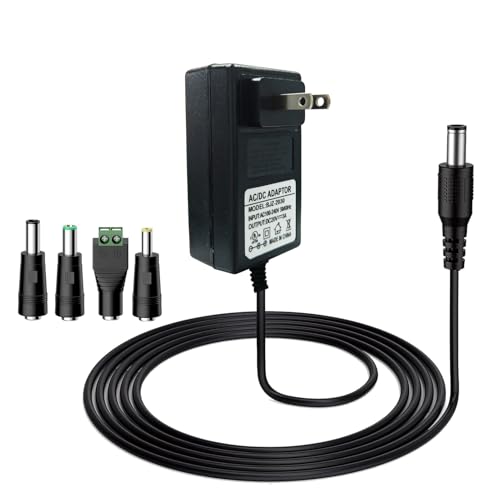
Best for: Projects requiring a fixed 20V output with multiple tip options. The PDEEY device provides 20V at up to 3A and adds four extra plug tips, broadening compatibility with LED controllers, small routers, and other 20V electronics.
Why chosen: The 14-plug set and 4 extra plug options simplify connections for devices with varied power adapters, reducing the need to buy additional adapters.
Best for whom: Suitable for makers who frequently swap devices or work with various 20V peripherals, especially where 20V is a standard requirement.
Caution: This model is optimized for 20V applications; if you need a broader voltage range, pair with a different supply.
Meiyue Adjustable Power Supply 3V–24V 5A 120W

Best for: General-purpose electronic projects that require a broader current capacity within a 3–24V range. The 120W rating supports higher-current loads up to 5A.
Why chosen: It offers a large adjustment range with an LED real-time voltage display, plus a wide array of DC plug options to fit common devices and DIY projects.
Best for whom: Great for hobbyists powering LED strips, small motors, and DIY hardware that benefits from a stable 3–24V supply.
Caution: Do not overload the supply beyond its 120W maximum to avoid overheating or protection triggering.
Buying Guide: Key Considerations For Selecting A 20V Power Supply
- Voltage range and stability: Look for a supply that covers your target voltage with fine adjustment (0.01V increments where possible) to protect sensitive electronics.
- Current capacity: Choose a unit with a current rating that meets or exceeds your typical load. If you anticipate surges, select a model with headroom above the expected draw.
- Display and controls: A clear LED/LCD readout and easy-to-use knobs or encoder controls help prevent misconfiguration and accidental overvoltage.
- Protection features: Overvoltage, overcurrent, and short-circuit protection (plus thermal management) improve safety for both the device under test and the power supply.
- Connectors and compatibility: A broad set of plug tips or interchangeable connectors reduces the need to acquire extra adapters, especially for DIY projects.
- Form factor and noise: Benchtop dimensions and quiet operation are practical for home laboratories or crowded workbenches.
- Safety and compliance: Ensure the product is suitable for your region’s voltage standards and that safety guidelines are observed during use.
Frequently Asked Questions
- What is the advantage of an adjustable 20V power supply over fixed-output adapters?
– An adjustable supply provides versatility across multiple devices and projects, allowing you to tailor voltage and current to match each load precisely and safely. - Why is a clear voltage display important?
– A real-time readout reduces the risk of applying too much voltage to sensitive components and helps verify that the device is receiving the intended power. - Is higher current capability always better?
– Not always. Use a supply with a current rating sufficient for your typical load. Excess headroom improves safety and reduces heat but may cost more and take up space. - Can these supplies power motors or LED strips?
– Yes, many models support modest motor loads and LED strips, but check the current rating and input requirements to avoid overloading the unit. - Are interchangeable tips necessary?
– They are convenient for compatibility with diverse devices. If your devices have standard connectors, you may not need many tips. - What safety practices should I follow?
– Always verify polarity, use the correct voltage setting for the device, avoid shorting outputs, and keep power supplies within their rated limits.