Best Pool Water Heat Exchanger Options for Efficient Heating
Answering the search query directly: these pool water heat exchangers are designed to transfer heat efficiently between hot water and pool water, enabling faster heating, better temperature control, and longer season use. They are suitable for residential pools, spas, hot tubs, and solar or boiler-assisted systems. The top picks below are chosen for reliability, corrosion resistance, and compatibility with saltwater or chemically treated pools. Overview table presents key specs at a glance to help you compare quickly.
| Product | Material | Max Heating Capacity | Ports | |
|---|---|---|---|---|
| AB Pool Heat Exchanger 300 kBtu | 316L Stainless Steel | 300 kBtu/hr | 2″ & 1.5″ FPT | Saltwater and chemical-treated pools |
| OtaniReno 200K BTU SS Heat Exchanger | 304 Stainless Steel | 200 kBtu/hr | 1″ & 1.5″ FPT | Standard residential pools, spa temps |
| AB 300K Btu Titanium Heat Exchanger | Titanium | 300 kBtu/hr | 2″ & 1.5″ FPT | High-chlorine or salt water environments |
| VEVOR Pool Heat Exchanger 360K | 316L Stainless Steel | 360 kBtu/hr | Not listed (standard fittings) | High-demand heating and larger pools |
| QUELECO 43 kBtu Titanium Exchanger | Titanium | 43 kBtu/hr | Not listed | Small setups, solar or auxiliary heating |
AB Pool Heat Exchanger 300 kBtu Stainless Steel

Material and capacity: Made from 316L stainless steel, this exchanger supports pool heating up to 23,800 gallons at 300 kBtu/hr, suitable for swimming pools, spas, and solar heating. Best for saltwater or chemically treated pools where corrosion resistance is critical. It comes with a one-year warranty. Caution: Ensure compatibility with your heat source’s water chemistry and flow rates to avoid underperformance.
- Best for: Saltwater pools and high-chemical environments
- Why chosen: Strong corrosion resistance and high heating capacity
OtaniReno 200K BTU Stainless Heat Exchanger

Core features: Constructed from 304 stainless steel, this exchanger delivers 200 kBtu/hr and maintains consistent temperature by transferring heat between hot water circuits and pool/spa water. Best for standard residential pools needing reliable, steady heating. Limitation: Lower maximum BTU than larger models, so better suited for smaller to mid-size pools.
- Best for: Standard residential pools and spas
- Why chosen: Durable stainless steel with reliable heat transfer
AB 300K Btu Titanium Heat Exchanger
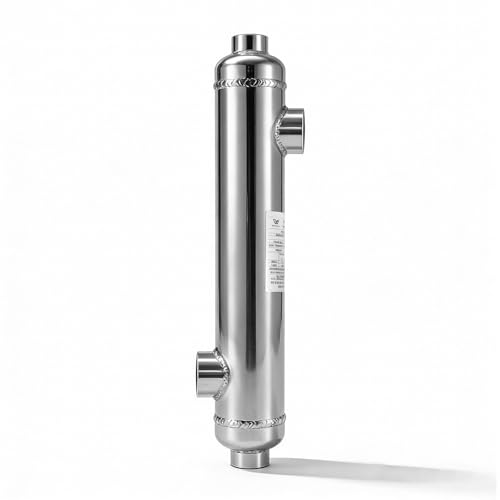
Materials and versatility: Titanium construction provides exceptional resistance to high chlorine levels and saltwater, making it suitable for aggressive pool chemistries. Rated for up to 23,800 gallons with 300 kBtu/hr. The unit features 2″ and 1.5″ FPT ports for flexible installation. Caution: Titanium units may cost more upfront but offer longer service life in corrosive environments.
- Best for: High-chlorine or saltwater pools
- Why chosen: Titanium resists corrosion better than stainless in harsh chemistries
VEVOR Pool Heat Exchanger 360K

Performance and durability: This unit offers up to 360 kBtu/hr with a 316L stainless steel construction and a large heat transfer area. It’s designed for demanding heating tasks, including larger pools or spa facilities. Best for: Bigger pools or higher heating demands. Limitation: More extensive installation and maintenance may be needed due to its higher capacity.
- Best for: High-demand heating and larger pools
- Why chosen: Highest BTU capacity among listed options
QUELECO Pool Water Heat Exchanger 43 kBtu Titanium

Compact and customizable: Titanium tubes provide corrosion resistance and a small footprint with a 43 kBtu/hr capacity. Ideal for solar-assisted or auxiliary heating in smaller pools or spa systems. Caveat: Low heating capacity means it’s best for supplemental heating rather than primary heat source.
- Best for: Small pools or solar-assisted systems
- Why chosen: Titanium durability in compact form
Buying Guide: Pool Water Heat Exchangers
How to choose the right material
Metal choice affects longevity in chlorinated or saltwater pools. Titanium excels in highly corrosive environments, while 316L stainless steel offers strong corrosion resistance at a lower cost. 304 stainless is common but may require more maintenance in seawater or high-chlorine setups.
What heating capacity do you need?
Match BTU/hr to your pool volume and desired temperature rise. Larger pools or faster heating require higher BTU/h, but not all installations need maximum capacity. Consider climate, pool usage, and heat source compatibility when sizing.
Port size and compatibility
Most units use 2″ and 1.5″ FPT ports. Check your heat source, plumbing layout, and pump capacity to prevent flow restrictions. Inlet/outlet alignment matters for a clean, leak-free installation.
Corrosion considerations and water chemistry
Pools with high chlorine, bromine, or salt require materials that resist corrosion. Titanium and 316L stainless steel are top choices. Always verify compatibility with your pool chemistry and planned maintenance schedule.
Installation and maintenance factors
Some models come with easier welding and leak-proof seals. Lighter titanium sections may simplify installation but can come at a higher upfront cost. Regular inspection for leaks and pressure changes helps prevent long-term issues.
Budget versus long-term value
Less expensive stainless options may save upfront cost but could incur higher maintenance in aggressive chemistries. Titanium offers superior durability in corrosive environments, potentially reducing replacement cycles.
FAQ
- What is a pool water heat exchanger? A device that transfers heat from a secondary hot-water circuit to pool water, increasing the pool temperature without directly heating the pool water source.
- Which material lasts longest in saltwater pools? Titanium generally offers superior resistance to corrosion in saltwater environments compared to standard stainless steels.
- Do I need a high BTU model for a small pool? Not necessarily. A smaller pool can reach comfortable temperatures with lower BTU/h, though larger pools may require higher capacity for faster heating.
- Can heat exchangers be used with solar heating? Yes. They can be integrated with solar heating systems to improve efficiency and temperature control.
- What maintenance is required? Periodic inspection for leaks, cleaning of heat transfer surfaces, and verifying flow rates help maintain performance.
- Are there installation constraints I should plan for? Ensure proper flow, fittings, and match with heat source output and pool plumbing to avoid pressure and seal issues.