Best 12v 300Ah Deep Cycle Battery Solutions for RVs, Marine, and Off-Grid Power
Find reliable deep-cycle power with these 12V 300Ah LiFePO4 batteries. Ideal for RVs, boats, solar storage, and backup power, these packs balance long life, safety, and space efficiency. This guide highlights top options, who they’re best for, and key trade-offs to help you choose.
Top picks at a glance (summary):
- Yeagulch 12V 300Ah LiFePO4 Battery — Best for high energy density and robust protection
- Rvpozwer 12V 300Ah LiFePO4 Battery — Best for long cycle life and expandability
- BtrPower 12V 300Ah LiFePO4 Battery — Best for safety features and sturdy construction
- ECOBOSS 12V 300Ah LiFePO4 Battery — Best for cold-weather protection and cycling
- ECIENWELL 12V 300Ah LiFePO4 Battery — Best for waterproofing and rugged use
Product Comparison Table
| Product | Best For | Typical Deep Cycle Range | Key Protection | Notes |
|---|---|---|---|---|
| Yeagulch 12V 300Ah | High energy density requires compact storage | 6000+ cycles to 80% DoD | 200A BMS, temp cut-offs | 316Ah rated; strong protection profile |
| Rvpozwer 12V 300Ah | Long lifecycle and expandability | 4000–15000 cycles depending on DoD | 200A Smart BMS | Group 31 compatible, scalable |
| BtrPower 12V 300Ah | Durability and safety | 6000+ cycles (50% DoD typical) | 200A BMS, protection against over/under | Lightweight for size |
| ECOBOSS 12V 300Ah | Cold weather use and reliability | 15000+ cycles | 200A Smart BMS, low-temp protection | Strong low-temperature handling |
| ECIENWELL 12V 300Ah | Waterproof and offshore readiness | 6000–15000 cycles depending on DoD | Upgraded BMS, IP65 waterproof | Durable for harsh environments |
Note: All products listed are LiFePO4 chemistry, 12V nominal, around 300Ah capacity. Performance figures vary with depth of discharge and temperature. Ensure proper battery management and enclosure for outdoor use.
Yeagulch 12V 300Ah LiFePO4 Battery — 314Ah Capacity
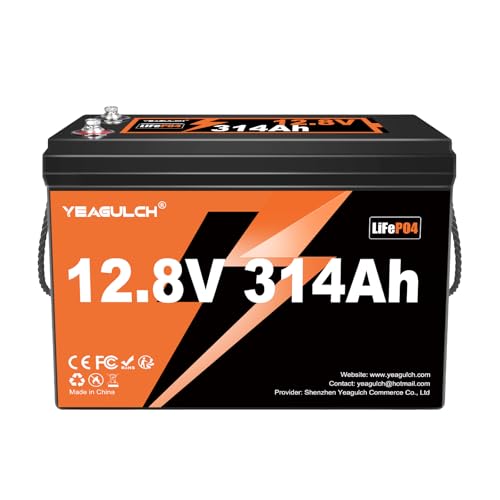
Best for high energy density with compact form. The 314Ah LiFePO4 cell design provides more energy per unit weight than lead-acid, helping storage in tight spaces. A built-in 200A BMS protects against overcharge, over-discharge, over-current, and short circuits, and includes temperature cut-off protection. Suitable for RVs, marine, or solar storage where weight and space matter.
Who it’s best for: buyers needing strong energy density in a lighter package with reliable protection. Why selected: the 314Ah rating and protective features translate to better energy density and safer operation in mobile or tight-space setups. Caution: ensure adequate cooling in hot climates; data indicates temperature protections, but continuous high-temperature charging may still impact longevity.
Rvpozwer 12V 300Ah LiFePO4 Battery — 200A BMS

Best for long cycle life and expansion. This portable LiFePO4 pack emphasizes a 200A BMS with extended longevity claims, and supports scalable configurations up to 51.2V in series or 1200Ah in parallel, under Group 31 standards. Designed to support RVs, trolling motors, solar setups, and off-grid systems.
Who it’s best for: users planning future system growth or large off-grid arrays. Why selected: excellent 15000+ cycles at lower DoD, with expandability. Caution: verify compatibility with your existing charging setup when wiring multiple units in series/parallel.
BtrPower 12V 300Ah LiFePO4 Battery — 200A BMS

Best for safety and longevity. The 200A BMS guards against overcharge, over-discharge, and short circuits, while the pack’s LiFePO4 chemistry affords 6000+ cycles at a modest DoD. Lightweight at about 58 pounds and easy to install, it suits RVs, boats, and off-grid solar arrays.
Who it’s best for: buyers prioritizing safe operation and straightforward installation. Why selected: noted for a strong balance of cycle life and protection in a lightweight form. Caution: ensure proper ventilation and heat management in enclosed spaces to maintain optimal temperature.
Rvpozwer 12V 300Ah LiFePO4 Battery — 200A BMS

Best for dependable power with a long 15,000+ cycle potential. This pack uses Grade-A LiFePO4 cells and a 200A BMS to shield against common faults. It’s designed to fit Group 31 standards and supports expansion in series or parallel for RVs, marine, solar, and off-grid uses.
Who it’s best for: customers seeking a proven long-life platform with expansion options. Why selected: the combination of longevity and protection supports dependable daily use. Caution: plan for thermal management in hot environments to avoid efficiency losses.
HumsiENK 12V 300Ah LiFePO4 Battery — Compact & Bluetooth

Best for compact systems with scalable configurations. This battery emphasizes a 200A BMS, low-temperature protection, and a compact form factor with Bluetooth monitoring for some units. Useful for RVs, marine, solar, and off-grid home backup where space is at a premium.
Who it’s best for: buyers needing a compact, weight-friendly option without sacrificing capacity. Why selected: high capacity (314Ah) and Bluetooth monitoring offer practical value. Caution: verify Bluetooth compatibility and software access if remote monitoring is important to you.
Buying Guide: How To Choose A 12V 300Ah LiFePO4 Battery
What matters most: cycle life and depth of discharge
Cycle life indicates how many charge–discharge cycles you can expect. Higher cycle counts at a given depth of discharge translate to longer service. For RVs and off-grid setups, aim for 4000–15000 cycles depending on how often you recharge and how deeply you discharge.
How does the BMS affect reliability?
A robust Battery Management System protects against overcharging, over-discharging, short circuits, and temperature extremes. A 200A BMS is common at this capacity and provides solid protection for most setups. Some packs also include low-temperature cutoffs for cold climates.
Weight, size, and space considerations
LiFePO4 cells offer lighter weight per amp-hour than lead-acid. This helps when you must fit a large capacity into a compact trailer, boat, or cabinet. Confirm dimensions and weight to ensure safe mounting and handling in your space.
Expansion potential and system compatibility
Many 12V 300Ah batteries support series/parallel configurations. Check for Group 31 compatibility and think about whether you may want to scale up to higher voltages (e.g., 24V/48V) or larger Ah counts in the future.
Temperature and environment considerations
Low-temperature protection helps prevent charging in freezing conditions, while high-temperature safeguards help avoid degradation in hot climates. For outdoor or unheated spaces, ensure adequate ventilation and enclosure protection.
Which features should you prioritize?
Prioritize: 200A+ BMS, long cycle life (prefer 6000+ cycles at moderate DoD), good low-temperature protection, compact weight, and the possibility to expand with additional modules if needed.
FAQ
- What does 300Ah mean in practice?
It refers to the battery’s capacity, or how much energy it can store. Higher Ah indicates more available energy between charges for devices and loads. - Can I connect multiple 12V 300Ah batteries in series or parallel?
Yes, many models support series/parallel configurations. Follow the manufacturer’s guidance for voltage limits and balancing across cells. - Is LiFePO4 safer than lead-acid for marine use?
Yes, LiFePO4 generally offers more stable chemistry, thermal safety, and lower risk of leaking or venting compared to lead-acid. - Do these batteries need special chargers?
Use a charger designed for LiFePO4 chemistry with the appropriate voltage profiles and a suitable charging algorithm to optimize longevity. - What maintenance is required?
LiFePO4 batteries are maintenance-free for the most part, but routine inspection of connections and securing the battery in a ventilated area is advised.