Best Pressure Sensitive Water Pumps for Reliable on-Demand Water Supply
The best pressure sensitive water pumps automatically start and stop based on faucet use, delivering water only when needed. They suit RV owners, boaters, campers, and homeowners seeking quiet operation, energy efficiency, and simple setup. This guide highlights five top options, explains who each is best for, and points out practical limits to consider. Use the buying guide to compare pressure ranges, priming capabilities, and power requirements to match your use case.
Summary table of selected products:
- ECO-WORTHY 33-Series Industrial Water Pressure Pump – Best for off-grid or marine setups that require higher lift and adjustable 45-70 PSI.
- SEAFLO 33 Series – Best for RVs and caravans needing NSF/UL compliant potable water performance.
- YOUNGTREE 110V 4.0GPM – Best balance of price and on-demand reliability for DIY home systems.
- YOUNGTREE Brushless 6.0GPM – Best for continuous or higher-flow needs with energy efficiency.
- WASSERMANN 55-Series 12V – Best for quiet, high-flow 12V setups on larger RVs or boats.
ECO-WORTHY 33-Series Industrial Water Pressure Pump
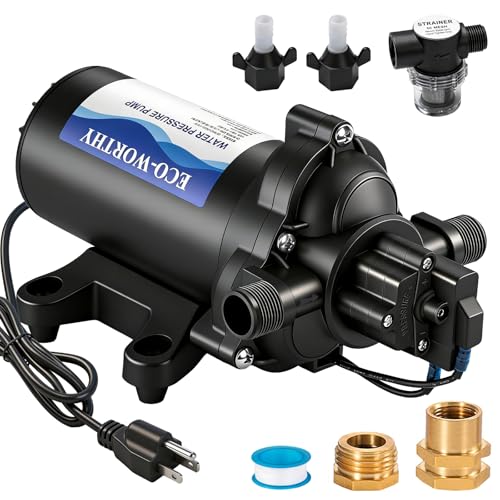
Key features: 110V AC diaphragm pump with 4.0 GPM flow, 50 PSI on demand, adjustable 45-70 PSI, self-priming to 9.8 feet, lift up to 131 feet, thermal overload protection. It uses a smart pressure switch and does not require a marine battery for operation.
Best for: RVs, marine boats, or irrigation setups where a stable 50 PSI is desired and power is readily available from AC sources. The adjustable pressure range helps tailor output for faucets, sprinklers, or hoses. It’s suitable where quiet operation and automatic shutoff are valued.
Why selected: This model offers a robust combination of lift, flow, and a smart switch that responds to demand. It can operate from standard AC power, making it convenient for on-site installations without extra battery systems. Its safety features help protect the motor during high-temperature conditions.
Caution: Thermal protection will disconnect if temperatures exceed 203°F (95°C); ensure adequate ventilation and cooling in enclosed compartments.
SEAFLO 33 Series 110V/115V Fresh Water Pump

Key specifications: 3.3 GPM at 45 PSI, self-priming, 115V, NSF/ANSI/CAN 61 & 372 compliance, UL 778 listed, 4-year warranty. Features a smart pressure switch and a compact build designed for RVs, caravans, boats, and off-grid living.
Best for: Buyers who prioritize potable water safety standards and long-term reliability in small to mid-size travel rigs or cabins. The NSF/UL compliance is advantageous for drinking water applications.
Why selected: The NSF/UL certifications and a defined 45 PSI cut-off provide predictable performance for consistent shower and faucet use. The 4-year warranty adds long-term reassurance for critical water systems.
Caution: Check compatibility with your plumbing fittings (1/2″ MNPT ports are common but verify connection types before purchasing).
YOUNGTREE RV Water Pressure Diaphragm Pump

Key features: 4.0 GPM, 50 PSI on-demand with a 40-70 PSI adjustable range, self-priming up to 9.8 ft, 1.3 A max current. On-demand pressure switch activates when a faucet opens or closes. Includes garden hose adapters for irrigation or general water transfer.
Best for: Home users or RV setups that require a straightforward, affordable on-demand pump with reliable performance and ease of integration with garden hoses.
Why selected: It combines a modest price point with proven on-demand operation and a broad PSI range, making it a versatile choice for mixed-use systems. The safety features aid in reducing risk during dry run or overheating.
Caution: The 1.3 A max current indicates the unit works with standard household outlets; avoid overloading circuits with other devices on the same run.
YOUNGTREE Brushless 110V Water Pressure Pump

Key features: Brushless motor, 6.0 GPM, 55 PSI with 40-70 PSI adjustable range, self-priming to 9.8 ft, lift up to 131 ft, 1.6 A draw. Notable for extended service life and fast heat dissipation via an integrated cooling fan.
Best for: High-flow domestic or outdoor projects requiring continuous operation with energy efficiency and lower maintenance than brushed motors.
Why selected: The brushless design offers longer service life and lower heat buildup, ideal for tasks like irrigation or large-volume water transfers. The improved heat dissipation helps prevent overheating during longer runs.
Caution: The pump is designed for continuous use but recommends turning off when not in use to maximize life; plan for duty cycles in your installation.
WOJET Pressure Washer Pump (3/4″ Shaft)

Key details: 3400 PSI, 2.5 GPM, compatible with several engine models, 3/4″ shaft, self-priming with adjustable unloader. Designed as a replacement pump kit for various gas-powered washers.
Best for: Users seeking a versatile replacement pump for existing pressure washers, especially when upgrading to higher PSI capabilities for heavier cleaning tasks.
Why selected: The broad compatibility and adjustable pressure control simplify upgrading equipment without changing many components. The unloader design enables easier pressure management for different chores.
Caution: This is a pressure washer pump and not a dedicated potable-water pump; ensure correct application to avoid cross-contamination with drinking water systems.
WASSERMANN 55-Series 12V Water Pump

Key features: 12V diaphragm pump, up to 7.5 GPM at 75 PSI, five-chamber design for stable flow, copper motor for durability, intelligent pressure switch for automatic on/off control, supports simultaneous supply to multiple faucets.
Best for: Larger RVs or boats needing a higher flow at a steady pressure with quiet operation and solid durability in a 12V system.
Why selected: The combination of high GPM, stable 75 PSI, and intelligent switch makes it well-suited for demanding water-use scenarios. The copper motor and five-chamber design emphasize longevity and smooth performance.
Caution: A 12V system should be sized to handle the current draw; verify electrical capacity and wiring in tight compartments to prevent overheating or voltage drop.
Buying Guide: Pressure-Sensitive Water Pumps
- Power source: Choose between AC powered (110V/115V) and DC (12V) pumps based on your power options. AC pumps work well in spaces with shore power, while DC pumps suit boats and RVs with battery systems.
- Flow rate and pressure: Common ranges are 3.3-6.0 GPM and 40-70 PSI. Match the flow and pressure to faucet needs, showerheads, and irrigation equipment to avoid overworking the pump.
- Self-priming and lift: Look for self-priming capability up to several feet and a lift distance to ensure reliable priming in tanks located above the pump. For vessels and RVs, consider higher lift numbers for basement-to-tap configurations.
- Smart pressure switch: A built-in switch that starts and stops the pump based on faucet use helps conserve energy and prolongs motor life. Check for adjustable ranges if you need different settings for various tasks.
- Materials and safety: For potable-water systems, prefer pumps with NSF/UL certifications and corrosion-resistant materials. Thermal overload protection is a helpful safety feature in enclosed spaces.
- Durability and noise: Brushless motors tend to run cooler and longer, with quieter operation. Consider heat dissipation features if the pump sits in confined compartments.
- Compatibility: Review port sizes (MNPT, garden hose adapters) and shaft sizes to ensure the pump fits your existing plumbing and fittings.
FAQ
- What is a pressure-sensitive water pump?
– It is a pump that automatically starts when a faucet is opened and stops when it is closed, maintaining a preset pressure range. - Do I need a separate battery for these pumps?
– Most 110V pumps run from AC power; 12V models run from a vehicle or marine battery. Check the product specifications for current draw and power source requirements. - Can I use these pumps for potable water?
– Some models are certified for potable water under NSF/UL standards. Verify the certification and suitability for drinking water before use. - Is a higher PSI always better?
– Not necessarily. Higher PSI is useful for long runs or multiple fixtures, but it can waste energy and cause rapid wear if not matched to the faucet and hose needs.