Best Plug-Load Occupancy Sensors for Energy Savings in Homes and Small Spaces
Plug-load occupancy sensors are an efficient way to automate lighting and devices in rooms with plug-in fixtures, desks, or portable lamps. They’re ideal for offices, workshops, garages, and residential spaces where portable lighting is common. This guide highlights five reliable options from trusted brands, explaining who each product is best for, and why it stands out. Use this to compare installation style, sensing range, and control features to match your space and energy goals.
Summary table of selected products:
| Product | Brand | Best For | Notes |
|---|---|---|---|
| WattStopper BZ-200 Plug-Load Power Pack | Watt Stopper | Hard-to-reach plug-loads and commercial spaces | 120/277V, 24V output, 20A |
| Leviton 20-Amp Super Duty Power Pack | Leviton | High-load, code-compliant lighting control | Fail-safe design, CA Title 24/ASHRAE 90.1 ready |
| Taigeguang Motion Sensor Switch Indoor Plug-in | Taigeguang | Residential or garage/utility areas | Adjustable time, sensitivity, Lux; up to 12–16 ft |
| Maxxima Ceiling Mount 360° PIR Sensor | Maxxima | High-ceiling spaces and wide coverage | 360° sensing, up to 15 ft mounting height |
| Lutron Maestro Motion Sensor Light Switch | Lutron | Indoor spaces needing reliable on/off sensing | XCT technology for stable performance |
WattStopper BZ-200 Plug-Load Power Pack
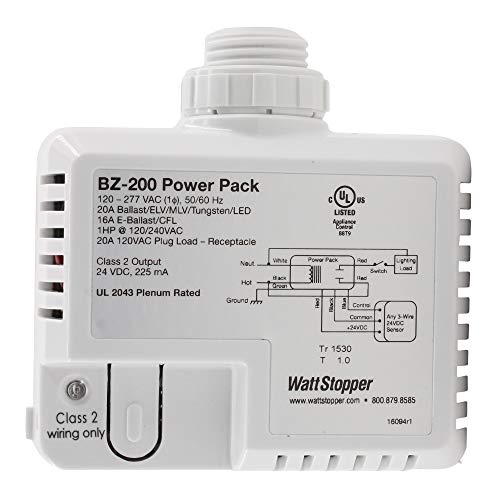
The WattStopper BZ-200 is designed for plug-load control with 120/277V input and a 24V output, handling up to 20A at 120V. This makes it suitable for commercial or large residential installations where heavy plug-in devices must be controlled automatically. Best for spaces needing reliable power-pack control without hard-wiring. Limitation: may require proper wiring and integration with existing sensor systems to maximize energy savings.
Leviton 20-Amp Super Duty Power Pack

Leviton’s 20-Amp Super Duty Power Pack emphasizes a fail-safe design to keep lights ON for life-safety requirements and robust performance for high-load control. It’s well-suited for spaces requiring dependable operation and compliance with building codes like NFPA 101 and Title 24/ASHRAE 90.1. Consider this when your space relies on constant illumination during critical hours; the model supports Switched Daylighting with compatible sensors. Caution: ensure compatibility with your wall switches and photocells before integration.
Taigeguang Indoor Plug-in Motion Sensor

This two-pack offers adjustable time, sensitivity, and Lux settings to tailor operation for basements, garages, or pantries. The wide 120° coverage and 12–16 ft sensing range provide flexible placement. Best for households seeking hands-free lighting in utility spaces. Limitation: more complex setup with multiple controls can lead to false triggers if not calibrated properly.
Atictek LED High Bay Plug-in Motion Sensor

Designed for high-mounted areas, this 360-degree PIR sensor is built for warehouses or large workshops. It supports 0-10V bi-level control and a range suitable for ceilings up to 40 ft, helping you optimize LED fixtures with scalable brightness settings. Best for large, high-ceiling spaces needing broad coverage. Caution: the remote customization via RC-100 is an additional component to consider if you plan advanced control scenarios.
Maxxima Ceiling Mount 360° PIR Sensor

Maxxima’s ceiling-mounted 360° PIR sensor covers a wide area, ideal for rooms with high ceilings up to 15 feet. It supports a broad range of lighting loads and is compatible with many indoor lighting configurations. Best for open spaces where a single sensor must monitor a large footprint. Limitation: ceiling height and mounting position can influence detection accuracy; plan placement accordingly.
Lutron Maestro Motion Sensor Light Switch

Lutron’s Maestro Motion Sensor Light Switch brings reliable occupancy sensing to indoor spaces like bathrooms, garages, and laundry rooms. XCT technology helps ensure lights stay on when needed for tasks, while still turning off automatically. Best for areas where occupants perform short tasks and need quick, responsive control. Caution: this is a standalone switch, not a plug-load pack, so consider wiring implications if you’re only replacing a plug-in device.
Buying Guide
- Application type: Choose plug-load packs for portable fixtures and devices, or fixed-wall sensors for built-in lighting circuits.
- Sensing range and coverage: Consider room size and mounting height to avoid missed detections or false triggers.
- Load capacity: Match wattage and current ratings with your fixtures to prevent overloads.
- Control options: Look for auto-on, daylight sensing, and dimming features if you want precise energy savings.
- Code compliance: For homes and businesses, ensure the device supports necessary NFPA/Title 24 or local requirements.
- Installation complexity: Some options require wiring changes; others are plug-in and simpler to implement.
- Reliability and maintenance: Prefer brands with consistent performance and straightforward maintenance or replacement parts.
FAQ
What is a plug-load occupancy sensor?
A sensor that controls lighting or devices plugged into outlets, automatically turning them on or off based on occupancy detected near the plug or in the space.
When should I use a plug-load sensor vs. a wall switch sensor?
Use plug-load sensors for movable lamps and outlets; wall switch sensors are better for fixed lighting circuits and harder-to-reach areas.
Do these sensors require professional installation?
Some plug-load packs are quick to install with standard wiring; others, especially ceiling-mounted or high-load packs, may benefit from professional installation.
Can sensors work with existing light fixtures and bulbs?
Yes, most sensors are designed to work with common LED, CFL, and incandescent fixtures, but check compatibility with your specific bulbs and drivers.
Are there any downsides to plug-load sensors?
Calibration is key to avoiding false triggers, and some units may introduce slight startup delays or limited control when used with certain smart home ecosystems.