Best Small Quiet Propane Generators for Home Backup and Camping
The right small quiet propane generator gives you dependable power without loud disturbances. This guide highlights five compact, dual-fuel or propane-focused models ideal for home backup, camping, or tailgating. Each option balances run time, noise level, and fuel flexibility to fit different needs—from apartment-dwellers seeking neighbor-friendly operation to campers needing long, quiet sessions off-grid.
Buyer-focused quick-reference table
| Product | Best For | Fuel Options | Key Strength |
|---|---|---|---|
| PowerSmart 3800 Watt Dual Fuel | Home backup in quiet neighborhoods | Gasoline, Propane | High starting watts with long propane run time |
| WEN 2800-Watt Dual Fuel DF280iX | Lightweight, portability with reliable power | Gasoline, Propane | Clean power and CO watchdog safety |
| POXURIO 2450-Watt Portable Inverter | Ultra-quiet camping and RV use | Gasoline | Very low noise for a compact unit |
| WEN 4800-Watt DF480iX | RV-ready backup with higher output | Gasoline, Propane | Notable quiet operation for its size |
| Westinghouse iGen2800DFc | Home or recreation with long run time | Gasoline, Propane | Excellent fuel efficiency and very low noise |
PowerSmart 3800 Watt Dual Fuel Inverter Generator
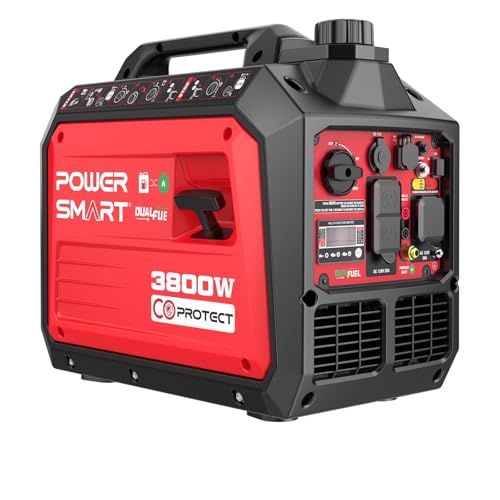
Overview: This dual-fuel model offers 3800 starting watts on gasoline and 3500 on propane, with running watts of 3300 and 3100 respectively. It features Pure Sine Wave power with less than 3% total harmonic distortion, protecting sensitive electronics. The noise level is described as quiet for its class, around 65 dBA at 23 feet.
Best for: Home backup in quiet neighborhoods and campers who need flexibility between gasoline and propane. It’s suitable for powering essential devices and small appliances without excessive noise.
Why selected: The dual-fuel capability provides cost and availability benefits during emergencies or extended trips. The inverter technology helps maintain stable voltage for electronics like CPAP machines, laptops, and phones.
Caution: Run time can vary with load; high demand or heavy use may reduce propane efficiency as compared to gasoline in some conditions.
WEN 2800-Watt Dual Fuel Inverter Generator (DF280iX)

Overview: This unit runs on gasoline or propane with 2800 surge watts and 2250 running watts on gas, or 2800 surge and 2000 running watts on propane. It prioritizes clean power to protect electronics and includes a CO watchdog sensor for safety.
Best for: Individuals seeking a compact, portable dual-fuel generator with integrated safety features for small apartments or cabins where quiet operation and protection of electronics matter.
Why selected: The CO watchdog offers additional peace of mind in enclosed spaces or during camping. Its dual-fuel design provides flexibility for fuel availability and cost control.
Caution: The inline power output is modest; plan for essential loads rather than heavy air conditioning or large appliances.
POXURIO 2450-Watt Portable Inverter Generator

Overview: A 2450-watt rating with a compact 1.6-gallon tank delivers up to 8.3 hours at a modest load. It uses modern inverter technology to provide a stable sine wave, safe for sensitive electronics, and operates at a notably quiet level around 59 dB.
Best for: Campers and RV users who want a very quiet, portable solution for lightweight essential loads and supplemental power on the go.
Why selected: The combination of portability, quiet operation, and safe power makes it a strong pick for minimalist setups where noise is a primary concern.
Caution: Gasoline availability and tank size limit run time under heavy or extended loads; avoid using with high-wattage appliances for extended periods.
WEN Quiet And Lightweight DF480iX

Overview: This 4800-watt dual-fuel generator balances power with quiet operation. It supports gasoline and propane, and includes both electric and recoil start options with a CO watchdog for safety. It’s designed to be RV-ready with multiple outlets for versatility.
Best for: Small to midsize RV setups or home backup where higher output is needed without sacrificing quiet operation in a neighborhood or campsite.
Why selected: It provides robust power for essentials and small appliances, while still prioritizing noise control and safety features like CO shutdown.
Caution: Higher output may be heavier and less portable than smaller units; consider transport needs before frequent relocation.
Westinghouse iGen2800DFc

Overview: A 2800-watt peak/2200-watt running gasoline and 2520 peak/1980 running propane unit, with up to 12 hours of run time at 25% load. It’s lightweight at about 42 pounds and includes a CO sensor, economy mode for efficiency, and RV-ready outlets.
Best for: Home backup or recreational use where low noise and fuel efficiency are priorities, plus easy handling and storage in small spaces.
Why selected: Its quiet operation and economy mode reduce fuel use, while the dual-fuel capability adds flexibility for emergencies or remote trips.
Caution: With heavier loads, run time and noise levels can change; plan for your essential devices first rather than full-house ventilation loads.
Buying Guide: Small Quiet Generators For Home And On The Go
Fuel flexibility vs. noise
Dual-fuel models offer fuel flexibility during shortages or price spikes. If quiet operation is the top priority, compare units with inverter technology and THD below 3% and noise levels around 52-65 dBA at standard distances.
Power needs and run-time planning
List your essential devices and total wattage. Choose a generator with higher starting watts than your heaviest appliance and longer run time at a safe load. For camping or RV use, consider models with RV outlets and easy portage features.
Safety features you should expect
CO sensors, automatic shutdown, and loudness controls help prevent accidents. An inverter with clean power protects electronics like phones, laptops, and CPAP machines from surges or frequency fluctuations.
Portability and storage considerations
Weight, wheel kits, and compact design affect how often you’ll move the unit. If you need frequent relocation, prioritize lighter units with integrated handles or wheels and a compact footprint.
Fuel availability and maintenance
Gasoline and propane availability varies by location and season. Propane tends to have longer shelf life, while gasoline requires stabilization for storage. Regular maintenance checks help extend life and reliability.
Which one should you buy?
For apartment or quiet neighborhood use with a focus on sensitive electronics, smaller dual-fuel inverter units with CO safety are ideal. For campers and RVs needing higher output without excessive noise, larger inverter models with RV outlets and economy modes are better choices. If you need maximum portability for light loads, a compact 2450-2800W option with USB outlets can be perfect.
FAQ
- What makes a generator “inverter” different from a standard portable generator?
Answer: Inverter generators produce cleaner, more stable power with variable engine speeds, reducing noise and fuel use and protecting sensitive electronics. - Are dual-fuel generators worth it for home backup?
Answer: Yes, they offer flexibility to use whichever fuel is available or cheaper, which can be beneficial during power outages or fuel shortages. - Is 52 dBA considered quiet for a generator?
Answer: Yes, 52 dBA is about the level of a normal conversation and is considered quiet for neighborhood and campground use. - What should I prioritize for RV use?
Answer: Look for RV-ready outlets, lower THD, and parallel-capable designs if you anticipate needing additional power in the future. - Can I run a CPAP machine on a generator?
Answer: Yes, if the generator provides clean, stable power (low THD) and a consistent voltage suitable for medical devices. - How do I estimate run-time accurately?
Answer: Consider the load as a percentage of the generator’s rated running watts; run-time typically improves at lower loads and decreases as you approach capacity.