Best Load Cell and Indicator Systems for Precise Industrial Weighing
The best load cell and indicator combos offer accurate measurement, clear readouts, and flexible outputs for automation. This guide highlights five reliable options ideal for industrial weighing, force measurement, and data logging. Each product is suited for different needs—whether you need compact panels, peak-recording, dual-relay outputs, or multi-unit display. Use the buyer’s guide below to compare features and decide which setup fits your workflow.
| Product | Best For | Key Benefit | Relay Outputs |
|---|---|---|---|
| Load Cell Sensor with Indicator Display (0-2T) | Medium-range precise weighing | Peak recording with bright five-digit display | 2 |
| Load Cell Sensor with Indicator Display (0-20KG) | Compact scale tasks | Clear five-digit readout, peak hold | 2 |
| S Type Load Cell (0-5000KG) | High-capacity weighing | 0.2% accuracy, dual relays for control | 2 |
| Load Cell Indicator Display (0-5000KG) | General-purpose weighing | 0.2% accuracy, rugged platform | RS485 (display) |
| S Type Load Cell (0-1000KG) | Versatile scale systems | Dual relays, high precision | 2 |
Load Cell Sensor With Indicator Display 0-2T
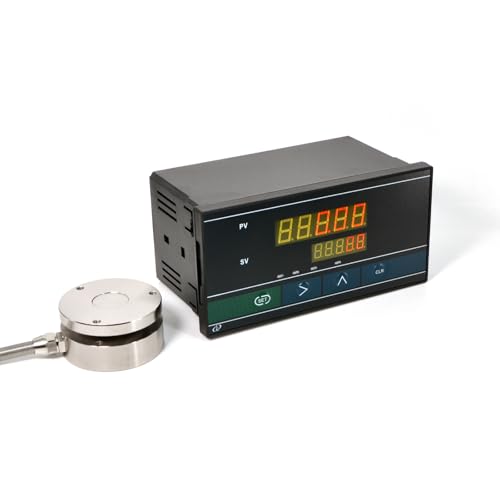
This bellows-based load cell combines high-precision measurement with a bright LED five-digit display for easy reading. The peak recording function captures the maximum value, supporting data logging and peak analysis. Best for: medium-range industrial weighing where fast peak data is important and readings must be visible from a distance.
- Best for environments needing quick peak data capture.
- Clear display aids operators in busy facilities.
- Two relay outputs support simple automation thresholds.
Caution: Bellows sensors can be sensitive to installation orientation and mounting stability; ensure proper leveling for accurate readings.
Load Cell Sensor With Indicator Display 0-20KG
This compact sensor set uses the same bellows-based structure for stable readings and includes a five-digit display for legible weight values. Peak hold aids in recording transient peaks during filling, batching, or quality checks. Best for: small to mid-sized weighing tasks where space is limited but reliability matters.
- Better for tight spaces without sacrificing readability.
- Two relays enable simple automation or alarms.
Limitation: Suitable for lower ranges; accuracy remains high, but for very heavy loads consider higher-capacity options.
S Type Load Cell With Indicator Display 0-5000KG

This high-capacity S-type load cell emphasizes precision with a 0.2% accuracy and dual relay outputs for automation, alarms, or data capture. It supports multiple preset thresholds and is suitable for heavier industrial processes. Best for: applications requiring robust volume weighing and automation integration.
- Choose this if operations demand high-capacity measurement and automation.
- Dual relays can handle separate process controls or alerts.
Limitation: Higher-capacity units may require stronger mounting hardware and proper calibration for accuracy across temperature variations.
S Type Load Cell With Indicator Display 0-500KG

Operating with a high-precision load cell and an intuitive LCD interface, this model supports multi-language menus and practical tare and totalization features. It’s a solid choice for general-purpose weighing tasks across production lines and labs. Best for: facilities that need a versatile, user-friendly indicator with reliable 0.2% accuracy.
- Better for mixed-use environments requiring straightforward setup.
- Multi-language support enhances usability in diverse teams.
Caution: The display’s legibility and interface responsiveness depend on a stable power supply and clean signal lines; ensure RS485 wiring is properly terminated where used.
S Type Load Cell With Indicator Display 0-1000KG
This model offers dual-relay output and a 0.2% precision, suitable for dynamic weighing and monitoring in automated systems. It supports a range from 0 to 1000 kg and provides a straightforward path to integration with control logic or data logging. Best for: setups requiring precise readings plus automation to trigger processes or alarms.
- Choose this if you need reliable readouts with automated control.
- Dual relays support more complex process logic.
Limitation: Higher dynamic loads may require careful mounting and consistent calibration to maintain accuracy.
Buying Guide: How To Choose The Right Load Cell And Indicator
- What range do you need? For light to medium tasks, select 0-20 KG or 0-2T ranges. For heavier industrial weighing, consider 0-1000 KG or 0-5000 KG models.
- What output do you require? If you need automation, ensure the unit has dual relay outputs and compatible interfaces (RS485, etc.).
- How important is peak recording? If you must capture maximum weights, pick models with Peak Hold or Peak Recording features.
- Display readability matters. Bright five-digit displays are easier to read in bright environments or from a distance.
- Mounting and stability. Bellows-based sensors excel in anti-bias loading but require proper mounting to prevent skewed results.
- Power and interface compatibility. Some indicators work on DC 12-24V and offer RS485; verify with your control system.
Frequently Asked Questions
- Do these load cells support dynamic weighing? Yes, several models are designed for dynamic weighing and include features like peak hold for capturing transient loads.
- Is dual-relay output standard? Many models offer two relay outputs, enabling control, alarm, or data-logging actions based on preset thresholds.
- Can I use these with RS485 networks? Some indicators include RS485 communication; confirm compatibility with your existing data system.
- What range should I choose for industrial tasks? Choose a range that comfortably exceeds the maximum load you expect, with some margin for safety and accuracy.
- Are these sensors accurate? Most models advertise up to 0.2% accuracy, but accuracy depends on calibration, mounting, and environmental conditions.