Best Wind Turbine to Charge 12V Battery: Top 5 Controllers and Kits for Reliable Off-Grid Power
Answering the question “what wind turbine controller or kit best charges a 12V battery?” this guide highlights five reliable options sized for 12V or 24V systems. These selections are suitable for off-grid cabins, boats, RVs, and home backup setups. Each product emphasizes MPPT or automatic battery matching to maximize charging efficiency in varying wind conditions. The buyers most served by these picks range from casual weekend off-grid users to small-scale hobbyists seeking dependable, low-maintenance wind power solutions. Below is a quick comparison table of the chosen products to help you decide at a glance.
| Product | Best For | Key Benefit |
|---|---|---|
| Culnflun Wind Turbine Generator, 12V/24V | Mid-range wind sites, MPPT efficiency | Smart MPPT and auto battery matching |
| Wind Turbine Charges Controller, 12V/24V 300W‑1000W | Low wind speeds, rugged water exposure | IP67 waterproof with MPPT and auto-match |
| Wind Turbine Home Use Kit (Vertical, 14000W Kit) | Residential/backup power with vertical design | Versatile, quiet operation for multiple environments |
| MPPT Wind Turbine Charger Controller, 12V/24V 500W | Compact systems needing efficient MPPT | Auto voltage matching and heat management |
| 2000W Wind Solar Hybrid Charge Controller | Hybrid wind/solar setups | Boost MPPT for wind, wide input compatibility |
Culnflun Wind Turbine Generator, 12V/24V

The Culnflun unit is designed for 12V or 24V battery systems and emphasizes MPPT control to maximize charging efficiency, especially at variable wind speeds. Its deep air duct design aids heat dissipation, supporting stable operation under higher charging currents. It automatically matches up to 12 24V batteries, making it suitable for setups where multiple battery banks share a common controller. Best for homeowners or campers needing robust MPPT performance in modest wind environments.
Best for: Off-grid cabins or boats with moderate wind access who want automatic battery matching and improved efficiency. Limitation: Real-world gains depend on wind availability; very low wind may reduce charging rates.
Wind Turbine Charges Controller, 12V/24V 300W‑1000W MPPT PWM

This waterproof MPPT controller supports 12V or 24V systems with 300W–1000W input, delivering MPPT-assisted charging at higher efficiency. It features automatic battery matching and a secure automatic braking when the battery charges fully, reducing wear on the turbine and battery. Choose this for compact, weatherproof installations on RVs, tiny homes, or remote lighting projects where reliable auto-management matters.
Best for: Systems needing dependable MPPT performance at modest wattage, especially in outdoor or wet locations. Limitation: The unit’s maximum current is 16A; very large wind setups may exceed its capacity.
Wind Turbine Home Use Kit with Controller (Vertical, 14000W Kit)

This kit centers on a vertical wind turbine generator designed for home or small business use. It can harness wind energy from multiple directions without tracking and is positioned as quiet and adaptable for residential or commercial environments. It’s a practical choice for emergency power generation or supplemental lighting in homes, yards, or workplaces where wind patterns are consistent enough to justify a fixed turbine.
Best for: Home or small-utility users seeking a compact, multi-environment vertical turbine. Limitation: Best results come from steady wind; vertical designs may have different performance profiles compared with horizontal turbines.
MPPT Wind Turbine Charger Controller, 12V/24V 500W

This MPPT controller automatically detects 12V or 24V battery configurations and maintains voltage and current limits for safe charging. It emphasizes enhanced heat dissipation through a deep wind channel design, maintaining stability during high-current charging. Best for compact wind power systems that require reliable automatic adjustment and protection in variable wind.
Best for: Small to mid-size off-grid systems needing reliable auto-matching and robust heat management. Limitation: It is a single-controller option for moderate wind projects; larger installations should consider higher wattage capacity.
2000W Wind Solar Hybrid Charge Controller
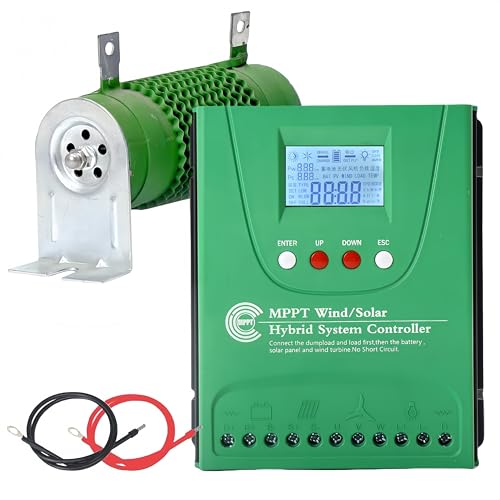
The 2000W hybrid controller is designed for all 12V/24V battery banks, supporting both wind turbines (up to 1000W) and solar panels (up to 1000W). It uses Boost MPPT to improve wind charging at low speeds and PWM for solar charging. This option suits households seeking a combined wind-and-solar solution for continuous power during mixed weather and longer outages.
Best for: Comprehensive off-grid systems that blend wind and solar for steady energy capture. Limitation: With a high-wattage capability, installation and wiring may require careful planning and space considerations.
Buying Guide: Key Factors For Choosing A 12V Wind Charging Solution
What charging performance matters most?
MPPT efficiency is critical when wind speeds fluctuate. Look for controllers that optimize power point tracking to maximize energy capture at low rotor speeds. Automatic battery matching reduces the risk of overcharging or undercharging across multiple batteries.
Is heat management important in windy environments?
Controllers with deep wind channels, heat dissipation tunnels, and robust thermal design help sustain charging under high current. This reduces component wear and extends system life in exposed installations.
How important is waterproofing and ruggedness?
For outdoor setups, IP67-rated or higher protection helps withstand rain, humidity, and dust. Waterproofing is a practical feature for installations on boats, RVs, or exposed rooftops.
How do I size a controller for my turbine?
Match the controller’s maximum wattage and current rating to your turbine’s output rating. If you expect occasional gusts over 1000W, choose a higher-capacity controller and ensure your battery bank and cabling can handle the load.
What about hybrids or multiple energy sources?
Hybrid controllers that manage wind and solar inputs offer flexibility for variable climates. They simplify wiring and can improve overall energy capture in mixed weather, especially for off-grid homes or remote outposts.
Choosing between 12V and 24V systems
12V systems are common for small setups and easier wiring, while 24V systems can provide better efficiency for larger batteries and longer runs. Ensure your battery bank and charging expectations align with the chosen voltage.
Frequently Asked Questions
- What is an MPPT controller? A maximum power point tracking controller optimizes the voltage and current to extract the most energy from a wind turbine given wind conditions.
- Do I need a separate charge controller for wind and solar? Not always. Some hybrid controllers can handle both energy sources, simplifying wiring and management.
- Can a wind turbine charge a 12V battery directly? A wind turbine typically requires a controller to regulate charging and protect the battery from overcharging.
- What is IP67 protection? IP67 indicates dust-tight protection and water immersion up to 1 meter for 30 minutes, useful for outdoor equipment.
- Is automatic battery matching important? Yes. It helps ensure charging efficiency across battery banks and prevents mismatched charging that can reduce battery life.
- How do I choose between a vertical and horizontal turbine? Vertical designs can handle crosswinds without tracking and are typically quieter, while horizontal turbines may offer higher efficiency in steady winds.