Best Astronomical Time Clock Switches for Home Automation
Looking for reliable astronomical time clock switches to automate lighting, fans, and basic appliances? This guide highlights top options that automatically adjust to local sunrise and sunset times, with schedules you can customize. The best picks suit different buyers: homeowners seeking simple energy savings, security-minded users aiming for convincing occupancy patterns, and tech enthusiasts needing flexible programming. Below you’ll find five strong choices, each with a clear use case, plus a buying guide and quick FAQs to help you decide.
| Product | Best For | Key Benefit |
|---|---|---|
| EWZ Series Multipurpose Control Astronomic 7 Day Time Switch | Homeowners needing precise daily scheduling | 7-day digital with daylight compensation |
| Leviton Decora Programmable Astronomical Timer | Smart, flexible lighting control | Built-in sunrise/sunset, versatile wiring |
| BN-LINK 7 Day Astronomical Timer | Energy-conscious users | 18 programs, multiple time zones, DST |
| Southwire Woods Indoor Astronomical Timer | Simple plug-in automation | Two outlets, quick setup |
| myTouchSmart 33861 LE In-Wall Timer | Custom lighting schedules | SunSmart and countdown features |
EWZ Series Multipurpose Control Astronomic 7 Day Time Switch

The EWZ switch is best for buyers who want a robust, all-week control with precise daily on/off cycles. It supports 120-277 VAC input and provides 1-channel DPST dry contact output, making it suitable for lights, fans, and other loads that don’t require a powered switch. The digital 7-day, 24-hour display allows up to 20 on/off cycles per day, with a one-minute minimum cycle. A manual override and automatic compensation for daylight saving time, leap year, and seasonal sunrise/sunset changes add reliability for year-round use. It’s an excellent pick for homeowners who want dependable, scheduled control without smartphone apps.
Who it’s best for: buyers needing consistent, fixed scheduling with latitude-based adjustments and a clear, standalone timer. Why chosen: its broad input range, precise daily cycling, and automatic time adjustments reduce manual tweaks and ensure consistent operation. Caution: set up is more technical than plug-and-play timers; ensure compatibility with the load type and wiring in your installation.
Leviton Decora Programmable Astronomical Timer Switch
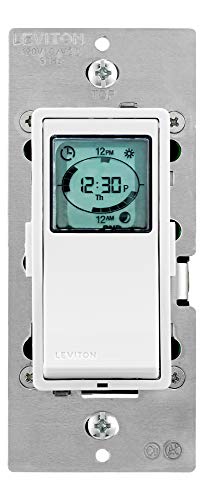
This Leviton model is best for homeowners who want flexible, secure lighting control with strong scheduling options. It supports neutral wire connections and can be used as a single-pole or 3-way device, offering up to 49 ON/OFF events and automatic adjustments for local sunrise/sunset. Daylight savings handling reduces manual corrections. It’s well suited for entryways, living areas, and exterior lighting that benefits from realistic occupancy patterns. Caution: ensure you’re wiring compliant for a 3-way setup if you plan to use it beyond a single pole.
BN-LINK 7 Day Programmable Astronomical Timer Switch

The BN-LINK timer is well-suited for users who want robust astronomical control with extensive programming options. It offers automatic sunrise and sunset-based operation with six preset time zones for accurate local timing, plus 18 ON/OFF programs across a 7-day period. It also includes DST adjustments and a Random mode for occupancy simulation. Choose this if you need flexible scheduling across multiple days and simplified time-zone handling. Limitation: you’ll need to confirm your local time zone setting matches your location for precise sunrise/sunset timing.
Southwire Woods Indoor Astronomical Timer

The Woods timer is a practical option for those seeking plug-in simplicity without complex wiring. It powers two grounded outlets and automates appliances like fans and lamps, aiding energy savings and home security. It’s a straightforward choice for basic automation in living rooms or bedrooms where you want a reliable, time-based routine. Caution: this model is more about plug-in convenience than advanced scheduling, so it may lack some nuances of wall-mounted astronomical timers.
Buying Guide
What should you consider when choosing an astronomical timer switch?
- Load type and wiring: Ensure the device supports your load (lighting, fans, outlets) and matches your wiring configuration (single-pole, 3-way, neutral required).
- Programming depth: Decide between simple daily schedules and deeper options like 7-day programming, multiple ON/OFF events, or countdowns.
- Sunrise/sunset accuracy: Look for models that automatically adjust for local sunrise/sunset and daylight saving time to reduce manual tweaks.
- Power range: Check input voltage compatibility (some models accept 120 VAC, others up to 277 VAC) to fit your circuit.
- Security features: Randomized on/off modes can create the appearance of occupancy when you’re away.
- Ease of installation: Plug-in timers are easiest to install; wall-mounted models require proper wiring and may need a neutral.
- Future-proofing: If you want more integration, consider how well the timer can be combined with other smart home devices in the future.
FAQ
- What is an astronomical timer switch?
An astronomical timer automatically adjusts its on/off schedule based on local sunrise and sunset times, often with daylight saving time adjustments. - Do these timers support multiple days or only daily schedules?
Many models support 7-day programming with multiple on/off events per day, while some offer fewer options; check the product’s programming options. - Is a neutral wire required?
Some timers require a neutral wire for proper operation, especially in newer homes; verify wiring needs before purchase. - Can I use an astronomical timer for security purposes?
Yes, features like randomized on/off timings help simulate occupancy and deter intruders when you’re away. - What load types can these control switches handle?
Most are designed for lights and fans; verify the output type (electromechanical vs. solid-state) to ensure compatibility with other devices. - Are these timers difficult to install?
Plug-in models are generally easier; wall-mounted timers require basic wiring knowledge. If unsure, consult an electrician.