Best Solar Panel Kit Solutions for Home and RV Power Needs
Looking for a reliable solar panel kit to power a cabin, RV, shed, or whole-home backup system? This guide highlights five top kits that balance capacity, safety, and ease of use. Each product is suited to different buyers—from weekend campers to full-time off-grid homes. Below, you’ll find quick at-a-glance buy guidance and a short buying table to compare key specs side by side.
| Product | Best For | Key Benefit | Storage/Output |
|---|---|---|---|
| ECO-WORTHY 10KW Output Off-Grid System | Homes needing high daily energy | High max output with parallel up to 6 units | Up to 9.36 kWh/day, 10 kW inverter |
| ECO-WORTHY 200W Solar Panel Kit (RV) | RV or small off-grid setups | All-in-one starter for mobility | 2x100W panels, 1100W inverter |
| ECO-WORTHY 10000W Complete Off-Grid System | Whole-house back-up | Integrated 10 kW inverter and large battery | 2950W PV, 16.1 kWh storage |
| ECO-WORTHY 200W Starter Kit for RV Off Grid | Beginner RV users | Simple DIY with included charger and battery | 2x100W panels, 100Ah battery |
| Renogy 100W Starter Kit | Budget-friendly off-grid start | Solid efficiency and service plan | 100W panel, PWM controller |
ECO-WORTHY 10KW Output Off-Grid Solar System Kit

- Includes 12pcs 195W solar panels (total 2340W) and a 10KW 120V/240V inverter with UL certifications.
- Real-time battery monitoring via CAN/RS485; mobile app compatibility for status checks.
- Parallel capability up to six units for higher total output; suitable for home, shed, or farm energy backup.
Best for: Homeowners needing robust, scalable power with strong safety certifications. Choose this if you plan to run high-demand appliances and want 60 kW potential when expanded.
Caution: System complexity is higher; ensure proper electrical installation and parallel connection requirements are understood before scaling.
ECO-WORTHY 200 Watt RV Complete Starter Kit
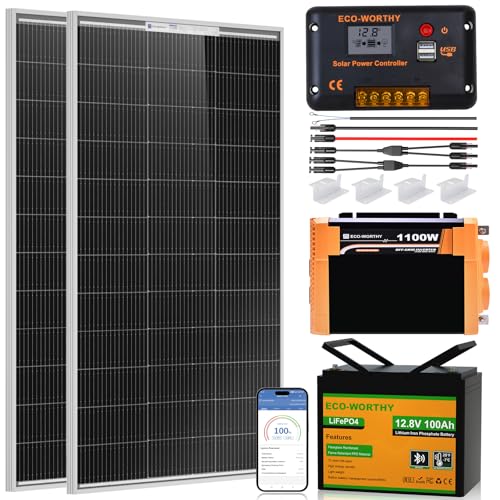
- Two 100W panels with a 1100W inverter and 30A PWM controller create a compact RV solution.
- All-in-one kit designed for novice setup and quick deployment on trailers or small cabins.
- Includes cables and essential components for straightforward installation.
Best for: RV owners looking for a simple, mobility-friendly solar option. Better for light daily use and short trips. Avoid if you need long-term, heavy-load power storage.
ECO-WORTHY 10000W Complete Off-Grid System

- Full home-ready system featuring a 48V 314Ah LiFePO4 battery bundle and a 10kW inverter with parallel expansion up to six units.
- Includes 5 × 590W solar panels totaling 2950W; capable of high daily production under optimal sun.
- Smart monitoring with display, Bluetooth, Wi-Fi, and RS485/CAN connectivity for integration with other inverters.
Best for: Homeowners seeking scalable, whole-house resilience with modern monitoring. Choose this if you want a high-capacity, future-proof upgrade path. Caution: Advanced setup complexity and parallel configuration require careful planning.
ECO-WORTHY 200 Watt 12V RV Starter Kit
- Complete with two 100W panels, 12.8V 100Ah lithium battery, and 1100W inverter for RV use.
- Simple four-step installation designed for novice users and portable mobility.
- Well-suited for recreational off-grid trips and backup power on the go.
Best for: RV enthusiasts seeking a compact, easy-to-assemble solution. Choose this if portability and quick setup are priorities. Limitation: Lower daily energy output compared with larger home systems.
Renogy 100W Starter Kit

- 100W monocrystalline panel with a 30A LCD PWM charger, plus hardware for RV or off-grid setups.
- UL 61730, CSA, and IEC certifications with durable weatherproofing and service plans.
- Includes adaptors and mounting hardware for straightforward installation.
Best for: Budget-conscious buyers starting with solar energy for RVs or small cabins. Choose this if you want reliable performance with a long-tail service plan. Caution: Power output is lower than multi-panel, home-grade kits.
Buying Guide
Key considerations when selecting a solar panel kit:
- Energy needs: Estimate daily consumption in kWh and match with panel wattage and battery capacity. For high-demand homes, consider systems that support parallel expansion.
- Type of system: Off-grid kits are best for remote sites; grid-tied or hybrid options suit urban homes with net metering.
- Expansion potential: If you may add more panels or batteries, choose systems designed for scalable parallel configurations.
- Storage: Battery chemistry (LiFePO4 vs lead-acid) affects safety, lifespan, and cost. LiFePO4 offers longer life and safer operation.
- Monitoring and connectivity: Real-time status via apps or displays helps manage performance and maintenance.
- Durability: Look for weather resistance, housing, and mounting hardware suitable for your climate (wind, snow loads).
- Installation complexity: Starter kits are easier for beginners; larger setups may require professional wiring and permits.
Frequently Asked Questions
- What size solar kit do I need for a small cabin?
– Start with a kit in the 800W–2kW range and a compatible battery bank to cover daily usage. - Can these kits be expanded later?
– Yes, many kits are designed for parallel expansion up to higher outputs; confirm the maximum parallel units before purchasing. - Do I need a professional to install a home solar kit?
– For complex, high-capacity systems, professional installation is recommended to ensure safety and code compliance. - What battery type is best for long-term storage?
– LiFePO4 batteries typically offer longer life, better safety, and deeper discharge capabilities than lead-acid options. - Is monitoring important for off-grid systems?
– Real-time monitoring helps optimize performance, enables timely maintenance, and supports troubleshooting. - Are these kits suitable for RVs?
– Several kits are designed specifically for RV use; verify inverter capacity and wiring for your vehicle’s electrical system.