Best Lead Acid Battery Bank Solutions: Restore, Desulfate, and Extend Life
For buyers seeking to maximize the lifespan and performance of lead-acid battery banks, a targeted restoration approach can save money and reduce downtime. This guide highlights five effective products designed to revive old batteries, extend charging capacity, and keep fleets, boats, RVs, and golf carts reliably powered. Best for fleets or individuals managing multiple lead-acid packs, these options emphasize desulfation and reconditioning in a straightforward, store-ready format.
Summary table of selected products:
| Product | Brand | Best For | Key Benefit |
|---|---|---|---|
| Battery Restorer and Desulfator | FORTIVO | General lead-acid recovery | High success in reviving old batteries |
| Battery Restore Desulfator Solution | Samorillo | Golf carts and multi-battery banks | Non-toxic, US-made formula |
| NOCO Genius GEN5X2 | NOCO | Two-bank on-board charging | Independent bank charging with modes |
| Battery Renew Solution | Samorillo | Fleet or multi-battery systems | Larger gallon size for multiple batteries |
| Professional Battery Restorer & Maintainer | BATTERY MEDIC | 6–48V systems | High-performance restoration blend |
Best Overall Lead-Acid Restore for Versatility

The Battery Restorer and Desulfator from FORTIVO targets wide lead-acid use in cars, golf carts, boats, ATVs, and more. It emphasizes reviving weak batteries and extending performance, making it a practical choice for mixed fleets or households with several devices relying on lead-acid packs. This option is best for buyers seeking a budget-friendly, one-step revival that reduces premature replacements and supports longer life across multiple applications.
Best for: Individuals or small fleets needing a general, versatile restore that improves capacity without overhauling charging systems.
Why selected: It combines a broad compatibility claim with a focus on extending life and reducing replacement costs, appealing to budget-conscious buyers who manage diverse equipment.
Limitation: Product claims emphasize high success, but user results can vary by battery chemistry and sulfation level. Regular charging cycles support best results.
Best 64oz Desulfator Solution for Golf Carts

The Samorillo Battery Restore Desulfator is designed to penetrate and dissolve sulfation in lead-acid cells, increasing charge capacity and extending life. It is marketed as compatible with golf carts, motorcycles, boats, and other lead-acid systems. The 64-ounce bottle is positioned as a one-bottle solution to treat multiple batteries, making it suitable for fleets or seasonal preparations.
Best for: Golf cart owners or small fleets needing a single large bottle to treat multiple batteries over a season.
Why selected: The formulation emphasizes non-toxic, USA-made chemistry and broad compatibility, reducing the need for frequent replacements across several battery types.
Limitation: It can require up to 10 days of regular charging for full effect; results vary with charging practices and battery condition.
Best Dual-Bank Onboard Charger for 12V Systems
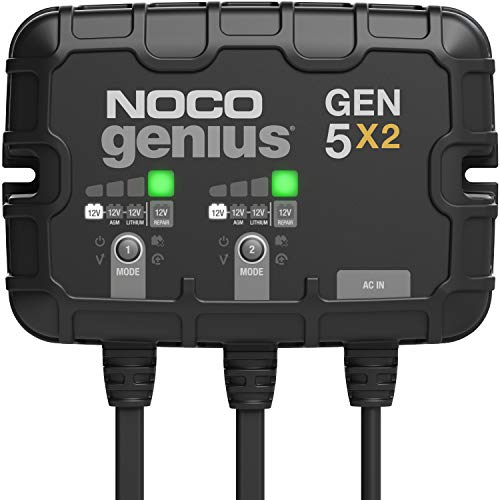
NOCO Genius GEN5X2 delivers a compact, rugged, two-bank onboard charger with a total of 10A (5A per bank). It supports multiple charging modes suitable for lead-acid and lithium batteries, and adds temperature compensation for stable charging in harsh environments. This option is best for boats, RVs, and other setups needing reliable, independent bank charging without manual intervention.
Best for: Users who require independent bank charging with marine-grade reliability and multiple mode options.
Why selected: Its independent banks and charge modes provide flexible maintenance for mixed battery setups, helping prevent overcharge while preserving long-term capacity.
Limitation: Requires space for installation and proper wiring to use both banks optimally.
Best Three-Bank Onboard Charger for 12V Systems
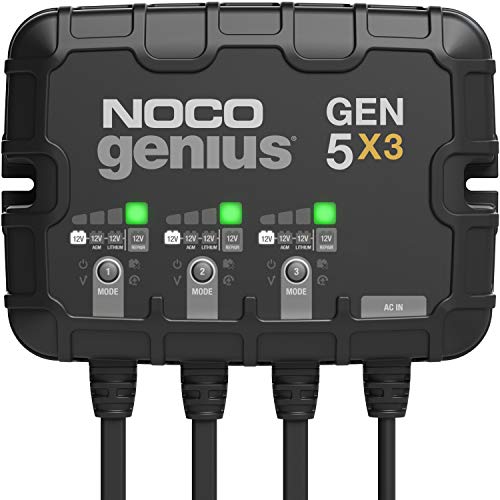
The NOCO GEN5X3 expands charging capacity to three banks with a total of 15A (5A per bank). It is designed for deeper multi-bank maintenance in marine, RV, and automotive environments. Each bank supports 12V, 12V AGM, 12V Lithium, plus a Repair Mode to address aging cells. This option suits larger battery banks requiring careful, independent maintenance across several cells.
Best for: Larger fleets or systems with three separate 12V battery groups needing precise, independent maintenance.
Why selected: The three-bank design reduces cross-bank interference and provides granular control for varying battery chemistries, improving long-term reliability.
Limitation: More complex wiring and setup compared to 2-bank units; installation effort is higher.
Best 32oz Battery Restorer & Maintainer for 6–48V

The Professional Battery Restorer & Maintainer by BATTERY MEDIC targets multiple voltages from 6V through 48V and supports different lead-acid families. It emphasizes advanced restoration and mult-system compatibility, offering a solution for professional maintenance and long-term system reliability. This option is best for service providers or operators managing complex, mixed-battery configurations.
Best for: Professionals or serious hobbyists who manage varied 6V, 8V, 12V, and 48V systems and need robust restoration chemistry.
Why selected: The product is positioned for long-term system maintenance with broad compatibility and high restoration potential, suitable for fleet operators and service teams.
Limitation: As a professional-grade product, it may require careful handling and adherence to usage instructions for optimal results.
Buying Guide: Lead-Acid Battery Bank Restoration and Maintenance
- Battery type and voltage: Confirm your system voltage (6V, 8V, 12V, or 48V) and whether you use flooded, AGM, or gel batteries. Choose products that explicitly support your chemistry to maximize safety and effectiveness.
- Scope of the system: For single-battery setups, simpler desulfator options may suffice. Larger fleets or banks benefit from multi-bank chargers and gallon-sized restorers designed for multiple cells.
- Desulfation vs. reconditioning: Desulfators dissolve sulfate crystals to improve charging efficiency. Reconditioners provide a broader restoration, often combining penetration and chemical dissolution for extended life.
- Installation and compatibility: Onboard chargers require mounting space and proper wiring. Standalone restorers work with batteries during charging cycles but may require regular monitoring.
- Time to full effect: Many restorers note visible improvements after several charging cycles or days of regular charging. Plan for a period of gradual recovery rather than instant results.
- Safety and handling: Use non-toxic and USA-made options when possible. Follow label directions, especially for concentrated liquids and containers with multiple batteries.
- Maintenance strategy: Pair restoration products with a consistent charging routine and periodic testing to verify voltage and capacity improvements over time.
FAQ
- What is sulfation in lead-acid batteries? Sulfation occurs when lead sulfate crystals form on battery plates, reducing charge acceptance and capacity.
- Do these products work on all lead-acid batteries? Most products target flooded, AGM, and some gel batteries; always verify compatibility with your specific battery type and voltage.
- How long does restoration take? Many formulas show noticeable improvements after several charging cycles, often 7–10 days for full effect in some cases.
- Can I use these products with solar storage systems? Yes, several are designed for solar storage and other deep-cycle lead-acid applications, but follow product directions for best results.
- Is a multi-bank charger better than a single-bank unit? For larger or mixed systems, a multi-bank charger provides precise, independent maintenance, reducing cross-bank interference.
- Are these solutions safe for first-time users? Many products are designed for household and fleet use, but always read the label and use proper protective equipment when handling chemicals or electronics.