Best No-Battery Flashlights for Emergencies and Outdoors
For buyers seeking reliable illumination without swapping out batteries, these no-battery or self-powered flashlights offer practical options for emergencies, camping, and everyday use. The top picks below include hand-crank, solar-powered, and rechargeable designs that minimize waste and maximize readiness. Each product is evaluated for who it’s best for and why, with clear pros and practical caveats.
Summary of selected products:
| Product | Power Type | Best For | Notes |
|---|---|---|---|
| Leelosp Hand Crank Flashlight (Red/Blue/Yellow/Gray) | Hand-crank, no batteries | Budget emergencies, classrooms, group activities | Crank generates power manually |
| VOETIR Led Solar Flashlight | Solar + rechargeable | Outdoor adventures, survival kits | Rechargeable with USB output |
| TFTDOUP NOAA Weather Radio With Flashlight | Self-powered with solar/hand-crank options | Disaster preparedness kits | Weather radio + flashlight |
| Lighting EVER LED Flashlight (Small, AAA Included) | Battery-powered (AAA included) | Compact carry and backup light | Includes batteries; not strictly no-battery |
| FASTPRO 4-Pack Aluminum LED Flashlights | AA batteries included | Group kits, family emergency packs | Pre-installed batteries; multiple tools |
Leelosp Hand Crank Flashlight (Set of 4)

Product overview: Leelosp’s 48-piece set includes four color options (red, blue, yellow, gray) with 12 flashlights per color. No batteries are required; power is generated by squeezing the handle to crank the internal micro power generator. Each compact flashlight measures roughly 3.94 x 2.05 x 1.02 inches, making them easy to carry in pockets or kits. The crank mechanism provides a simple turnkey energy source, suitable for classrooms, campers, or emergency supplies where conventional batteries are scarce.
Who it’s best for: This is ideal for families, educators, or outdoor groups seeking a large, low-cost stockpile of no-battery flashlights. The varied color options help with assignment or sharing. It’s also well-suited for kids’ emergency kits and group activities where having multiple light sources is beneficial.
Why selected: Its no-battery requirement plus distributed quantity reduces ongoing costs and waste while guaranteeing light when power is unavailable. The lack of electronics complexity keeps maintenance minimal.
Caution/limitation: The crank mechanism requires manual effort and may produce inconsistent brightness if cranking is not steady. The 4-pack design prioritizes quantity over high-performance output, so brightness levels are modest by design.
TFTDOUP NOAA Weather Radio With Flashlight

Product overview: TFTDOUP combines a NOAA weather radio with a self-powered flashlight. It supports solar charging and hand-crank operation, enabling continued use during power outages or disaster scenarios. This compact unit can receive AM/FM/WB signals, delivering critical weather updates along with a lighting option for emergencies. The integrated solar panel and hand-crank mechanism provide flexible charging in outdoor or disaster contexts.
Who it’s best for: This is a strong choice for emergency kits, campers, and prepper households that want both weather updates and a reliable light source without depending on a single power method. It’s particularly useful where weather alerts are essential for safety planning.
Why selected: The combination of weather radio and flashlight in one device reduces the number of gadgets needed in a kit while ensuring access to critical information and illumination during events when power is out.
Caution/limitation: Some users may find the built-in radio controls and feature set complex for casual use. The device’s size may be less convenient for ultra-mini portable needs compared with smaller hand-crank flashlights.
VOETIR Led Solar Flashlight

Product overview: VOETIR’s solar-powered flashlight features up to 1500 lumens with four modes (high, low, SOS, side light). It houses a 2000mAh rechargeable battery and serves as a power bank via USB output for emergencies. The solar charging capability allows operation in outdoor settings with sunlight, while USB charging offers flexibility when sun is limited.
Who it’s best for: This model suits outdoor enthusiasts, hikers, and survival kits needing a bright, rechargeable option that can also power other devices in a pinch. Its solar plus USB charging is advantageous for remote locations.
Why selected: Its high brightness, multi-mode operation, and dual charging options provide versatility in scenarios where battery replacement is impractical. The included USB output adds practical value for charging devices.
Caution/limitation: Brightness and charging efficiency depend on sunlight conditions. The flashlight’s larger form factor may be less convenient for ultra-compact carry in wallets or pockets.
Lighting EVER LED Flashlights High Lumens (Small, AAA Included)

Product overview: Lighting EVER offers compact LED flashlights with a 4.2-inch length and 1.2-inch diameter, weighing 128g. They deliver up to 140 lumens and a beam distance of about 492 feet. The construction is designed for water resistance (IPX4) and durability with a military-grade aluminum body. Batteries are included (AAA), ensuring immediate use out of the box.
Who it’s best for: This is suitable for shoppers seeking compact, durable pocket lights for everyday carry, camping basics, or emergency kits where a small, reliable light is helpful. The included batteries simplify immediate use.
Why selected: The combination of portability, sufficient brightness, and water resistance makes it a dependable all-around option for quick lighting needs. It’s a practical backup light in many small-scale scenarios.
Caution/limitation: Because batteries are included, it does not satisfy a no-battery requirement; consider this if avoiding any battery reliance is a non-negotiable criterion.
FASTPRO 4-Pack Aluminum LED Flashlights
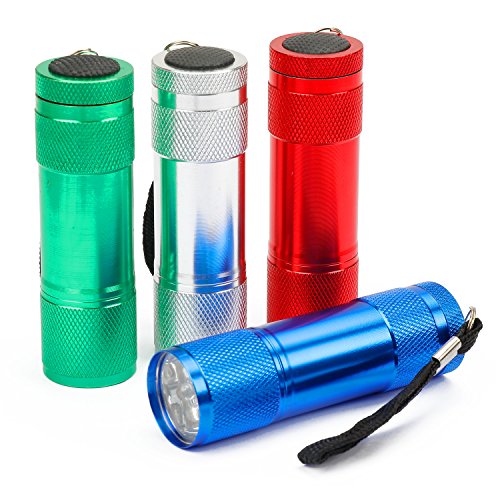
Product overview: FASTPRO’s 4-pack provides aluminum-bodied flashlights with a simple 20-lumen output per device, powered by pre-installed AAA batteries. The compact design (roughly 3-1/3″ long by 1″ diameter) emphasizes portability and a basic, rugged build for reliable everyday use or emergency kits.
Who it’s best for: This set is well-suited for households, schools, or offices needing multiple light sources in a compact, low-cost package. It’s ideal for grouped preparations where uniformity and quick access to lights are priorities.
Why selected: The included batteries ensure immediate usability, while the aluminum body supports durability in travel or outdoor use. The 20-lumen output is adequate for general tasks and signaling in dim environments.
Caution/limitation: The devices rely on disposable batteries, so long-term sustainability and ongoing costs should be considered. The brightness level is modest compared with higher-lumen options, which may be a limitation for some outdoor tasks.
Buying Guide: No-Battery And Low-Dependency Flashlights
Power type and use cases matter. Hand-crank and solar-powered models are best when you expect power outages, camping off-grid, or limited access to replacements. For urban environments, compact, battery-powered options with durable bodies can be reliable backups.
- Power method: Prioritize hand-crank or solar if you want to minimize battery purchases; look for multi-mode flashlights to adapt brightness for different tasks.
- Brightness and runtime: Consider lumens and runtime under your typical use case. Higher lumens are helpful for outdoor tasks; lower lumens save energy for longer use in emergencies.
- Durability: Water resistance (IP rating) and a sturdy housing (aluminum or reinforced plastics) increase survivability in rugged conditions.
- Portability: Size and weight affect carryability. Pocket-sized models are convenient for everyday carry; larger models may be better for home kits or vehicles.
- Maintenance: For no-battery designs, ensure you can perform the required cranking or solar maintenance easily. Battery-inclusive options require checks on battery availability and replacement cycles.
FAQ: No-Battery Or Low-Dependency Flashlights
Q1: Can a flashlight truly work without any batteries? A1: Yes, hand-crank and solar-powered flashlights generate power through manual cranking or sunlight, eliminating the need for disposable batteries.
Q2: Are solar-powered flashlights reliable in cloudy conditions? A2: They can charge in daylight even on overcast days, but charging efficiency decreases; having a backup power method is advisable.
Q3: What should I consider when choosing a no-battery flashlight for camping? A3: Prioritize brightness, battery independence method (crank vs solar), durability, and the availability of charging options in your camping environment.
Q4: Do no-battery flashlights require maintenance? A4: They generally require minimal maintenance, such as periodically charging via sunlight or ensuring the crank mechanism remains smooth and functional.
Q5: Is a no-battery flashlight suitable for kids? A5: Yes, particularly hand-crank models with simple operation; choose devices with clear ergonomics and safety features appropriate for children.
Q6: Can you substitute no-battery options with standard battery flashlights in emergencies? A6: Having at least one no-battery option provides resilience when replacements are unavailable, while battery-powered lights add convenience and higher brightness for many tasks.