Best Single Mode Fiber Optic Transceivers for Long-Distance Networking
Answering the needs of IT managers, network engineers, and enthusiasts, this guide focuses on single-mode fiber transceivers designed for long distances and compatibility across vendors. The listed products suit different buyers: those building enterprise fiber links, upgrading existing SFP+ ports, or expanding a campus network. Below is a quick summary table of five carefully selected options to help you compare at a glance.
| Product | Brand | Interface | Wavelength / Reach | Best For |
|---|---|---|---|---|
| 10Gtek 10G SFP+ Bidi Transceiver | 10Gtek | SFP+ | 1270/1330 nm, up to 20 km | 10G links with bidirectional single fiber |
| TP-Link Omada Gigabit SFP Module | TP-Link | SFP | 1310 nm, up to 20 km | Legacy Gigabit fiber extensions |
| QINIYEK 1 Pair Simplex SC BiDi SFP | QINIYEK | SFP | 1310/1550 nm, up to 3 km | Compact BiDi fiber links for small setups |
| 10Gtek 10GBase-LR SFP+ Transceiver | 10Gtek | SFP+ | 1310 nm, up to 10 km | Long-reach 10G fiber with LR optics |
| TRENDnet SFP Single Mode LC Module | TRENDnet | SFP | 1310 nm, up to 20 km | Reliable 1 Gbps fiber links with LC duplex |
10Gtek A Pair Of 10G SFP+ Bidi Transceiver
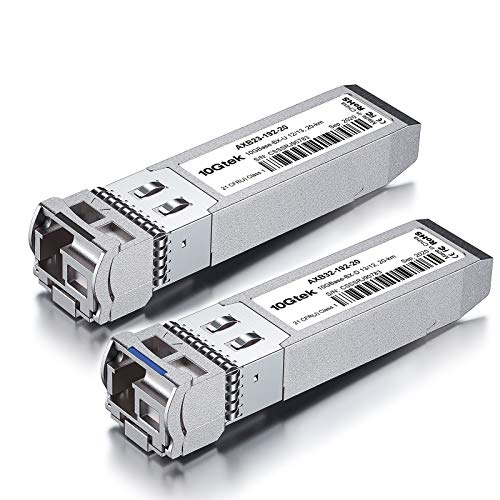
The 10Gtek SFP+ Bidi transceiver provides bidirectional single-fiber operation over a single LC channel. It supports 10GBASE-BIDI with TX/RX wavelengths of 1270 nm and 1330 nm in a pair configuration, enabling long-haul links up to 20 km. It is best for networks needing high-speed 10G links over a single fiber while maintaining compatibility with Cisco BX and Ubiquiti UniFi deployments. A potential limitation is that the module is designed for specific switch ecosystems and may require proper matching of TX/RX directionality in your setup.
- Best for: 10G links over single fiber with broad vendor compatibility
- Why selected: Bidirectional SFP+ reduces fiber runs and supports common enterprise devices
- Caution: Confirm your switch supports BX-style optics and BiDi configuration
TP-Link Omada Gigabit SFP Module

This single-mode mini-GBIC module supports full-duplex 1.25 Gbps links with a 1310 nm wavelength and LC/UPC interface. It is ideal for upgrading legacy fiber installs to gigabit capacity or extending a campus network up to about 20 km on SMF. It’s plug-and-play in many standard SFP-enabled switches, though users should verify compatibility with their specific vendor’s fiber optics policy. A limitation is that it targets 1 Gbps rather than higher speeds.
- Best for: Upgrading or extending Gigabit fiber networks
- Why selected: Reliable single-mode operation with long reach
- Caution: Check compatibility with existing switch hardware and optical budget
H!Fiber.com Gigabit Single Mode LC Media Converter Kit

This kit includes two SFP LX modules and two Gigabit SFP to RJ45 media converters, enabling fiber-to-Ethernet bridging in a compact package. It supports up to 20 km on SMF, offers a straightforward installation, and includes power supplies and a manual. The approach is best for small-to-medium offices or labs needing quick fiber-to-copper conversion. A possible limitation is that it embeds multiple components, which may complicate troubleshooting if issues arise.
- Best for: Small deployments needing fiber-to-Ethernet conversion
- Why selected: All-in-one kit with SFP and RJ45 ethernet support
- Caution: Ensure network devices can accommodate SFP-to-RJ45 bridging in your topology
10Gtek 10GBase-LR SFP+ Transceiver

This 10GBASE-LR SFP+ module delivers 10 Gb/s over single-mode fiber with a 1310 nm wavelength, supporting links up to 10 km. It’s suitable for long-haul campus backbones and enterprise connections to data centers. It pairs well with devices offering LR optics and is a strong option for standardized 10G links. A limitation is that actual reach depends on fiber quality and cable conditions.
- Best for: 10G long-reach links (up to 10 km)
- Why selected: Widely compatible LR option for existing 10G networks
- Caution: Check fiber type and connector cleanliness to maintain performance
TRENDnet SFP Single Mode LC Module

TRENDnet’s TEG-MGBS20 is a single-mode LC module with a 1310 nm wavelength and a reach up to 20 km, supporting IEEE 802.3z Gigabit Ethernet. It’s a straightforward choice for upgrading or adding gigabit fiber links to Cisco, Meraki, Ubiquiti, and other SFP-enabled devices. A consideration is that it operates at 1 Gbps, so higher-speed upgrades would require different transceivers.
- Best for: Long-distance Gigabit fiber links
- Why selected: Reliable and widely compatible single-mode SFP module
- Caution: Not suitable for 10G network upgrades without higher-speed modules
Buying Guide: Key Considerations For Single-Mode Fiber Transceivers
What distance do you need to cover?
Distance determines the appropriate wavelength and transceiver class. For distances under 5 km, 1.25 Gbps or 10 Gbps LR/BASE-LR options are common. For longer runs, BiDi or LR transceivers with 1310 nm are typically chosen.
What speed do you require?
Identify current port speeds (1 Gbps, 10 Gbps, etc.) and future growth. Match transceiver data rates to your switch ports to avoid bottlenecks.
Which fiber type and connectors?
Single-mode fiber (SMF) uses LC or SC connectors. Ensure the module wavelength matches your fiber (1310 nm or 1550 nm) and that the fiber is OS1/OS2 rated for duplex links.
Vendor compatibility and optics policy
Optics can vary by vendor. Confirm the transceiver is compatible with your switch brand and model and respect any vendor-specific requirements for SFP/SFP+ modules.
Monitoring and reliability
Digital Diagnostic Monitoring (DDM) helps track temperature, voltage, and signal integrity. Choose modules that offer DDM if ongoing monitoring is important for your network reliability.
Power, EMI, and installation
Look for low power consumption, EMI protection, and hot-swappable, plug-and-play features for easier maintenance and installation.
Frequently Asked Questions
What is a single-mode fiber transceiver?
A transceiver that uses single-mode fiber to transmit data over long distances, typically at wavelengths like 1310 nm or 1550 nm, across SFP/SFP+ interfaces.
What’s the difference between LR and BiDi transceivers?
LR (Long Reach) transceivers use one fiber pair with separate TX/RX directions, while BiDi transceivers use bidirectional wavelengths on a single fiber, reducing fiber counts but requiring precise wavelength management.
Can I mix transceivers from different brands?
Compatibility varies by device. Ensure the transceiver is MSA-compliant and check the switch’s optics compatibility list before mixing brands.
Do these transceivers require special installation?
Most listed modules are plug-and-play with SFP-capable switches. Some may require configuration to match Tx/Rx direction or BiDi settings.
Which wavelength is best for long distances?
1310 nm is common for longer single-mode links due to favorable fiber attenuation, though 1550 nm is also used for very long runs with appropriate fiber types.
What should I verify before buying?
Verify speed compatibility, fiber type (SMF OS1/OS2), connector type (LC or SC), reach, vendor compatibility, and whether DDM is supported.