Best Variable Speed Air Pumps for Aquariums
When choosing a variable speed air pump for an aquarium, look for adjustable airflow, low noise, and reliable dual outlets for oxygenation and substrate aeration. This guide highlights five aquarium-focused pumps that offer adjustable output, quiet operation, and durable design. Best for small to mid-sized tanks, community tanks, and planted setups, these picks balance power, efficiency, and price. The following table summarizes key specs to help you compare at a glance.
| Product | Air Flow (GPH) | Outlets | Power | |
|---|---|---|---|---|
| Uniclife 64 GPH Aquarium Air Pump | 64 | Dual | 4 W | Small to mid tanks, steady oxygenation |
| Pawfly Aquarium Air Pump 50 GPH | 50 | Dual | 1.25 W | Quiet, energy-efficient setups |
| HITOP Dual Outlet Aquarium Air Pump | Adjustable via knob | Dual | 3 W | Reliable dual output, medium tanks |
| AQQA Aquarium Air Pump | Up to 100 GPH | Dual | 3/6/10 W variants | Upsize tanks up to 200 gallons |
| VIVOSUN Commercial Air Pump 634GPH | 634 | 6 Outlets | 25 W | Larger planted or hydroponic setups |
Each option below is chosen for clear, objective criteria: adjustable airflow, quiet operation, and suitability for aquarium environments. The selections also avoid features that don’t translate well to tanks (such as high-watt inflators) to keep the focus on reliable, aquarium-friendly performance.
Uniclife 64 GPH Aquarium Air Pump
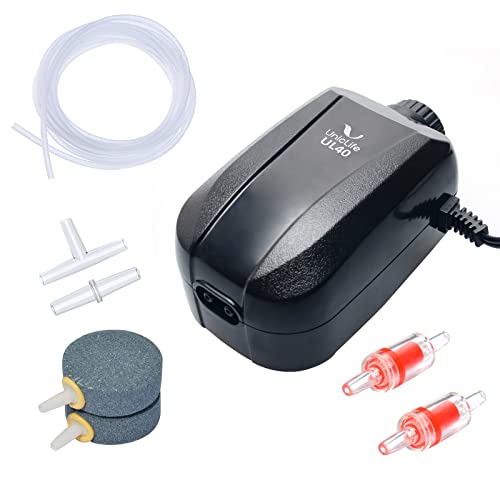
The Uniclife pump delivers a steady 64 GPH output with dual outlets for flexible air distribution in a 10–100 gallon tank. It uses a rotary knob to adjust airflow, allowing precise oxygenation during different tank needs. Power consumption is low at 4 W, making it suitable for continuous operation. Best for small to medium aquariums where consistent aeration is essential, such as community tanks or lightly planted setups. A primary caution is potential drop in air volume if intake cotton becomes blocked; regular maintenance of the intake is recommended.
Pawfly Aquarium Air Pump 50 GPH

The Pawfly pump provides 50 GPH with a dual outlet design and an adjustable top knob for manual airflow control. It is designed for tanks up to 60 gallons and emphasizes low power use at 1.25 W with a quiet performance of under 30 dB thanks to rubber feet that dampen vibration. Best for budget-conscious hobbyists seeking modest aeration without noise. It’s especially compatible with a range of aquariums where gentle, constant air flow is desired. A limitation is that higher demand setups may require larger-capacity models.
HITOP Dual Outlet Aquarium Air Pump

The HITOP model features two adjustable outlets in a compact 3 W air pump designed for tanks from 10 to 100 gallons. It emphasizes quiet operation, with soft rubber feet and a design that reduces vibration and electric field fluctuations. This makes it a sensible option for bedrooms or offices near the tank. Best for users who want reliable dual-air supply with straightforward manual adjustment. A potential limitation is that manual adjustment may not hold perfect precision under heavy flow, so periodic re-checking is advised.
AQQA Aquarium Air Pump with Stainless Steel Dual Outlet

The AQQA pump provides quiet operation with a stainless steel dual outlet design and a robust 3–10 W power range depending on model. It is engineered to support up to 200 gallons, making it suitable for larger aquaria or multi-tank setups. The unit is designed for energy efficiency and reduced noise (max around 35 dB). Best for larger planted tanks or systems that require consistent, higher air volume. A consideration is selecting the correct wattage for your tank size to avoid over-aeration in highly enclosed spaces.
VIVOSUN Commercial Air Pump 634GPH
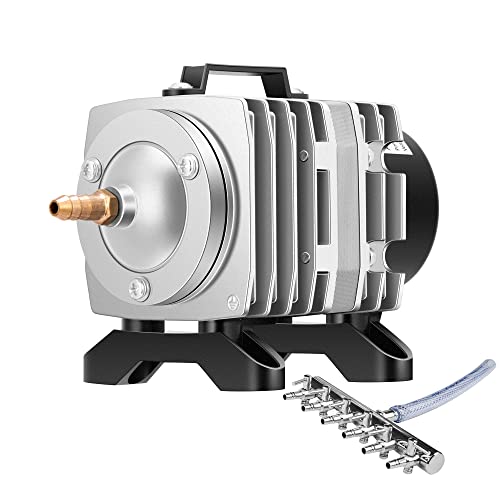
The VIVOSUN 634GPH pump offers six outlets and a 25 W motor, designed for higher-demand setups such as larger planted tanks or hydroponic systems. Its aluminum heat-dissipation surfaces and copper outlets support durable, continuous operation. Best for users who need multiple air lines and higher total airflow. A caveat is the higher power draw relative to smaller aquarium models, which may be less suitable for simple betta or nano tanks.
Buying Guide: Key Considerations For Variable Speed Aquarium Pumps
- Tank size and aeration needs: Choose airflow capacity that matches your tank volume and stocking level. Larger tanks often benefit from dual outlets and higher max flow.
- Noise and vibration: Look for rubber feet, insulated housings, and quiet motors to minimize disturbance.
- Adjustability: A reliable, easily adjustable control helps tailor oxygenation for daytime activity or nighttime rest periods.
- Power consumption: For continuous operation, prioritize low wattage with adequate output to reduce energy usage.
- Durability: Stainless steel or high-quality plastics reduce wear from moisture and salt, especially in marine setups.
- Maintenance: Accessibility of inlet filters and air stones makes routine upkeep straightforward and cost-effective.
Frequently Asked Questions
- What does GPH mean and why does it matter?
GPH stands for gallons per hour and indicates how much air the pump can deliver. Higher GPH supports larger tanks or higher aeration needs. - Are dual-outlet pumps better than single-outlet for planted tanks?
Dual outlets offer more flexible placement of air stones and can improve circulation around plants and substrate, which is beneficial in many setups. - Is a more powerful pump always better?
Not always. Excessive airflow can disturb fish or create unnecessary surface agitation in small tanks. Match the flow to your tank’s needs. - How important is noise for a bedroom tank?
Very important. Look for pumps with rubber feet and sound-damping design features to minimize disruption. - Can I use these pumps with saltwater tanks?
Yes, many models support both freshwater and saltwater, but ensure materials resist corrosion and avoid over-pressurizing delicate equipment.