Best Step Up Isolation Transformer Options for Home and Travel Use
When you need reliable voltage conversion, choosing the right step up and down transformer matters for device safety and performance. This guide highlights five top picks suitable for American buyers, including compact travel models and heavy‑duty units. Best for travelers needing portable solutions, best for home electronics, and best for high‑wattage appliances. The table below offers a quick comparison to help you decide at a glance.
| Product | Best For | Output Power | Notable Feature |
|---|---|---|---|
| Pyle Step Up and Down Converter | Travelers and light-use devices | 500 W | USB charging port, safety switch |
| VEVOR 1000VA Converter | Household electronics with multiple outlets | ~600 VA max load | Dual protection, US/EU outlets |
| LiteFuze JP-1000 | Mid‑range appliances and electronics | 1000 W | ConvertingBox technology, noise reduction |
| Generic 3000W Transformer | High-wattage appliances | 3000 W | Compact design for its class |
| VEVOR 5000VA Auto Converter | Multiple devices and heavy use | Up to 4000 VA usable load | Automatic voltage detection |
Pyle Step Up and Down Converter — 500 Watt

- Best for: Light‑weight travel devices, small electronics, and USB‑charged gadgets.
- Why selected: A compact 7x7x5 inch form with a USB charging port adds convenience for travelers or office setups.
The Pyle unit supports stepping up from 110/117/120 V to 220/230/240 V and vice versa, with a safety break switch. It is suitable for travelers who need a compact, simple converter for small devices. A potential limitation is its 500 W rating, which excludes high-wattage appliances.
VEVOR Voltage Converter Transformer — 1000VA

- Best for: Mid‑range electronics and devices requiring more power than travelling models can provide.
- Why selected: Dual protection features, a built‑in US/EU outlet mix, and a 1000VA rating balance portability with utility.
Note: It requires correct voltage selection before powering on. The unit uses a dual‑protection design for overcurrent and overload protection, but the data suggests a 600 VA usable load at max; plan for devices that stay within that range to avoid tripping the breaker.
LiteFuze JP‑1000 Step‑Up/Down Transformer

- Best for: Japanese and US appliances up to 1000 W, suitable for a broad range of devices.
- Why selected: ConvertingBox technology promises efficient conversion and reduced noise, with straightforward plug‑and‑play operation.
Limitation: As with most lower‑to‑mid wattage units, exceeding the 1000 W limit will cause failure or tripping. Ensure load stays within limits and check device amperage for safety.
Generic 3000W Transformer — 110V to 220V
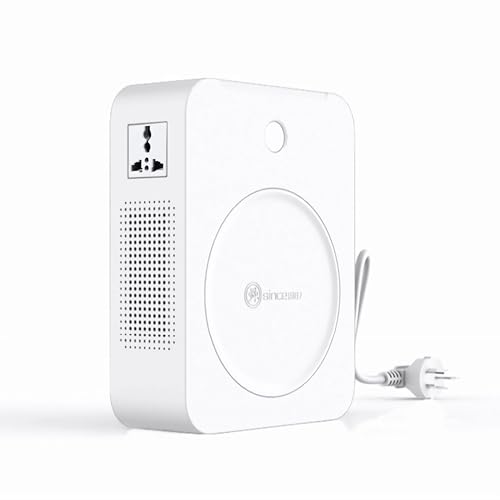
- Best for: High‑wattage appliances and equipment that require substantial power conversion.
- Why selected: The high wattage rating enables powering devices like large kitchen appliances or entertainment systems from 110 V to 220 V.
Caution: Higher wattage devices draw more current; ensure the transformer’s rating aligns with the device’s startup surge. The unit’s large footprint might reduce portability for travel use.
VEVOR 5000VA Auto Converter

- Best for: A setup where many devices must be powered from different mains without manual switching.
- Why selected: Automatic voltage detection and multiple outlets support simultaneous use, with a robust 4000 VA usable load capacity and added USB and Type‑C ports.
Limitation: Automatic detection helps usability, but ensure you stay within the rated load to avoid overheating or tripping the circuit. Heavy units are less portable than compact travel models.
Buying Guide: How To Choose The Right Step Up Isolation Transformer
- Determine your load. List all devices you plan to power simultaneously and add their wattage. Choose a transformer with a higher wattage rating than your total expected load to avoid overloads.
- Voltage needs. Decide whether you need mainly step‑up, step‑down, or dual capability. Some models auto‑detect voltage, while others require manual switching.
- Outlets and plugs. Check the outlet types (US, EU, USB, Type‑C) and ensure plugs fit your devices and destination power grid.
- Portability vs. power. Travel scenarios favor compact, lighter units with modest wattage, while home use may justify higher capacity units with multiple outlets.
- Safety features. Prioritize devices with circuit breakers, overcurrent protection, and thermal safeguards to protect sensitive electronics.
- Inclusion of USB or data ports. If you need charging for gadgets, a converter with USB ports adds convenience and reduces adapter clutter.
- Installation simplicity. Models with easy plug‑and‑play operation reduce the risk of incorrect voltage use and accidental damage.
Frequently Asked Questions
- What is a step up isolation transformer? A device that converts voltage from one level to another while providing electrical isolation to protect connected equipment.
- Can I use any transformer for high‑wattage appliances? No. Always match or exceed the device’s wattage rating and account for startup surges.
- What does VA or VA rating mean? VA (volt‑amps) reflects apparent power; use wattage guidance to estimate real load. For resistive loads, VA and watts are similar; for others, consult device specs.
- Is automatic voltage detection safe for every device? Generally safe for devices that tolerate automatic variation, but verify device tolerances and surge requirements before use.
- Are USB ports on voltage transformers standard? Some models include USB or Type‑C ports for charging, which is useful for small electronics and mobile devices.
- How do I avoid overloading a transformer? Add up all device wattages, include startup surges, and choose a transformer with a comfortable safety margin (e.g., 20–30% higher than total load).