Best Solar Panel Voltage Controllers for Off-Grid Power Systems
Answering the top buyer question: the right solar panel voltage controller helps manage charging, protects batteries, and optimizes energy transfer in 12V or 24V solar setups. This guide highlights five reliable PWM and MPPT options that suit common needs—from small RV systems to home battery banks. Each pick targets a specific user: boaters, campers, DIY hobbyists, and small businesses seeking dependable, maintenance-free regulation of solar charging.
Quick reference table of selected products
| Product | System Type | Best For | Main Advantage |
|---|---|---|---|
| [Upgraded] 30A Solar Charge Controller (Depvko) | 12V/24V PWM | Home solar, small cabins, RVs | Memory of user parameters; dual USB charging |
| 2PCS 30A PWM Solar Charge Controller (Rolokit) | 12V/24V PWM | DIY setups, multiple battery banks | Two units with shared features; easy expansion |
| [Upgraded] 30A Black Solar Panel Controller (Depvko) | 12V/24V PWM | Lead-acid systems in outdoor environments | Dual USB output; automatic parameter memorization |
| Renogy Wanderer 10A | 12V/24V PWM | RVs, boats, off-grid cabins | 4-stage charging; negative ground design |
| SOLPERK MPPT 10A 12V | 12V (MPPT) | Larger panels in constrained spaces | High efficiency up to 99%; wide battery compatibility |
[Upgraded] 30A Solar Charge Controller (Depvko)

Best for: Small home or cabin solar systems where a single controller must manage 12V or 24V operation with simple USB charging. This unit uses a built-in microcontroller to automate panel and battery management and can memorize user-set parameters, reducing resets after battery depletion.
- Automatic adaptation to 12V or 24V systems; minor voltage deviation is normal.
- Dual USB ports (5V/2.5A max) for charging phones, tablets, or small devices.
- Lead-acid only: Open, AGM, GEL types supported; lithium not recommended.
Best for: Buyers who prioritize automatic parameter memory and USB charging while keeping a compact PWM design. Limitation: Not suitable for lithium or LiFePO4 batteries.
2PCS 30A PWM Solar Charge Controller (Rolokit)

Best for: DIY enthusiasts needing reliable PWM regulation with easy LCD readouts and adjustable parameters. Two units enable parallel setups or multi-battery arrangements while maintaining straightforward operation.
- Automatic 12V/24V adaptation; suitable for lead-acid variants (OPEN, AGM, GEL).
- Dual USB 5V/3A outputs for mobile devices or small peripherals.
- Not lithium-compatible; verify battery type before wiring.
Best for: Those seeking scalable PWM control with clear LCD feedback and simple mode switching. Caution: Not designed for lithium chemistries.
[Upgraded] 30A Black Solar Panel Controller (Depvko)
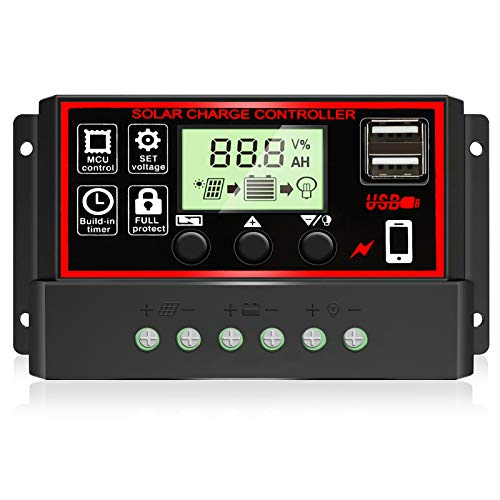
Best for: Outdoor leading to solid battery life with PWM regulation and USB charging. This model emphasizes memory of user parameters and safe 5V/2.5A USB charging for devices while keeping a simple 12V/24V setup.
- Fully 3-stage PWM charge management with auto-recognition for lead-acid types.
- Smart memory function to recall user settings after battery depletion.
- Limitations: Not compatible with lithium-based batteries; ensure battery type matches specification.
Best for: Users who want a rugged, easy-to-operate PWM controller for lead-acid systems in outdoorsy environments. Limitation: Do not use with lithium chemistries.
Renogy Wanderer 10A
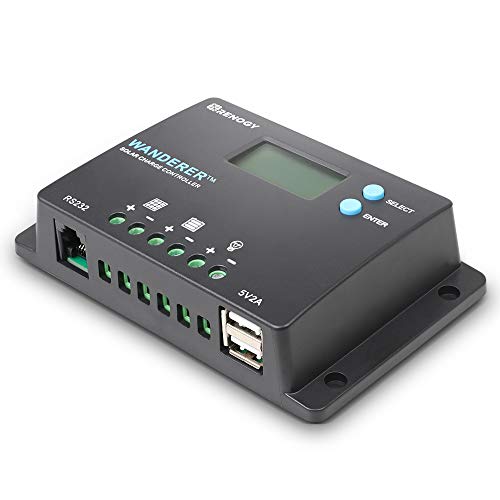
Best for: RVs, boats, or off-grid cabins where a compact, reliable PWM controller with negative grounding is advantageous. The Wanderer series emphasizes longevity and safety across multiple battery types.
- 4-stage charging (Bulk/Boost/Float/Equalization) to optimize battery lifespan.
- Supports AGM, Gel, Flooded, and Lithium with the Wanderer Li variant; negative ground design improves safety in certain installations.
- IP32 waterproof rating adds outdoor suitability; compact dimensions fit tight spaces.
Best for: Those prioritizing a proven, compact regulator with multi-stage charging and negative-ground compatibility. Caution: Check specific battery compatibility, especially for lithium variants.
SOLPERK MPPT 10A 12V Solar Charge Controller
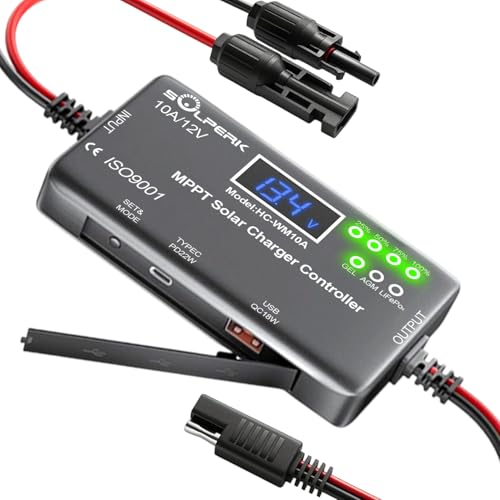
Best for: Users with limited space and a need to maximize solar harvest via MPPT tracking. Suitable for GEL, AGM, Flooded, and LiFePO4 batteries; supports Type-C and USB outputs for charging small devices.
- MPPT efficiency can surpass PWM in many setups, especially with larger panels or higher voltage strings.
- Three battery types supported; robust ABS housing with IP65 rating for weather resistance.
- Note: MPPT controllers generally require slightly more setup; ensure panel voltage is within recommended range for best results.
Best for: Small, space-constrained installations where higher efficiency and versatile battery compatibility matter. Limitation: MPPT units can be more complex to configure than basic PWM controllers.
Buying Guide: How to Choose The Right Solar Panel Voltage Controller
- System voltage: Confirm whether your setup runs on 12V or 24V. Many controllers auto-detect, but it’s important to verify compatibility with your battery bank.
- Battery chemistry: If you use lead-acid variants (OPEN, AGM, GEL), most PWM controllers are suitable. For lithium or LiFePO4, select MPPT controllers or models explicitly listed as lithium-compatible.
- Charging method: PWM vs MPPT. PWM controllers are simple, affordable, and adequate for smaller systems. MPPT controllers extract more energy from larger panels or panels at higher voltages, improving efficiency in demanding setups.
- Safety features: Look for overcharge, over-discharge, short circuit, reverse polarity, and reverse current protections. Consider negative-ground designs if your installation requires it (common in RVs and boats).
- USB charging: If you plan to power mobile devices directly from the controller, ensure USB outputs meet your device power needs and are rated for sustained use.
- Environment and durability: Outdoor installations benefit from IP ratings and rugged housings. Waterproof or weatherproof designs extend life in harsh climates.
- Expandability: If you anticipate adding more panels or batteries, you may prefer units that support multiple units or easier parallel operation.
Frequently Asked Questions
- What is the difference between PWM and MPPT solar controllers?
PWM controllers regulate charging by reducing voltage to the battery, offering simple regulation and lower cost. MPPT controllers dynamically adjust to harvest more power, particularly with higher panel voltages, improving efficiency in larger systems. - Can I use these controllers with lithium batteries?
Some models support lithium chemistries (like LiFePO4) or offer lithium-compatible modes. Always confirm battery type in the product specs before wiring. - Is it safe to charge devices directly from the controller’s USB port?
USB outputs are designed for charging small devices (phones, tablets). Do not rely on them for high-power loads; check amperage ratings and ensure devices stay within safe levels. - Do these controllers require maintenance?
Most PWM and MPPT controllers are maintenance-free beyond routine inspections. Keep connections clean and dry, and monitor battery health to maximize system lifespan. - What installation considerations are important?
Mount in a dry, ventilated area; ensure proper wiring gauge for panel and battery currents; respect polarity and avoid exposing sensitive electronics to extreme heat.