Best Analog Insulation Resistance Tester for in-Field Electrical Inspections
Answered: an analog insulation resistance tester is best for quick, hands-on measurements of insulation integrity in motors, transformers, cables, and electrical panels. This guide highlights five proven models that balance simplicity, reliability, and field-readiness. Ideal buyers include maintenance technicians, electrical contractors, and IV testing professionals who prefer intuitive analog dials and straightforward operation over digital interfaces. The products below were chosen for clear displays, stable engagement, and practicality in typical work environments. A compact buying table is provided to compare core specs at a glance.
| Product | Brand | Voltage Range | Key Strength |
|---|---|---|---|
| Hioki 3490 Analog Megohm HiTester | Hioki | 250–1000 V DC test voltages; up to 4000 MΩ | Clear three-range testing with simple steps |
| Extech 380320 Analog Insulation Tester | Extech | 250/500/1000 V; up to 400 MΩ | Large dial display; three test voltages |
| TY6045 Insulation Resistance Tester 1000V | Hyuduo | 5 MΩ–2000 MΩ; 1000 V | Adjustable self-locking bracket for stability |
| Klein Tools ET600 Megohmmeter | KLEIN TOOLS | 125/250/500/1000 V | Easy test with lock and safety indicators |
| Megger MIT1025-US 10kV Insulation Tester | Megger | 85–265 V; up to 10000 MΩ | Compact, versatile with digital/analog display |
Hioki 3490 Analog Megohm HiTester
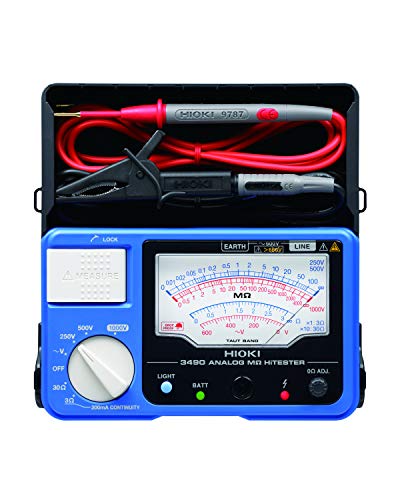
The Hioki 3490 offers a straightforward three-range insulation test with voltages of 250, 500, and 1000 V. It measures up to 4000 MΩ, enabling quick checks of insulation resistance in motors, cables, and transformers. Best for technicians who value a simple workflow and a clear, easy-to-read dial. Limitations include a lower maximum resistance than some large-scale test sets, which may matter for very high-resistance applications.
Extech 380320 Analog Insulation Tester

The Extech 380320 has three essential test voltages (250V, 500V, 1000V) and measures up to 400 MΩ. Its large analog dial provides immediate visual feedback, which helps reduce interpretation errors on-site. A notable advantage is the lock-on feature for extended testing. A potential drawback is that its resistance ceiling is lower than some high-end models, suitable for many standard insulation tasks but not all.
TY6045 Insulation Resistance Tester 1000V

The TY6045 delivers a wide measuring range from 5 MΩ to 2000 MΩ at a 1000 V range, with a clear analog dial. It includes a self-locking bracket for stable field testing, which helps keep hands free during longer tests. Best for users working with motors, cables, and transformers who need a broad resistance span. A limitation is that some users may prefer digital logging for documentation and trend analysis.
Klein Tools ET600 Megohmmeter

The Klein Tools ET600 supports insulation testing up to 4000 MΩ at voltages of 125V, 250V, 500V, and 1000V. It emphasizes safety with a visible voltage warning and simple test/lock operations, making it suitable for field work where quick, repeatable checks are needed. A potential caveat is the limited high-voltage capability compared with specialized units used in some large facilities.
Megger MIT1025-US 10kV Insulation Tester

The MIT1025 offers a 10 kV insulation test capability with a digital/analog display and wide measurement range. It is designed for portability and versatile testing, supporting PI, DAR, DD, SV, and ramp testing modes. This makes it a strong choice for technicians needing high voltage insulation testing in industrial environments. The trade-off is the higher complexity and cost compared with simpler, lower-voltage analog meters.
Buying Guide
- What voltage range do you need? For general purpose, 250–1000 V tests cover most motors, cables, and panels. For high-voltage equipment, consider models like the MIT1025 or MIT525 with higher output.
- How important is a large dial? An easy-to-read analog dial reduces interpretation errors in bright shop lights or glare conditions.
- Do you require stability during long tests? Look for built-in brackets or hands-free lock features to free your hands for probes.
- Is portability critical? Compact, lightweight units are preferable for field service and on-site inspections.
- Digital vs. analog display: If you need documentation or data logging, digital features may be valuable; for quick on-site checks, analog clarity often wins.
- Safety and warnings: Choose meters with clear safety indicators and appropriate insulation protection for the expected work environment.
FAQ
- What is an analog insulation tester used for? It measures insulation resistance to determine the integrity of electrical insulation in devices like motors, transformers, and cables.
- Why choose an analog meter over a digital one? Analog meters provide immediate visual trends without relying on digital readouts or logs, which can be advantageous in bright work areas or when quick interpretation is needed.
- What voltage range should I start with? For most general inspections, start at 250–500 V to test common equipment; use higher voltages only if the device requires it.
- Can these meters test live circuits? Insulation testers apply voltage as part of the test; always follow safety procedures and use appropriate PPE and test disconnects where required.
- Are there batteries required? Yes, most portable analog testers are battery-powered for field use, enabling mobility and portability.
- How to read results effectively? Read the dial for the resistance in MΩ. Higher MΩ indicates better insulation; very low values may indicate degraded insulation.