Best Electric Ceiling and Baseboard Heat Thermostats for Precise Comfort
If you’re shopping for an electric ceiling or baseboard heater thermostat, you want reliable control, simple installation, and compatibility with your heater. This guide highlights five practical options designed for different setups, budgets, and installation needs. The selections cover both single-pole and double-pole configurations, 240V systems, and universal-fit designs. Ideal buyers range from DIY homeowners updating an existing baseboard heater to facilities managers replacing aged thermostats in commercial spaces. The following table summarizes each recommended product to help you compare at a glance.
| Product | Voltage / Type | Best For |
|---|---|---|
| Cadet T522-W Double Pole Mechanical Wall Thermostat | 4-wire, 120-240V | Replacing older line-voltage thermostats; straightforward, robust control |
| YeloDeer 240V 4-Wire Manual Thermostat | 240V, 4-wire | Stylish flush-mount look; high accuracy for 240V systems |
| DR. Infrared Heater DR-001 Wall Thermostat | 120-277V, 3360-7756W range | Versatile, high-capacity control for larger spaces |
| Honeywell T410A1013 Electric Baseboard Thermostat | Two-wire retrofits | Replacing older two-wire devices with simple install |
| Stelpro SWT1F Single Pole Line Voltage Thermostat | Single-pole 240V; two-wire | Versatile and easy to install in commercial or residential settings |
Cadet Double Pole Mechanical Wall Thermostat for Electric Heaters

The Cadet T522-W is a double-pole, 4-wire thermostat with a positive-off position. It replaces most line-voltage wall-mounted thermostats and features color-coded wires for easier installation. This unit is best for buyers who want a robust, straightforward replacement that preserves two-stage or line-voltage control in older baseboard configurations. It is suitable for 120-240V circuits. A key limitation is that it emphasizes mechanical control, which may not appeal to users seeking digital programming or high-precision scheduling.
YeloDeer 240 V Only 4-Wire Manual Electric Baseboard Thermostat

The YeloDeer thermostat offers a modern white design that sits flush against the wall, with a large knob for easy temperature adjustments. It provides a wide control range from 40 °F to 80 °F (4.4 °C to 26.7 °C) and is wired for 240V systems up to 4800 watts. It’s best for buyers who want a high-visibility control with precise adjustment on 240V baseboard setups. A potential limitation is that it is a basic manual thermostat without digital connectivity or advanced scheduling.
DR. Infrared Heater DR-001 Wall Thermostat
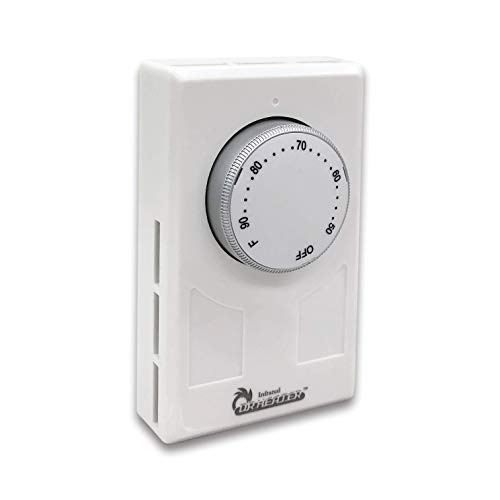
The DR-001 thermostat supports both 120- and 277-volt systems with a wide wattage range (3360W at 120V up to 7756W at 277V). It includes control dials for setting temperature and a flush wall-mount design. This option is best for spaces requiring higher heat output with flexible voltage compatibility. A limitation is that the device may be bulkier than compact mechanical units and could require careful wiring during installation.
Honeywell T410A1013 Electric Baseboard Thermostat

The Honeywell T410A1013 is designed for easy replacement of virtually any two-wire line voltage thermostat with 6-inch color-coded leads and a durable micro switch mechanism. It’s best for users replacing older two-wire units with minimal wiring changes. The primary caveat is that two-wire configurations lack the off-position safety of a double-pole model, so consider a double-pole option if safety and control isolation are priorities.
Stelpro SWT1F Single Pole Line Voltage Thermostat

The SWT1F is a versatile single-pole mechanical thermostat for 240V systems, compatible with a wide range of heating products, including baseboard heaters and wall fan heaters. It uses a simple dial for temperature control and is noted for straightforward installation with just two wires. This model is best for commercial and residential spaces where a durable, easy-to-service thermostat is needed. A potential limitation is that single-pole operation offers less complete shutoff isolation than a double-pole unit.
Buying Guide
What should you consider when choosing an electric ceiling or baseboard heater thermostat?
- Voltage and wire configuration: Confirm 120V, 240V, or high-voltage capabilities and whether a single-pole or double-pole design is required for safety and control.
- Type: Mechanical versus digital. Mechanical units are simple and reliable, while digital or programmable units offer scheduling and tighter temperature control.
- Compatibility: Check compatibility with your heater’s wattage rating and whether the thermostat is designed for baseboard, wall-mounted, or ceiling-integrated installations.
- Installation ease: Consider whether the thermostat uses two-wire or four-wire connections and if color-coded leads simplify wiring.
- Size and aesthetics: For flush-wall designs, a slim profile and neutral color can blend with room decor.
- Safety and control: Double-pole units provide better isolation and safety, especially in multi-wire setups or damp environments.
Frequently Asked Questions
- What is the difference between single-pole and double-pole thermostats?
Single-pole switches only one leg of the circuit, while double-pole switches both legs, offering better isolation and safety. - Do baseboard thermostats require professional installation?
It depends on wiring and local codes; some models are DIY-friendly with clear wiring diagrams, while others may require an electrician. - Can programmable thermostats be used with baseboard heaters?
Yes, programmable models exist for baseboard and convector heaters, enabling schedules and energy savings. - Are electronic thermostats more accurate than mechanical ones?
Many electronic models offer higher accuracy and precise control, but performance varies by model and installation. - What should I do if my thermostat won’t turn off the heater?
Check for stuck switches, wiring faults, or a failing control; consider replacing with a functional double-pole model. - Is it safe to mix different thermostat brands on the same circuit?
No. Mixing brands can create unsafe or unpredictable behavior; use compatible units designed for your heater type.