Best Single Bank Onboard Battery Chargers for Marine Use
Answering buyers who need reliable, compact onboard charging for a single battery bank, this guide highlights top options that balance performance, durability, and ease of use. These chargers are best for boaters, marine enthusiasts, and truck/RV owners who want safe, automated charging with minimal maintenance. The list emphasizes models suitable for lead-acid, AGM, lithium, and calcium batteries, with a focus on 12V systems. Read on for practical picks, clear pros and cons, and a buyer-friendly comparison.
Summary table: Selected single-bank onboard battery chargers
| Product | Brand | Bank Count | Max Amps | |
|---|---|---|---|---|
| NoCO Genius GEN5X1 | NOCO | 1 | 5A | Compact, versatile modes for lead-acid and lithium |
| NoCO Genius GENPRO10X1 | NOCO | 1 | 10A | Higher power in a single bank for faster charging |
| Marine Battery Charger 5X1 | FirstPower Pro | 1 | 5A | IP68 waterproof, 24/7 capable |
| ProMariner ProSport HD 6A | ProMariner | 1 | 6A | Microprocessor control, versatile charging |
| VEVOR 1-Bank 5A | VEVOR | 1 | 5A | IP68, multi-mode for LiFePO4 and lead-acid |
NOCO Genius GEN5X1: 1-Bank, 5A Onboard Battery Charger
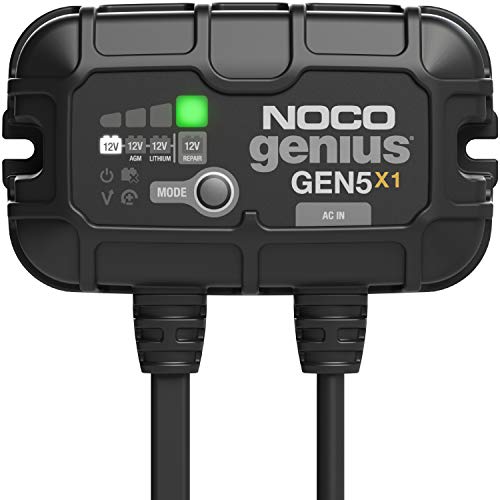
Best for compact mariners seeking a versatile single-bank charger. The GEN5X1 delivers 5A per bank and supports 12V lead-acid and lithium options, with modes for 12V, AGM, Lithium, and a repair mode. It’s praised for a compact size relative to power, making it ideal for smaller boats or spaces with limited installation room. A limitation is that it remains a single bank, so you’ll need additional units if you require multi-bank charging for separate battery banks.
NOCO Genius GENPRO10X1: 1-Bank, 10A Onboard Battery Charger

Best for users who need faster charging from a single bank. The GENPRO10X1 provides 10A per bank in one channel, offering quicker top-offs for larger starter or deep-cycle batteries. It supports 12V modes for AGM and lithium, plus a repair mode. The trade-off is a larger footprint than the GEN5X1, which may matter in tight installations. Choose this if you regularly charge bigger 12V packs and want speed without adding banks.
Marine Battery Charger 5X1 by FirstPower Pro

Best for all-around everyday use with 24/7 onboard charging capability. The 5X1 is designed for a broad mix of battery types (lead-acid, AGM, lithium, and calcium) and features IP68 waterproofing. It offers three charging modes and a force mode to revive deeply discharged batteries. However, the three-mode control may require a quick read of the manual to master mode toggling. It’s a solid pick for boaters who want a robust, all-condition charger in one unit.
ProMariner 44006 ProSport HD 6A

Best for users who want precise, distributed charging in a 6A single-bank unit. The ProSport HD uses microprocessor and software-controlled charging and distributes unused amps to batteries as needed. This makes it a good choice for boats with mixed battery needs or when you want efficient utilization of charging capacity. A potential limitation is its slightly older feature set compared to newer multi-mode competitors, though it remains a reliable, shipboard-friendly option.
KAISAL 2-Bank 20A (10A/Bank) IP67

Best for users needing two channels worth of charging in a single compact unit, with proven dual 10A channels. This model is compatible with LiFePO4, NCM lithium, and lead-acid batteries, making it versatile for mixed fleets aboard boats, RVs, or off-grid setups. A caution is that this option is a two-bank unit, so it technically exceeds the single-bank focus but can be useful if you anticipate upgrading to two banks without replacing your charger later.
VEVOR Marine Battery Charger, 1-Bank 5A
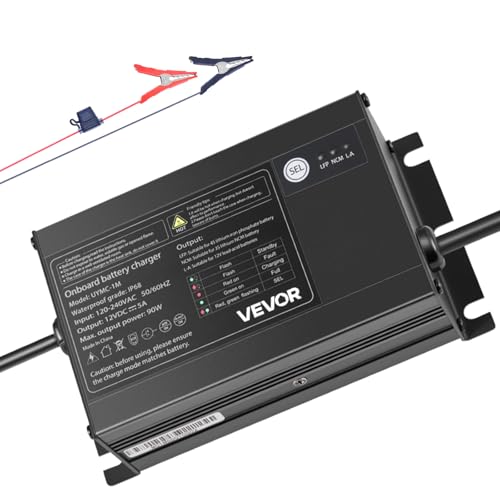
Best for boaters needingIP68-rated protection and smart charging for LiFePO4 and lead-acid. The VEVOR unit delivers stable 12V/5A output with three charging modes (LFP, NCM, L-A) and intelligent multi-stage charging. It is well-suited for marine environments with exposure to water and salt. A limitation is that its feature set may be less expansive than premium NOCO models, but it provides solid performance at a competitive price point.
Buying Guide: Key Purchase Considerations
- Battery type compatibility: Ensure the charger supports lead-acid, AGM, calcium, and lithium (including LiFePO4 and NCM) if you use mixed chemistries.
- Bank count and charging speed: Single-bank models focus on one battery at a time; higher amps per bank reduce charging time but may require more space and heat management.
- Waterproofing and ruggedness: For boats and open-water environments, IP68 or higher and robust corrosion resistance are important.
- Charging modes: Look for modes that match your battery type (12V, AGM, Lithium) and a repair or float mode for long-term maintenance.
- Temperature compensation: Temperature sensing improves battery safety and longevity in variable climates, especially on vessels exposed to sun and cold.
- Size and installation: Check dimensions and mounting options to fit consoles, battery compartments, or cramped bilge spaces.
- Safety features: Overcharge protection, short-circuit protection, and automatic shutoff help prevent battery damage and accidents at sea.
FAQ
- What is a single-bank onboard charger best for? – It is ideal for owners who have one main battery to charge, such as a boat’s starting battery or a single deep-cycle bank, with compact installation needs.
- Do these chargers work with lithium batteries? – Yes, most listed models support lithium chemistries like LiFePO4 and NCM, along with lead-acid options.
- Can I use a single-bank charger with multiple batteries? – It depends on the unit; a true single-bank charger focuses on one battery at a time. For multiple batteries, a multi-bank charger is usually better.
- Is IP68 waterproofing essential for marine use? – It is highly beneficial for exposed installations, as it resists water, dust, and salt in harsh marine environments.
- Should I choose a higher amperage charger? – Higher amps charge faster but require more space and generate more heat. Match amperage to battery capacity and space constraints.
- What maintenance practices are recommended with onboard chargers? – Keep connections clean, assess cables for wear, and periodically test the charger’s operation and safety features.