Best Air Conditioner Voltage Stabilizers for Home and Office
If you’re dealing with irregular power, a voltage stabilizer helps keep air conditioners running smoothly by smoothing out surges and dips. This guide highlights five reliable options suited for different needs, from compact single-appliance protection to high-capacity systems for whole rooms or small offices. Ideal buyers include homeowners wanting protection for a single A/C unit, renters needing portable protection, and small-business owners seeking steady voltage for multiple devices.
| Product | Best For | Key Benefit |
|---|---|---|
| SICWEDIM 6800W Voltage Stabilizer | Residential AC units | Fast response with high protection |
| SICWEDIM 15000W Voltage Stabilizer | High-power appliances | Large load handling and durable copper coil |
| QWORK 120V 1400W Surge Protector | Medium-size appliances | Safety cycle and clear LED indicators |
| Stopwatt SmartPlug Device (6-Pack) | Smart, multi-appliance protection | Plug-in stability with surge and leakage protection |
| Heavy Duty 5000W Voltage Stabilizer | Rugged, high-current devices | Copper coil and flame-retardant shell |
SICWEDIM 6800W Voltage Stabilizer

Best for: mid-sized homes with air conditioners and common household appliances. This wall-mounted, automatic stabilizer provides a 220V output and supports 120-280V input. It includes LCD display, six protection chips, and a copper coil for efficiency. Use this if you need reliable stabilization without waveform distortion and fast response.
Why selected: It balances price, performance, and durability for typical AC loads. The copper coil and heat-dissipation design extend service life and reduce overheating risks. A potential limitation is the single-device focus; for multiple heavy loads, consider a higher-capacity model.
SICWEDIM 15000W Voltage Stabilizer
Best for: households with high-power appliances or multiple large devices. This high-capacity stabilizer supports 120-280V input and 220V±5% output, backed by a pure copper coil and robust heat dissipation. Choose this if you need stable power for refrigerators, air conditioners, and computers simultaneously.
Why selected: It offers substantial load capacity and efficient operation. Limitation: larger footprint and higher cost than smaller stabilizers, which may be unnecessary for single-appliance use.
QWORK Voltage Protector 2-Pack

Best for: protecting large appliances such as air conditioners and freezers in homes or small offices. It provides surge and voltage fluctuation protection with a safety cycle that delays power to confirm voltage normalization. Real-time LED indicators show normal, high, and low voltage conditions.
Why selected: Clear status indicators and built-in delay help prevent damage from voltage spikes. Limitation: rated for 1400W per unit; for multiple high-load devices, you’ll need multiple protectors or a higher-capacity unit.
Heavy Duty Automatic Voltage Stabilizer 5000W

Best for: households with multiple high-current devices or single high-demand loads. It features a copper coil and a flame-retardant shell for safety, plus surge protection. This model aims to keep 150-260V input and 220V output within tight tolerances.
Why selected: Durable construction and copper coil deliver dependable performance under heavy loads. Limitation: size and weight may be greater than compact stabilizers intended for single appliances.
[ETL Listed] BSEED Surge Protector 2-Pack
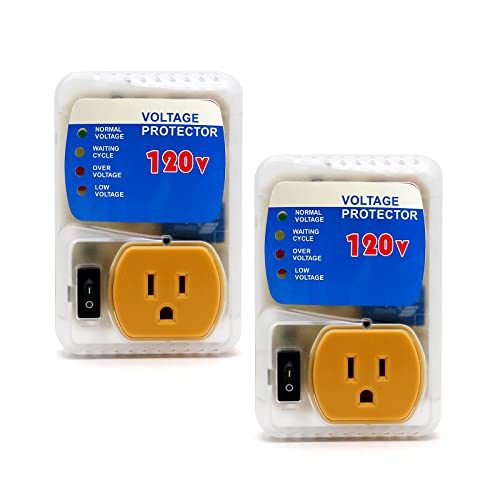
Best for: households needing adjustable protection for major appliances. The protector supports a 90-140V adjustable range and is designed to shield refrigerators, TVs, and other large devices from brownouts, spikes, and surges. It’s a practical choice for areas with unstable power.
Why selected: The adjustable voltage range provides flexible protection across devices with different operating voltages. Limitation: two-pack convenience may still require separate stabilization for high-demand loads beyond 1800W per outlet.
Buying Guide
What capacity do you need? Start with the total wattage of the devices you plan to protect. If you only stabilize a single air conditioner, a smaller unit (around 6800-9000W range) may suffice. For multiple high-power devices, choose 15000W or higher with robust copper coils for efficiency.
How important are safety features? Look for six-protection systems (over/under voltage, overcurrent, high/low temperature, reverse connection, lightning protection). A safety cycle delay can prevent sudden restarts that harm compressors.
What about indicators and ease of use? LCD displays and LED indicators help you monitor voltage status at a glance. Wall-mounted units save space; plug-in models offer portability for renters or temporary setups.
Single device vs multi-device protection: If you need to protect multiple appliances simultaneously, consider a higher-capacity stabilizer or multiple protectors with coordinated protection strategies. For a small apartment or office, a compact stabilizer with 6800-14000W capacity often provides the best balance.
Installation considerations: Ensure the stabilizer’s input and output voltage match your region’s standard (e.g., 120V or 220V). Verify wiring methods and ensure proper ventilation to avoid heat buildup during prolonged use.
FAQ
- What is a voltage stabilizer and why do I need one for my air conditioner? A voltage stabilizer maintains steady output voltage to protect your air conditioner from power surges and drops, which helps extend its life and reduces performance fluctuations.
- Can I use any stabilizer with any air conditioner? Compatibility depends on input/output voltage, load capacity, and wiring. Check the device’s rated input range and the appliance’s wattage before pairing.
- What does the six-protection system cover? It typically includes overvoltage, undervoltage, overcurrent, high/low temperature, reverse connection protection, and sometimes lightning protection.
- Is a higher wattage stabilizer always better? Not always. Choose a unit with sufficient headroom for all connected devices. Excess capacity can be costlier and bulkier, while too little capacity risks inadequate protection.
- Should I use a surge protector in addition to a voltage stabilizer? In many cases, a voltage stabilizer includes surge protection. If not, pairing with a dedicated surge protector adds protection against spikes.
- How do I know if my stabilizer is working correctly? Look for a stable output within the specified range, and monitor the indicator lights or LCD readout. If voltage fluctuates despite the device, consult support or replace it.