Best 25 Ft Heat Tape Options for Pipe Freeze Protection and Roof or RV Use
Answering the need for reliable, energy-efficient pipe freeze protection, a 25 ft heat tape offers long coverage for residential pipes, roofs, RVs, and more. These self-regulating cables help keep water flowing in subzero conditions by adapting output to ambient temperatures. This guide highlights five strong choices, suitable for homeowners, contractors, and campers who want automatic protection without manual adjustments. Read on to compare features, safety certifications, and installation considerations to pick the best fit for your climate and pipe material.
Product Snapshot (selected models):
- Toujreo 25FT Heat Tape with Thermostat – Self-regulating, ETL listed, 120V
- Cupohus 25FT Heat Tape with Digital Display Thermostat – 110–120V
- HEATIT 30ft Self-Regulating Pipe Heating Cable – ETL listed, 120V
- MAXKOSKO 30 Ft Heating Cable – Self-regulating, 120V
- BDDFOTO 25FT Heat Tape – IP65 waterproof, thermostat, 8W/ft
Toujreo 25FT Heat Tape With Thermostat
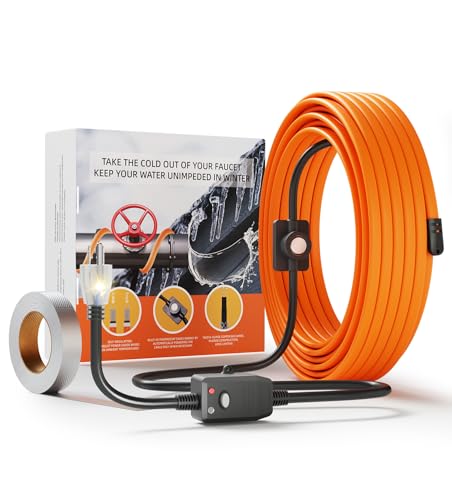
The Toujreo model uses a built-in thermostat to regulate heat, preventing overheating while protecting residential water lines. Best for homes in climates where winter temperatures regularly drop below freezing, and where a compact 25-foot run is sufficient for typical pipe layouts. It includes a built-in GFCI-friendly design on select lengths, enhancing safety in crawl spaces or outdoor installations. This model suits homeowners needing UL and ETL safety assurances. A potential limitation is that shorter configurations may be sold without integrated GFCI, depending on the exact kit.
Cupohus Heat Tape With Digital Display Thermostat

Cupohus combines a digital thermostat with a 25-foot heating cable designed to keep water lines above 15°C (59°F). It is suitable for homes that prefer real-time temperature readouts and a precise control interface. The model notes enhanced probe sensitivity and external GFCI protection to mitigate electrical risks in damp spaces. Choose this if you want clear temperature feedback and robust safety. A caveat is that the external GFCI may be required in certain outdoor installations, which could impact outlet selection.
HEATIT 30ft Self-Regulating Pipe Heating Cable

HEATIT offers a 30-foot self-regulating cable with ETL listing and a 2-foot power cord. It maintains flow down to -40°F (-40°C) and emphasizes full-system certification for safety. This option is better for longer pipe runs or where the thermostat control must cover extended lengths. It targets both residential and light commercial use, with robust warranty and safety assurances. A limitation is that some bundles require careful matching of cord length to the thermostat placement to maximize efficiency.
MAXKOSKO 30 Ft Heating Cable

MAXKOSKO delivers a 30-foot self-regulating heating cable designed to prevent freezing in metal and plastic pipes, with a 3-foot cord and total run length of 33 feet. It’s positioned as energy-saving due to automatic regulation, reducing overheating risk. This model is suitable for longer pipe segments or roof/attic routes where extended coverage is needed. A potential drawback is that the manufacturer notes a 3W/ft rating, which may impact total energy use in large installations compared to higher-watt alternatives.
BDDFOTO 25FT Heat Tape IP65 Waterproof

BDDFOTO’s 25-foot model emphasizes IP65 waterproofing and a self-regulating design with an 8W/ft rating. It includes a thermostat and a 3-foot power cord for straightforward installation. Best for outdoor or damp environments, such as roof lines or RV water systems, where water resistance matters. A limitation is that the 8W/ft rating can lead to higher electricity use in very large installations; plan your total length to balance performance with energy use.
Buying Guide
What should you consider when choosing a 25 ft heat tape?
- Temperature range and self-regulation: Choose models with automatic thermostat control to prevent overheating and conserve energy.
- Certification and safety: Look for ETL or UL listings; GFCI protection adds safety in wet areas.
- Installation flexibility: Self-adhesive or pre-assembled, with options for linear, spiral, or overlapped runs.
- Material compatibility: Ensure the tape is suitable for metal and/or plastic pipes in your system.
- Cord length: Confirm power and thermostat-to-plug distance fits your setup; some kits include short cords while others extend to 3–15 ft.
- IP rating and weatherproofing: For outdoor installations, IP65 or better helps withstand rain and snow.
What’s the right choice for different buyers?
- Best for budget-conscious homes: Models with standard 25 ft coverage and reliable self-regulation while keeping costs predictable.
- Best for outdoor roofs or gutters: IP65 waterproofing and longer cord runs improve durability in exposed environments.
- Best for RVs or temporary setups: Compact installations with plug-in simplicity and quick setup are ideal.
- Best for long pipe runs: 30 ft options deliver extended coverage, reducing gaps in heat delivery along the line.
Installation tips and safety reminders
- Follow manufacturer instructions for straight, spiral, or overlapped wrapping to ensure uniform heating.
- Avoid direct contact with flammable materials and keep cords clear of sharp edges or pinch points.
- Test operation before winter storms by powering on briefly to confirm heat activation and temperature regulation.
Quick reference buying considerations
| Model | Best For | Key Benefit | Potential Limitation |
|---|---|---|---|
| Toujreo 25FT | Residential lines | Thermostat and safety features | GFCI presence depends on length |
| Cupohus 25FT | Real-time temperature readouts | Digital display | GFCI requirement varies |
| HEATIT 30ft | Longer runs | ETL listed, keeps flow to -40°F | |
| MAXKOSKO 30 Ft | Extended coverage | Self-regulating, energy saving | |
| BDDFOTO 25FT IP65 | Damp outdoor or roof lines | IP65 waterproofing | Higher wattage per foot may raise energy use |
FAQ
- What is self-regulating heat tape?
– It uses a built-in thermostat that adjusts heat output based on ambient temperature to prevent overheating and save energy. - Do all 25 ft heat tapes require GFCI outlets?
– Not always; some models include GFCI protection, while others do not. Check the product details for your chosen length. - Can I install heat tape on plastic pipes?
– Yes, many models are compatible with both metal and plastic pipes, but verify the manufacturer’s compatibility notes before installation. - Is IP65 waterproofing important for roof installations?
– Yes, IP65 helps protect the cable from water jets and weather exposure, increasing reliability outdoors. - How do I determine the right wattage per foot?
– 3–8W/ft is common; higher wattage provides faster warming but can increase energy use. Choose based on climate severity and pipe length. - What installation patterns are recommended?
– Linear, spiral, or overlapped wrapping maximize contact with the pipe and promote even heating.