Best 100 Ft Copper Tubing for HVAC and Refrigeration Applications
Answering the most common buyer question: which 100 ft copper tubing is best for refrigeration, air conditioning, and DIY HVAC projects? This guide highlights five practical options, focusing on size options, material quality, and installation suitability. The products below are best for professionals, DIY enthusiasts, and hobbyists who need reliable, long-lasting copper coils for refrigerant lines and line sets. A quick buying table ahead helps compare key specs at a glance.
| Product | Size (OD x ID) | Length | Best For |
|---|---|---|---|
| GOORY Copper Tubing 1/4″ x 100 Ft | 1/4″ OD x 0.195″ ID | 100 ft | Small refrigerant lines, compact DIY projects |
| GOORY Copper Tubing 3/8″ x 100 Ft | 3/8″ OD x 0.312″ ID | 100 ft | Medium refrigerant runs, home HVAC tweaks |
| GOORY Copper Tubing 1/2″ x 100 Ft | 1/2″ OD x 0.445″ ID | 100 ft | Longer runs, more demanding systems |
| ELECTRAPICK Copper Tubing 1/4″ x 100 Ft | 1/4″ OD x 0.195″ ID | 100 ft | Budget-friendly DIY projects, light commercial tasks |
| VEVOR 100ft Mini Split Line Set | 1/4″ and 3/8″ OD configurations | 100 ft (coil set) | Mini-split installations, new build or retrofit |
GOORY Copper Tubing 1/4″ OD x 100 Ft

Dimension: 1/4″ OD x 0.195″ ID, 100 ft length, wall thickness 0.028″ (0.7 mm). Seamless, coil configuration. Best for compact refrigerant circuits and small DIY projects where tight routing matters. The tubing uses annealed UNS C12200 copper and adheres to ASTM B280. It offers good thermal conductivity and durability. Nitrogen charged treatment helps resist oxidation and impurities, extending service life. Caution: smaller diameter may limit high-volume refrigerant flow in larger systems.
GOORY Copper Tubing 3/8″ OD x 100 Ft

Dimension: 3/8″ OD x 0.312″ ID, 100 ft. Seamless, coil design with 0.8 mm wall. Made from annealed UNS C12200 copper and ASTM B280 compliant. Nitrogen charged treatment enhances oxidation resistance and impurity removal. Suitable for medium-radius runs in HVAC and refrigeration. Limitation: thicker wall means slightly stiffer tubing, which can be harder to bend for complex routes.
GOORY Copper Tubing 1/2″ OD x 100 Ft

Dimension: 1/2″ OD x 0.445″ ID, 100 ft length, wall thickness 0.028″ (0.7 mm). Seamless coil, suitable for longer refrigerant runs. It uses UNS C12200 copper and complies with ASTM B280. Nitrogen charged treatment supports longer lifespan by reducing oxidation and preventing condensation. Best for larger systems or when longer line sets are necessary. Caution: larger diameter requires more bending space and proper tooling during installation.
VEVOR 100ft Mini Split Line Set
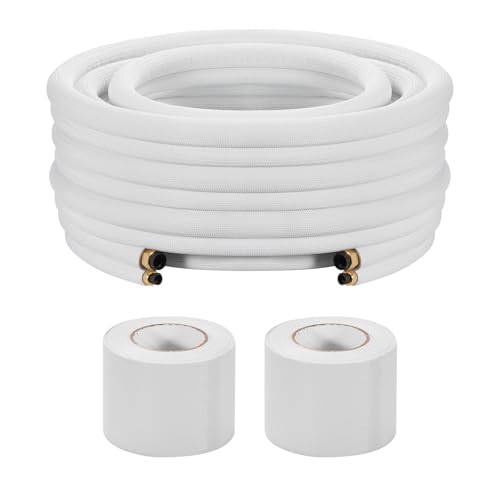
Configuration includes 1/4″ liquid line and 3/8″ suction line with thickened white PE insulation. Rated for high pressure up to 850 PSI, surpassing typical R410A operating ranges. The set is designed for mini-split installations and can simplify routing through walls. Best for new mini-split projects or retrofits needing a reliable, ready-to-install line set. Limitation: coil sets may require careful inspection for leaks and proper insulation in extreme climates.
Easier Buying Guide: Key Purchase Considerations
- Size compatibility: Match the copper tube OD and ID to your system’s fittings and manifolds. Smaller OD is easier to route in tight spaces; larger OD carries higher refrigerant flow.
- Material quality: Look for UNS C12200 copper and ASTM B280 compliance for durability and consistent performance in HVAC environments.
- Wall thickness and flexibility: Thicker walls offer better durability but can be stiffer to bend. Consider your installation path and required bends.
- Treatment and oxidation resistance: Nitrogen charged treatments reduce oxidation and extend service life, especially in condenser and outdoor runs.
- Length and coil format: 100 ft coils are convenient for longer runs but check if you need multiple pieces or a single continuous length.
- Insulation (where applicable): For line sets, insulation reduces heat gain and condensation; ensure compatibility with your system’s insulation needs.
- Compatibility with mini-split systems: If installing a mini-split, ensure the line set size matches the unit’s connections and that nuts and fittings are included if needed.
Buying Considerations by Scenario
- Residential HVAC retrofit: Choose 1/4″ or 3/8″ tubes for standard refrigerant runs; consider 1/2″ for longer or higher-demand routes.
- New mini-split installations: Look for pre-insulated line sets with standard 1/4″ and 3/8″ configurations and compatible flare nuts.
- DIY projects: A versatile 1/4″ or 3/8″ coil is typically easiest to handle; ensure coil length meets your planned layout.
- Professional HVAC service: Reliability and durability matter most; prioritize UNS C12200 copper with nickel or nitrogen treatments for longevity.
Frequently Asked Questions
- What does OD and ID mean in copper tubing?
– OD is the outer diameter; ID is the inner diameter. They determine flow capacity and connector compatibility. - Why is nitrogen charged treatment important?
– It helps prevent oxidation and removes impurities, potentially extending the tube’s lifespan in HVAC environments. - Can I bend 1/2″ copper tubing easily?
– Heavier-wall tubing is stiffer and requires proper bending tools or fittings to avoid kinks. - Is 100 ft of tubing sufficient for most installations?
– It covers many standard runs, but larger systems may require multiple coils or longer lengths. - Which size should I pick for a mini-split system?
– Most mini-splits use 1/4″ liquid lines and 3/8″ suction lines; ensure your coil matches these sizes. - Are there safety or warranty considerations?
– Follow local codes for refrigerant handling and installation. Confirm that tubing meets ASTM B280 requirements for reliability.