Best Old School 200 Amp Battery Charger Guide
Answering the need for rugged, high-current battery charging and engine-starting, these 200A units are ideal for larger batteries and emergency starts. They suit shop floors, fleet owners, hobbyists, and anyone who values quick starts and robust charging under demanding conditions. The top picks emphasize reliability, straightforward manual control, and strong engine-start performance. Below is a concise buyer’s guide for five strong options, followed by detailed product sections and a practical buying guide with questions to help you compare models.
| Product | Best For | Key Benefit |
|---|---|---|
| Schumacher SC1446 | Hands-on users who need quick starts | 2-in-1 charging and engine starting with a 135-minute timer |
| Schumacher SC1633 | Multiple charging modes for 12V/24V systems | 200A start, 50A boost, 25A/10A/12V-24V charging options |
| STANLEY BC200F | Steady maintenance and engine starts for 12V fleets | 40A charging, 200A engine start, voltage maintenance |
| Schumacher SC1353 | All-in-one maintenance and testing | 4-in-1 device with testing, reconditioning, and alternator checks |
| DEWALT DXAEC200 | Professional maintenance with alternator check | 200A engine start, 40A charging, 3A maintainer, reconditioning |
Schumacher SC1446 200A Start-Charge 2-in-1

Features a 2-in-1 device that starts and charges batteries, delivering 200-amp engine start and 40-amp boost. It also offers 20-amp and 10-amp charging options for 12V and a 6V/12V boost, with a precise 135-minute timer for controlled charging. Best for enthusiasts who want rapid engine starts and straightforward, manual control. Caution: heavy-duty use requires access to a stable 12V source and sufficient workspace.
Who it’s best for: Auto, marine, and power-sport owners who need reliable, immediate power for stubborn batteries and a clear timer-based charging process.
Why selected: It combines high-start power with a practical charging spectrum and an easy-to-use timer, making it a solid all-around option for demanding battery tasks.
Caution: The device is powerful; ensure proper safety procedures and ventilation during use.
Associated US20 6/12V Value Battery Charger

This value charger focuses on 6V/12V operation with an American-made build. It’s a simpler option for basic charging needs and steady performance, suitable for typical 12V car batteries, small boats, or lawn equipment fleets where advanced features aren’t required. Best for budget-conscious buyers who want a dependable, straightforward charger.
Who it’s best for: Everyday drivers and hobbyists who primarily need reliable 12V charging without extra modes or engine-start functions.
Why selected: Its simplicity and country-of-origin build can appeal to buyers prioritizing reliability and straightforward operation.
Caution: Lacks high-current start features found in premium models; plan for slower restoration of deeply discharged batteries.
Schumacher SC1633 200A 12V/24V Dual-Mode
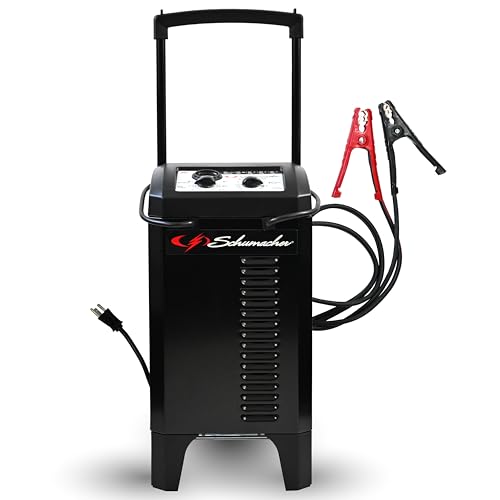
Offers a 2-in-1 device with engine start and charging, including 200A start power, 50A boost, and 12V/24V charging options of 25A, 10A, and 2-amp maintenance. A 135-minute timer provides precise control over charging stages. Best for users who need flexibility across multiple battery systems while maintaining high readiness for engine starts. Caution: heavier than portable models; requires proper setup space.
Who it’s best for: Fleet operators and gearheads who work with various 12V/24V battery configurations and need rapid engine starts plus multi-rate charging.
Why selected: The expanded charging modes and dual-voltage compatibility make it a versatile choice for mixed battery inventories.
Caution: Not ideal for very small hobby kits where space or weight is a constraint.
Schumacher SC1309 6-In-1 Automatic Battery Charger
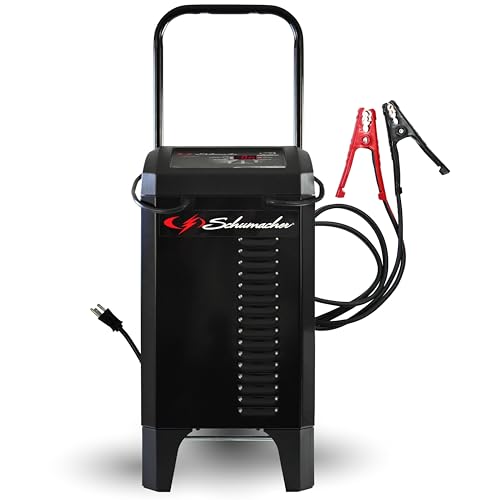
This 6-in-1 unit combines starting, charging, maintaining, testing, alternator testing, and reconditioning. It delivers 200A engine starts, 40A boost, and 6A to 2A charging while maintaining 6V/12V batteries. Smart trickle charging helps prevent overcharging during long-term maintenance. Best for garages that require a compact, all-in-one tool with diagnostic capabilities. Caution: higher feature set may introduce a steeper learning curve for new users.
Who it’s best for: Technicians and DIY enthusiasts who want not just charging but battery health diagnostics in one device.
Why selected: The combination of maintenance features and alternator testing offers deeper battery care in a single unit.
DEWALT DXAEC200 200A Charger with Maintainer

Professional-grade rolling charger with 200A engine start, 40A charging, and 3A maintainer. It also includes a battery reconditioner to assess if a battery can accept a charge and enhance longevity. Best for heavy-duty use where ongoing battery monitoring and reconditioning are valuable. Caution: heavier and bulkier than consumer models, requiring ample workspace and maneuverability.
Who it’s best for: Fleets, shops, or contractors who demand rigorous engine starting power and ongoing battery health checks.
Why selected: The reconditioning capability and dedicated maintainer add preventive care to the charging workflow, extending battery life in tougher applications.
Buying Guide
What matters most in a 200A battery charger
Consider engine-start capability, charging current ranges, and whether you need multi-voltage support (12V/24V). If you regularly start large engines or work with marine batteries, prioritize higher-start power and robust safety features.
Do you need a maintainer or reconditioning feature?
A maintainer helps preserve battery health over time, while a reconditioner can revive slightly sulfated batteries. If your batteries sit idle for long periods, a maintainer is beneficial; for aging batteries, look for reconditioning options.
Portability vs. on-site reliability
Wheeled designs improve mobility for shop use, but can be heavier. If you’re working on a single location, a stationary unit with strong clamps may suffice. For field or garage use, prioritize a wheeled model with easy maneuverability.
Safety and monitoring features
Look for clear indicators, automatic shutoff when fully charged, and protection against overcharging. A built-in voltmeter or ammeter can help you monitor battery status in real time.
Compatibility notes
Check compatibility with your typical batteries (lead-acid, AGM, flooded, or gel types) and ensure the unit supports the voltage range you use most (6V, 12V, and sometimes 24V).
FAQ
What is the advantage of a 200A engine start on a battery charger?
High engine-start power helps turn over stubborn or high-displacement engines quickly, reducing the risk of a stalled start.
Should I get a charger with a built-in tester or reconditioner?
If you maintain multiple vehicles and want to verify battery health, a tester or reconditioner adds diagnostic value and can save time.
Is a 135-minute timer common on these chargers?
Many manual and semi-automatic models offer a timer to control charging stages. This helps prevent overcharging and guides manual charging cycles.
Are these chargers safe for marine batteries?
Yes, most models support marine batteries, but check the manufacturer’s specifications for proof of compatibility with flooded or AGM marine cells.
Do these units work for 24V systems?
Some models support 24V or dual-voltage configurations; verify the specific product’s voltage compatibility in its specifications.
What maintenance should I perform after use?
Disconnect power, inspect clamps for corrosion, store in a dry place, and periodically test the unit to ensure safe operation.