Best Portable 220V Solar Panels for Off-Grid Power and RVs
Powered, reliable, and compact 220V-capable solar panels meet the needs of campers, boaters, and off-grid homeowners. This guide highlights five top options, each suited to different buyers—from RV enthusiasts to emergency-prepared households. Read on to compare efficiency, durability, and ease of use to choose the right 220V portable solar kit for your setup.
| Product | Best For | Key Benefit |
|---|---|---|
| 200 Watt Solar Panel 18BB (Rvpozwer) | RVs, Rooftop Installations | High efficiency with N-Type cells |
| SOKIOVOLA N-Type 16BB 220W | Outdoor Camping, Power Stations | Foldable design, IP68 waterproof |
| ZOUPW 220W N-Type 16BB | Power Stations, RVs | IP67 waterproof, universal compatibility |
| 2 Pack 2×4 LED Flat Panel Light | Indoor/Backup Lighting | Emergency battery backup |
| 200W Portable Solar Panel for Power Station (TWELSEAVAN) | Emergency and Travel | Multi-port charging and fast outputs |
200 Watt Solar Panel 18BB By Rvpozwer Store

Best for RVs and rooftop setups, this 200W panel uses N-Type solar cells with 25% conversion efficiency. EL tested for reliability and delivers roughly 1000 watt-hours per day under typical sun. It features 18BB technology for improved longevity over older cell designs. Pre-drilled back holes simplify mounting with various brackets. This option is ideal for owners seeking high efficiency in a rigid, weather-ready panel. Potential limitation: heavier panel weight compared to some foldable models.
SOKIOVOLA N-Type 16BB 220W Folding Panel

Best for campers and RVers who need portable power on the go, this 220W foldable panel weighs about 17 pounds and folds to a compact size. It uses A+ grade mono cells for up to 25% efficiency and includes a durable ETFE layer for outdoor durability. Best for short trips where portability matters; avoid if you require ultra-lightweight gear for long hikes, as it remains heavier than some pocket-size options.
ZOUPW 220W N-Type 16BB Portable Panel

Best for power stations and off-grid setups requiring wide compatibility, this 220W N-Type panel features IP67 waterproofing and a versatile 5-in-1 cable set for easy connection to most solar generators. It uses A+ monocrystalline cells for solid efficiency. The caveat: the junction box is not waterproof, so keep it dry in wet environments.
TWELSEAVAN 200W Portable Solar Panel
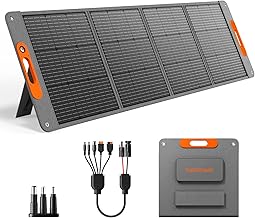
Best for a versatile power station setup, this 200W panel uses high-efficiency monocrystalline cells with 24% conversion and an ETFE laminated case for durability. It includes an 8-in-1 MC4 converter and multiple DC adapters, plus 60W USB-C and 18W QC3.0 fast charging ports. Choose this if you want broad compatibility and the ability to charge devices directly. Limitation: larger footprint compared to ultra-compact panels, may require more storage space.
Buying Guide: Key Purchase Considerations
What should I look for in a 220V portable solar panel?
- Efficiency: Higher percentage efficiency (like 24–25%) means more usable power from the same sunlight.
- Panel type: N-Type cells offer better performance and longevity than some older cell designs.
- Portability: Foldable panels save space; rigid panels are typically more durable but heavier.
- Durability: ETFE coating and IP ratings (IP67/IP68) indicate weather and dust resistance for outdoor use.
- Compatibility: Check connectors and cables (MC4, XT60, Anderson, etc.) to match your power station or inverter.
- Junction box protection: Some panels have non-waterproof junction boxes; plan for dry storage or cover in rain.
Buying considerations by scenario:
- RVs and rooftop use: Prioritize rigid panels with pre-drilled mounting holes and high efficiency, like the 200W options with N-Type cells.
- Outdoor camping and remote trips: Foldable designs with IP67/IP68 waterproofing offer portability and ruggedness.
- Power stations and emergency power: Panels with multi-port outputs and broad compatibility can simplify charging multiple devices.
Frequently Asked Questions
- What does N-Type mean in solar panels?
Answer: N-Type refers to a newer cell structure that reduces recombination losses, often improving efficiency and longevity. - Can these panels charge a 220V system?
Answer: They are designed to work with 12V–24V systems; an inverter or charge controller is needed to convert to 220V AC where required. - Are foldable solar panels as durable as rigid panels?
Answer: Foldable panels are portable but may have more moving parts; look for ETFE lamination and robust hinges for durability. - What is the typical daily energy yield for a 200W panel?
Answer: Roughly 800–1000 Wh per day under average sun conditions, depending on location and weather. - Do these panels require maintenance?
Answer: Routine checks on cables and connectors are recommended; keep junction boxes dry and clean.