Best Ethernet to RS485 Adapters for Seamless Serial Over IP
The best Ethernet to RS485 adapters turn serial data into IP packets for reliable remote monitoring, control, and data collection. This guide highlights five solid choices suited for different needs, from industrial IoT gateways to versatile dual-port serial servers. Ideal buyers include network administrators, factory floor technicians, and anyone integrating legacy serial devices with modern Ethernet networks. Below is a quick overview table of the selected products to help you compare at a glance.
| Product | Best For | Key Benefit |
|---|---|---|
| USRCN USR-TCP232-306 Serial to Ethernet Device Server | Cost-conscious setups | HTTP data format and wide power range |
| USR-TCP232-410S Dual Serial Server | High flexibility | Two serial ports with concurrent RS232 and RS485 |
| waveshare Ethernet Industrial Serial Server | Modbus/IoT gateways | Multiple protocols and modes, robust industrial design |
| PUSR TCP232-306 RS232/RS485/RS422 Gateway | Modbus RTU to TCP | Low latency TCP/IP with Modbus conversion |
| LINOVISION Dual Ports Serial Server | Remote monitoring | Multi-host polling and versatile Modbus gateway |
USR-TCP232-306 Serial to Ethernet Device Server

Best for budget-conscious environments needing a simple serial-to-Ethernet bridge. The USR-TCP232-306 supports HTTP data formatting and a broad 5-36V DC power range, making it suitable for retrofitting older equipment without a dedicated power supply. It is ideal for small shops, kiosks, and test benches where basic Ethernet connectivity to RS232 or RS485 devices is sufficient.
- Best for: Basic serial devices needing Ethernet access with straightforward HTTP data transmission.
- Limitations: May lack advanced IoT protocol support found in higher-end gateways.
USR-TCP232-410S Dual Serial Server
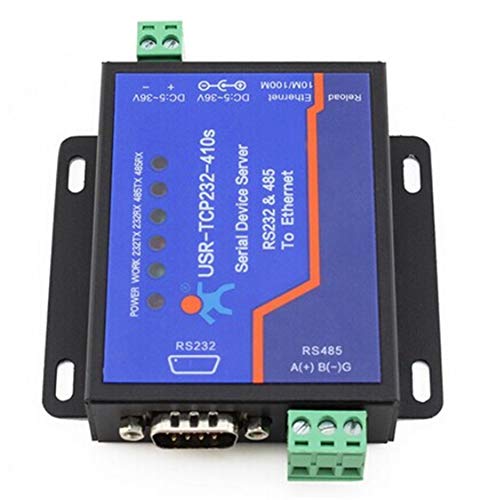
Best for multi-device environments requiring simultaneous RS232 and RS485 operation. The 410S houses two serial ports and supports both RS232 and RS485 concurrently, with web configuration or virtual COM software. It’s a strong choice for small plant floors or labs deploying Modbus RTU to IP and cloud connections. Data can be accessed via Modbus RTU, Modbus TCP, or JSON over MQTT/TCP/UDP/HTTP.
- Best for: Mixed-serial setups needing concurrent RS232 and RS485 access.
- Limitations: Higher energy consumption than ultra-compact models.
waveshare Ethernet Industrial Serial Server

Best for industrial environments needing Modbus gateway capability and versatile communication modes. This gateway supports multiple protocols including Modbus gateway, MQTT gateway, and RS485 to JSON, enabling robust data integration across different systems. It can operate in TCP server/client, UDP, or HTTPD client modes and supports dynamic IP via DHCP/DNS. It is rails-friendly for scalable installations.
- Best for: Industrial setups requiring Modbus and MQTT integration with flexible network modes.
- Limitations: Modbus protocol support is noted as not available in some models; verify your exact variant.
PUSR TCP232-306 RS232/RS485/RS422 Gateway

Best for versatile Modbus gateway needs with broad protocol support. The 306 gateway uses an ARM Cortex-M0 core with a highly optimized TCP/IP stack, enabling Modbus RTU to Modbus TCP translation and multi-host polling. It’s suitable for networked control rooms or facilities needing reliable serial-to-TCP bridging with efficient data handling.
- Best for: Modbus RTU to TCP bridging with low latency needs.
- Limitations: Requires careful configuration to maximize the multi-host polling features.
LINOVISION Dual Ports Serial Server
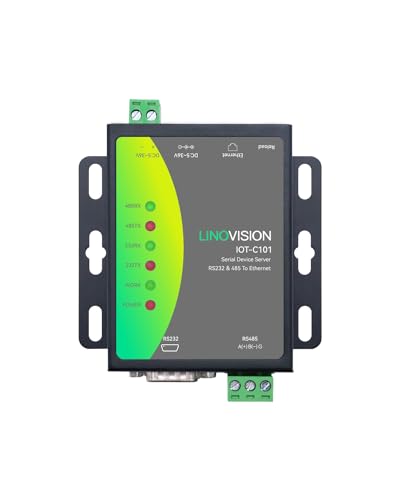
Best for remote monitoring with multi-host polling and a robust Modbus gateway. The LINOVISION device supports RS232 and RS485 to Ethernet and enables Modbus RTU/TCP conversion. It’s advantageous for environments like POS systems, greenhouses, and process controls where multiple devices require network visibility and centralized data collection.
- Best for: Remote monitoring across multiple hosts with Modbus gateway support.
- Limitations: Interface performance is tied to the specific hardware revision; check compatibility with existing RS-232/RS-485 devices.
Buying Guide: Choosing the Right Ethernet To RS485 Adapter
What is your network layout?
Consider whether you need a simple single-port bridge or a dual-port gateway that can handle RS232 and RS485 concurrently. For small setups, a single-port device may suffice; for factory floors, dual-port or multi-port gateways improve efficiency.
Do you need Modbus or MQTT support?
Many industrial adapters provide Modbus RTU/TCP or MQTT gateways. If your system relies on Modbus for sensor networks or PLCs, prioritize gateways with Modbus compatibility and easy configuration.
What about power and environmental conditions?
Look at the operating voltage range and environmental specs. Industrial environments may require extended temperature tolerance and stable power options, such as redundant power or wide input ranges.
How will you configure and manage devices?
Devices offer web-based configuration, command-line interfaces, or virtual COM software. Choose based on your IT team’s familiarity and the need for remote management. Web configuration often provides quick setup, while MQTT/TCP options support IoT architectures.
Future-proofing and scalability
Assess whether the gateway can handle growing networks, multiple hosts, or future protocol needs. Features like multi-host polling, DHCP/DNS, and JSON output can ease scalability and integration into cloud or on-premise systems.
Safety and reliability considerations
Opt for devices with stable TCP/IP stacks, watchdog features, and clear documentation. Redundant or secure power options reduce downtime, especially in critical monitoring environments.
Frequently Asked Questions
- What is an Ethernet to RS485 adapter used for? It bridges RS485 serial devices to an Ethernet network, enabling remote monitoring, control, and data collection.
- Can these adapters support Modbus? Many listed models offer Modbus RTU to TCP gateways or Modbus gateways; verify the exact model’s protocol support before purchasing.
- Do these devices require special software? Some provide web consoles or virtual COM software for configuration; others may use standard TCP/IP or MQTT for integration.
- Are dual-port adapters better than single-port? Dual-port devices allow simultaneous RS232 and RS485 connections, which can improve efficiency in mixed-device environments.
- How do I choose between TCP and UDP modes? TCP provides reliable data delivery, while UDP offers lower latency and is suitable for time-sensitive telemetry when reliability is managed at the application level.
- Do these gateways support remote management? Many options support network-based management via web interfaces, MQTT, or cloud APIs; check each model’s management features.