Best Marine Alternator Battery Chargers for Boat Power and Reliability
If you need a reliable marine battery charging solution, this guide highlights top options that work well with alternator-powered systems and deep-cycle batteries. These chargers are suitable for saltwater boats, freshwater craft, and dockside setups. The best pick is determined by battery type compatibility, charging speed, weather resilience, and onboard integration. This overview helps boaters choose a charger that protects battery life while keeping marine electronics ready.
Summary Table of Selected Products
| Product | Best For | Key Benefit | Notes |
|---|---|---|---|
| NOCO GENIUS1 1A 6/12V | Small boats and solo systems | Precision temp compensation, desulfator | Best for single-battery setups |
| Victron Orion XS Smart 50A | Dual battery with strong alternator support | High efficiency and IP65 protection | Best for complex systems |
| NOCO GEN5X2 12V 10A 2-Bank | Two-battery boats | Two independent banks, flexible modes | Best for redundancy |
| PZ.P 15A 12/24V Smart Charger | Versatile 12/24V systems | 9-stage charging with temperature compensation | Best value with real-time monitor |
| DEWALT DXAEC100 30A | Larger engines and multiple batteries | Engine start high current, LCD display | Best for heavy-duty needs |
NOCO GENIUS1 1A 6/12V Smart Battery Charger

The NOCO GENIUS1 is a compact, all-in-one charging solution designed for 6V and 12V lead-acid and lithium batteries, including marine and powersport configurations. It combines charging, maintenance, trickle, and desulfation in one unit. This makes it ideal for small craft, tenders, or boats with a single battery bank. The integrated thermal sensor automatically adjusts charging to ambient temperatures, helping prevent overcharge in heat and undercharge in cold conditions. This device emphasizes safe, precise charging rather than brute force power.
Who it’s best for: boaters with a single battery bank who prioritize protection from overcharging and want a compact charger that travels well on small vessels. Better for maintaining a healthy battery while dockside or during seasonal layups. Caution: it’s a 1-amp unit, so charging speed is modest for larger starter batteries.
Victron Energy Orion XS Smart DC-DC Charger
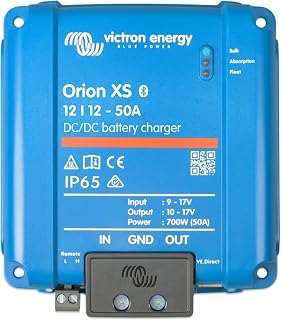
The Orion XS is a high-efficiency DC-DC charger engineered for dual-battery systems charged by intelligent alternators. With an impressive 98.5% efficiency and a continuous 700W output, it maintains stable voltage while minimizing heat. Its IP65 enclosure adds protection against dust and water exposure, making it suitable for exposed marine installations. The charger is fully configurable, allowing precise input/output adjustments to match battery chemistry and alternator capabilities.
Who it’s best for: boat owners with dual batteries or a complex electrical system that requires reliable, adjustable charging from the alternator. Better for demanding environments where heat, vibration, and moisture are concerns. Caution: the setup may be more complex for users new to marine electrical systems.
NOCO GEN5X2 12V 10A 2-Bank OnBoard Charger

The GEN5X2 provides two independent charging banks at a combined 10 amps, with each bank rated at 5 amps. It is designed for marine environments and includes IP68 waterproofing, overcharge protection, and temperature compensation. Modes for 12V lead-acid and Li-ion batteries cover a wide range of battery chemistries, including AGM, GEL, SLA, and LiFePO4. This makes it a versatile choice for boats running multiple battery packs or essential systems.
Who it’s best for: boats needing two separate charging channels for reliability or charging two distinct battery banks. Better for larger vessels or systems where independent maintenance and charging are required. Caution: higher amperage may require careful fuse/guarding in small setups.
PZ.P 15A 12/24V Smart Battery Charger

The PZ.P charger offers 9-stage charging with temperature compensation and supports 12V and 24V LiFePO4 and lead-acid batteries. It provides a color screen with real-time monitoring of voltage, current, temperature, charge percentage, and mode (summer/winter). The extended 6.7-foot charging cable adds convenience for hard-to-reach batteries. This unit is well-suited for boats with varied battery chemistries and longer cable runs.
Who it’s best for: boaters who want a robust, easy-to-read charger with real-time status and support for both LiFePO4 and lead-acid batteries. Better for installations where monitoring clarity is important. Caution: while feature-rich, setup may be more involved for very small or simple systems.
DEWALT DXAEC100 30A Battery Charger

The DEWALT DXAEC100 provides strong 30A charging plus a 3A maintainer and 100A engine-start capability. It supports 12V lead-acid batteries (Wet, Gel, AGM) and is designed for demanding marine and vehicle applications. An LCD display gives a clear view of charging progress, maintenance status, and battery health. This charger is a solid choice for larger boats with multiple high-demand systems and battery banks.
Who it’s best for: users with larger engine investments or multiple batteries that require high-current charging and reliable engine-start assistance. Better for heavy use and longer charging sessions. Caution: higher amperage means more power draw and potentially more heat in tight spaces.
Buying Guide: Key Considerations For Marine Battery Chargers
What battery types do you need to support? Consider whether you require lead-acid, AGM, GEL, or LiFePO4 compatibility. Some chargers handle multiple chemistries, which adds flexibility for mixed-battery systems on boats.
How many battery banks or circuits will you charge? For single-battery systems, compact models like the GENIUS1 may suffice. For dual or multi-bank setups, look at two-bank or DC-DC options such as the GEN5X2 or Orion XS to prevent cross-interference and ensure proper maintenance modes.
What is the environment and installation like? IP ratings (water/dust protection) and enclosure robustness matter on exposed decks or engine rooms. Temperature compensation is essential in climates with wide temperature swings.
Do you need real-time monitoring or display data? Some chargers include color screens andUSB/monitoring features to track voltage, current, and battery health. This helps with ongoing maintenance and troubleshooting.
What about safety and protection? Overcharge protection, desulfation modes, and thermal sensors reduce risk to batteries and electrical systems. Consider units with automatic shutoffs during fault conditions to prevent damage.
Compatibility with alternators and charging systems is crucial. Some DC-DC chargers are designed to work with intelligent alternators and protect the starting battery while charging the auxiliary bank, which helps to optimize performance on boats with complex electrical layouts.
Frequently Asked Questions
- What size charger should I use on a marine starting battery? A charger with enough amperage to reach full charge within the boat’s typical usage cycle is ideal. Start with a charger that matches the battery’s capacity and use a model with temperature compensation for stability.
- Can I use a marine charger to maintain batteries during storage? Yes. Many chargers include a trickle or float mode to keep batteries at optimal charge without overcharging during storage.
- Is an IP68 or IP65 rating necessary for marine use? For exposed locations or frequent splashing, higher protection ratings reduce risk from water and salt exposure. IP65 is common for reliable marine installations; IP68 provides added protection.
- Should I pick a 1-bank or 2-bank charger? Choose based on the number of batteries you actively manage. Two-bank units improve reliability and allow independent maintenance without cross-charging.
- Do these chargers work with LiFePO4 batteries? Many listed models support LiFePO4 in addition to lead-acid chemistries. Confirm specific compatibility with your battery type before purchase.
- Will a higher amperage charger harm my alternator? Modern smart chargers regulate current to avoid overloading the alternator. Use models with safeguards and consider a DC-DC charger if you need to protect the starting battery while charging a separate bank.