Best Lux Meter for Measuring LED Lighting: Accurate Readings for Every Space
Answering the need for precise light measurements, this guide highlights five top lux meters tailored for LED applications. The best options suit photographers, gardeners, facility managers, and hobbyists who require reliable lux (and often fc) readings in indoor environments. Each product section explains who it’s best for and why, plus a practical caveat to consider before purchase.
Summary of chosen products
| Product | Best For | Key Benefit | Approximate Range |
|---|---|---|---|
| Dr.meter LX1330B | Gardeners & indoor growers | Fast, precise readings with FC/LUX toggle | 0–200,000 Lux |
| BTMETER BT-881D | Pro users needing wide range | Very wide range with 0.01 Lux resolution | 0.01–400,000 Lux |
| Triplett LT80 | Professional lighting assessments | Min/Max/Avg; broad source compatibility | 0–400,000 Lux |
| TOPTES TS-710 | Plant care & studios | 180° rotating sensor; backlit display | 0.1–200,000 Lux |
| LATNEX LM-50KL | Industrial & photography setups | Large LCD; data hold; long battery life | 200–200,000 Lux |
Light Meter Digital Illuminance Meter Handheld Ambient Temperature Measurer
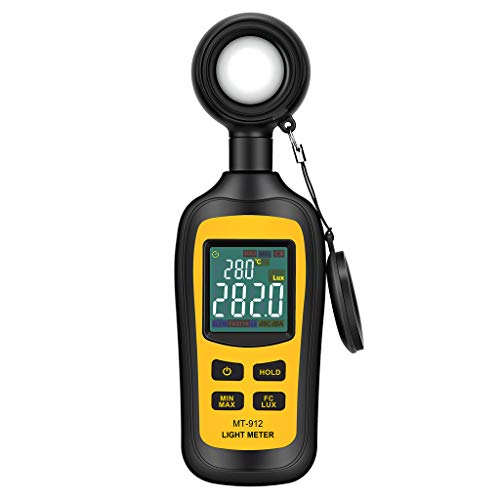
Best for general-purpose LED testing and ambient measurements. This URCERI device covers a wide 0–200,000 Lux range and adds ambient temperature readings, useful for environments where temperature affects light output. It features a 4-digit color LCD, MIN/Max logging, data hold, auto power off, and a low battery indicator. Ideal for hobbyists and technicians who want a single meter for light and temperature data in workshops or studios.
Best for: light audits in small labs, plant spaces, and home studios where both lux and temperature data improve control. Caution: accuracy is ±3% rdg within the first 10,000 Lux, which is typical for compact meters; readings may drift slightly under very bright or very dim conditions.
Dr.meter LX1330B Digital Illuminance Light Meter

Best for gardeners and indoor growers who need a fast, precise reading and flexible unit options. The LX1330B reports lux with fast response and supports FC/LUX conversion, letting you switch units depending on your project. The PEAK data feature helps capture brief high-intensity events like direct light pulses. This is a practical choice for optimizing plant photoperiods and indoor farming setups.
Best for: high-precision grow environments and photography work that benefits from quick peak readings. Caution: it may require manual interpretation of FC vs Lux conversions to maintain consistency across projects.
BTMETER BT-881D Digital Illuminance Light Meter
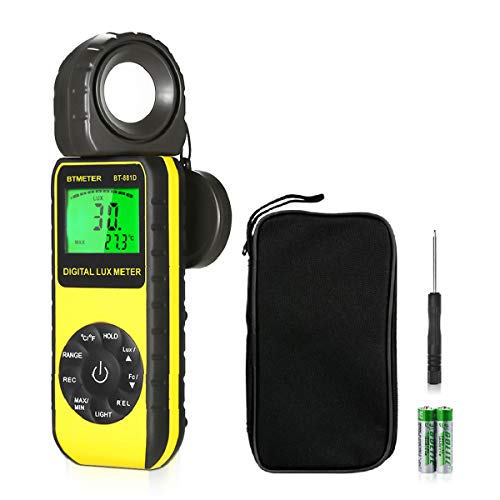
Best for users needing a broad measurement range with quick sampling. The BT-881D offers 0.01–400,000 Lux and 0.01–40,000 FC, with a reported 0.4-second response time and strong accuracy across the range. This makes it suitable for both studio lighting checks and large indoor spaces.
Best for: multi-source light testing where a wide dynamic range matters. Caution: the higher-ends of the range may show slightly larger measurement fluctuations if ambient lighting is highly variable.
Triplett LT80 LED Illuminance/Light Meter

Best for professionals who need wide source compatibility including LEDs, fluorescents, and conventional lamps. The LT80 measures up to 400,000 Lux and supports Min/Max/Avg, capturing trends over time. It uses a silicon photodiode sensor with a filter to improve measurement reliability across common lighting types.
Best for: lighting designers and facility managers evaluating mixed lighting environments. Caution: some users may prefer a larger display for field use, though the LT80 provides clear readings and quick sampling.
LATNEX Light Meter LM-50KL
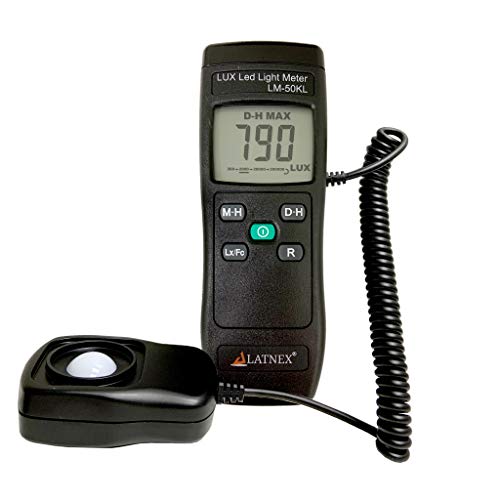
Best for industrial and photography setups needing reliable, versatile readings. The LM-50KL covers 200–200,000 Lux (and similar ranges in other units) with a large LCD and data hold function. It aims for long battery life and practical use in offices, studios, and galleries where quick confirmation of lighting levels matters.
Best for: environments where long-duration monitoring and straightforward data capture are important. Caution: the data range may be narrower at extremely low light compared to some specialist high-sensitivity meters.
Buying Guide: Key Considerations For Choosing A Lux Meter For LED Lighting
- Range and sensitivity: For LED assessments, ensure the meter covers at least 0.1 to 200,000 Lux, with a fine resolution (0.01 Lux is ideal for precise measurements).
- Unit compatibility: If your workflow requires both Lux and Foot-Candles (FC), pick a model with FC/Lux toggle to avoid manual conversions.
- Response time: A fast response (0.4–0.5 seconds) helps capture pulsed or changing LED light, important for photography and plant growth experiments.
- Display and ease of use: A backlit LCD aids readings in dim spaces; a rotating sensor can improve measurement angles in awkward setups.
- Data features: Min/Max/Avg, data hold, and peak recording help analyze lighting patterns over time and identify hotspots or dips.
- Reliability and calibration: Look for devices that specify accuracy in the target range and offer a straightforward verification method or calibration certificate when needed.
- Design and ergonomics: For portable field work, a compact, lightweight unit with clear labels reduces measurement errors.
Frequently Asked Questions
- What is a lux meter used for with LED lighting?
A lux meter measures light intensity in Lux, helping optimize LED setups for photography, horticulture, and workspace lighting. - Should I choose a Lux meter with FC/Lux conversion?
Yes if you frequently work with both metric systems; it avoids manual conversions and ensures consistency across projects. - How precise are typical LED lux meters?
Most devices offer ±3–5% accuracy in common ranges; higher-end models provide tighter tolerances across the full range. - Is data logging important for lighting projects?
Data logging (Min/Max/Avg, peak) is valuable for monitoring stability, scheduling, and long-term lighting behavior. - Can a lux meter measure ambient temperature?
Some models include ambient temperature readings, which can be helpful when LEDs influence or respond to thermal conditions. - What should I avoid when buying a lux meter?
Avoid meters with very limited range, poor resolution, or unclear unit support if you work with diverse LED applications.