Best 10 Amp Solar Controllers for Off-Grid Power and RVs
When selecting a 10 amp solar controller, focus on compatibility with your battery type, voltage, and intended use. This guide highlights five solid options for 12V/24V systems, including PWM and MPPT styles, suitable for RVs, boats, and off-grid setups. The top picks emphasize longevity, safety protections, and user-friendly LCD interfaces. Each product is best for a different use case, from compact portability to full-featured off-grid charging.
| Product | Best For | Why It Stands Out |
|---|---|---|
| Renogy Wanderer 10A PWM | RV and Marine applications | Negative ground design and robust protections with 4-stage charging. |
| Renogy Wanderer PG 10A PWM | Deep cycle AGM/Gel systems | Positive ground option with USB charging and LCD error codes. |
| Renogy Wanderer 10A PWM Auto-Detect | All-round off-grid setups | Auto-detects 12/24V and includes USB and lithium support features. |
| SunRock 10 (MPPT) | Portable solar charging | MPPT with compact design and LCD for monitoring, up to 150W PV input. |
| VUICCI 10A MPPT | Off-grid sheds and RVs | True MPPT with multiple charging ports and safety protections. |
Renogy Wanderer 10A PWM Negative Ground
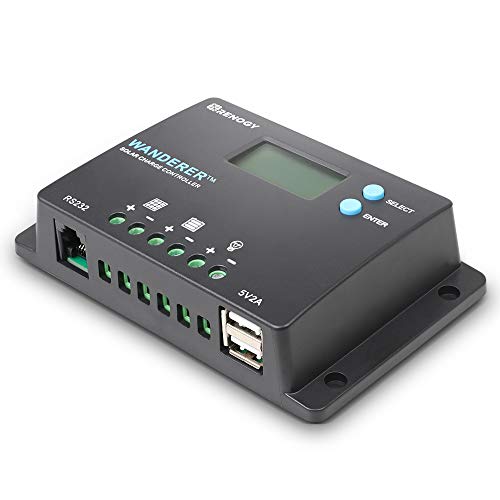
The Renogy Wanderer 10A PWM Negative Ground is designed for RV and marine use with a negative ground configuration. It employs a Smart 4-Stage charging (Bulk/Boost/Float/Equalization) to optimize battery life and solar efficiency for AGM, Gel, Flooded, and Lithium batteries. The LCD display enables quick status checks, and the controller is compact for tight control panels. Best for: mobile off-grid setups where negative-ground devices are standard and space is constrained. Limitation: does not support lithium batteries in all configurations; verify compatibility with your pack before use.
Renogy Wanderer PG 10A PWM Positive Ground

This Wanderer PG model offers a Positive Ground design, ideal for certain deep-cycle AGM/Gel systems. It includes overcharge/over-discharge/overload protection and LCD error codes for quick diagnostics. A built-in USB charging port adds convenience for travelers. Best for: systems with positive-ground configurations or where USB-charging capability is a priority. Caution: Not compatible with lithium batteries in all setups; confirm battery type before pairing.
Renogy Wanderer 10A Solar Charge Controller

This Wanderer 10A model emphasizes four-stage charging with 12V/24V auto-detect and an LCD display for easy monitoring. It supports manual/automatic/timed load control modes for direct DC-load management, making it suitable for off-grid cabins or boats. Best for: users needing flexible load control and straightforward battery protection. Limitation: lithium support is not universal across all configurations; validate compatibility with your battery chemistry.
Renogy 10A PWM Positive Ground For Deep Cycle

This model mirrors the Wanderer PWM design with a positive-ground setup for compatibility with specific AGM/Gel/Flooded configurations, including a full 4-stage charging cycle and USB charging. Best for: installations that require USB charging alongside traditional battery protection. Caution: Not suitable for lithium-only systems in some configurations; check your battery type before installation.
VUICCI 10A MPPT With USB And Type-C

The VUICCI 10A MPPT controller delivers up to 30% more solar power harvest than PWM models. It includes 22W USB-C and 18W USB ports for direct sun charging, along with 8-layer multi-protection and an LCD that shows PV and battery voltage in real time. Best for: off-grid setups where fast USB charging and higher efficiency are priorities. Limitation: not compatible with 24V or higher batteries in some configurations; confirm system voltage before purchase.
Buying Guide
Key considerations when choosing a 10A solar controller include battery type compatibility, voltage range, charge algorithm, and protection features. PWM controllers are typically simpler and cost-effective, suitable for basic AGM/Gel/Flooded systems. MPPT controllers offer higher efficiency, especially in cooler or higher-impedance conditions, and can handle lithium with proper settings.
- Battery compatibility: Confirm whether your batteries are AGM, Gel, Flooded, or Lithium, and ensure the controller supports them. Some models explicitly exclude lithium in certain configurations.
- Voltage handling: Most 10A controllers support 12V and 24V systems. Check auto-detect features if you have mixed-voltage panels.
- Protections: Look for overcharge, over-discharge, short-circuit, reverse polarity, and temperature compensation. LCD displays and error codes help with troubleshooting.
- USB ports and loads: If you need direct device charging, choose models with USB Type-C or USB-A outputs. Consider the practicality of load control modes for pumps or lighting.
- Portability and panel fit: Compact dimensions help in RV and boat installations. Ensure the PV input voltage and Voc are within the controller’s limits for your panels.
Frequently Asked Questions
- What is the difference between PWM and MPPT 10A solar controllers?
PWM controllers are simpler and cheaper, best for basic lead-acid batteries. MPPT controllers harvest more energy, especially in variable conditions, and can be better for lithium setups with proper configuration. - Can a 10A controller handle 12V and 24V systems?
Yes, most 10A controllers are designed to auto-detect or support both 12V and 24V configurations. - Do all these controllers support lithium batteries?
Not always. Some models explicitly support lithium across all settings, while others require checking battery type compatibility for lithium. - Is USB charging a standard feature?
Several models include built-in USB ports (Type-C or USB-A) for direct charging of devices from the solar setup. - What safety protections should I look for?
Overcharge/over-discharge, short-circuit, reverse polarity, temperature compensation, and LCD error codes for diagnostics are all important. - Do these controllers require professional installation?
Most installations are straightforward, but ensure correct wiring sequence and battery connection to avoid issues; follow manufacturer instructions.