Best 60 VDC Power Supplies for Bench Projects
When you need reliable 60 VDC power for electronics work, these 60V bench power supplies deliver stable voltage, current control, and essential protections. This guide highlights five top options, each suited to different kinds of projects—from hobbyist prototyping to industrial testing. If you work with microcontrollers, 3D printers, or CCTV setups, choose products based on current capacity, control precision, and safety features. The table below summarizes key specs to help you compare at a glance.
| Product | Max Voltage | Max Current | Notable Benefit |
|---|---|---|---|
| Jesverty SPS-6005C | 0-60V | 5A | 4-digit display, CV/CC auto-switch |
| Jesverty SPS-6020H | 0-60V | 20A | Encoder knob, output ON/OFF |
| CNCTOPBAOS 600W | 0-60V | 0-10A | 600W, full auto CV/CC, protections |
| BOSYTRO 60V | 0-60V | ≤10A | LED display, multiple voltages |
| Abestop 60V | 0-60V | 0-10A | High-resolution IPS display, auto balance |
Jesverty SPS-6005C 0-60V 5A Bench Power Supply
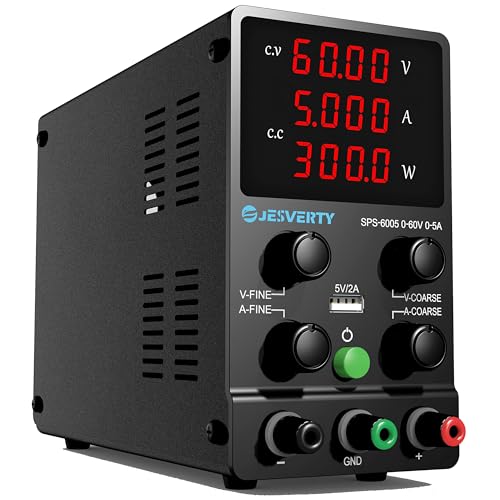
The Jesverty SPS-6005C provides a 0-60V, 0-5A output in a compact, regulated design. It features a 4-digit LED display that shows voltage, current, and power in real time, with high-resolution readouts (0.01V, 0.001A, 0.1W). The unit automatically switches between constant-voltage (CV) and constant-current (CC) modes as the load changes, making it suitable for general lab tasks and hobby projects. Best for small electronics labs or educational setups where precise CV/CC control is needed. Note: The crossover behavior depends on the selected voltage and current settings.
Best for: Beginners and students needing straightforward CV/CC behavior with clear readouts.
Limitation: Lower maximum current (5A) means it may not suit high-current testing or power-hungry devices.
Jesverty SPS-6020H 0-60V 20A Bench Power Supply

This SPS-6020H model brings higher current capability (0-60V, up to 20A) with an encoder knob for precise adjustment and a dedicated output ON/OFF switch. It includes over-voltage and over-current protections plus a cooling fan for sustained operation. Best for more demanding bench work, such as prototyping power-hungry modules or DIY robotics. The encoder knob improves repeatable setting accuracy, which is valuable in development environments.
Best for: Projects requiring higher current headroom and efficient, repeatable voltage programming.
Limitation: Larger, heavier unit; footprint and noise considerations may matter in compact setups.
Jesverty SPS-C 60V 5A with USB Charging

The SPS-C series adds USB-A and USB-C ports delivering up to 20W for quick charging while the main output provides 0-60V at up to 5A. An intelligent charging mode ensures safe battery charging with automatic stop when full, along with an output switch for easy control. Best for projects that require simultaneous device charging (phones, microcontrollers, or development boards) and power supply needs. Useful where a single bench unit supports both work and charging tasks.
Choose this if: You need integrated charging alongside main power delivery.
Limitation: USB ports share power with the main output, which may limit charging speed under heavy load.
CNCTOPBAOS 600W 60V DC Switching Power Supply

This unit delivers up to 60V and 10A with a robust 600W capacity and full auto-switching between CV and CC modes. It emphasizes high precision (±1% voltage, <±0.5% load regulation) and comprehensive protection (over-current, over-voltage, overload, short-circuit). Ideal for industrial prototyping and machines that demand consistent power with strict regulation. Best for users who need reliable performance across a wide load range and strong safety features.
Better for: Applications requiring stable power at the upper end of the current range with strong protection.
Limitation: Higher power unit may be more complex to set up in small labs or home environments.
BOSYTRO 60V 600W Adjustable DC Power Supply

The BOSYTRO model is a 600W supply offering 0-60V with 0-10A output. It emphasizes an upgraded LED display for clear operation status and includes fan cooling with robust heat dissipation. It is suitable for multi-device setups that require different voltages (2V, 5V, 12V, 24V, 48V) via additional buck conversion options. Best for workshops that test several components at varying voltages from a single unit.
Choose this if: You need versatility for multiple voltage requirements and clear operation feedback.
Limitation: Peak current may not consistently reach higher-demand devices; ensure load stays within spec.
Abestop 60V 10A 300W Variable Power Supply

Abestop’s 60V 10A supply offers 0-60V and 0-10A with a high-resolution 4-digit display (10 mV / 1 mA resolution) and a modern IPS screen for easy monitoring. It supports PC control via USB and SCPI for automated testing and data logging. The unit includes a list mode with 10 adjustable steps and 4 memory presets for repeatable workflows. Best for lab environments that require automation, data collection, and repeatable test sequences.
Best for: Automated testing, programming, and repeatable experiments with PC control.
Limitation: PC integration requires SCPI support; may be overkill for pure manual bench tasks.
Buying Guide: Key Considerations for 60V Benches
- Current headroom: Match max current to your device’s needs; high-current models handle more devices or motors but may be larger and pricier.
- CV/CC behavior: Ensure smooth automatic switching between CV and CC when load changes; essential for preventing device damage.
- Display and control: Encoder knobs offer precise, repeatable adjustments; 4-digit displays improve visibility of readings during debugging.
- Protections: OVP, OCP, short-circuit protection, and thermal management protect both supply and load during testing.
- USB/PC control: If automation or data logging matters, prefer models with USB/SCPI compatibility.
- Form factor and cooling: Larger, higher-wattage units may require better ventilation and desk space.
Frequently Asked Questions
- What is a 60V DC power supply best for? – It is suitable for powering test rigs, LED strips, motors, and DIY electronics that require a stable 60V supply with adjustable current.
- How does CV/CC switching help? – It automatically protects the load by regulating voltage or current based on the circuit’s needs, preventing overvoltage or overcurrent damage.
- Why choose an encoder knob over a potentiometer? – Encoder knobs provide finer, repeatable adjustments and faster setup for precise values.
- Is USB control necessary? – Not for basic bench work, but it helps with automation, data collection, and integration into test systems.
- What should I consider for cooling? – Higher wattage models generate more heat; ensure adequate ventilation or active cooling to maintain stable output.
- Can these supplies be used for 12V or 24V devices? – Yes, by setting the appropriate output within 0-60V; many models support common lower voltages directly.