Best UL1741 Grid Tie Inverters for Home Solar Systems
Finding the right UL1741 grid-tie inverter helps ensure safe, code-compliant solar power for your home. This guide highlights five top options, clarifying who each is best for and why. Buyers seeking grid-tie performance, easy monitoring, or scalable setups will find clear comparisons and practical tips to choose confidently.
| Product | Best For | Why It Stands Out |
|---|---|---|
| POWLAND 12000W Hybrid Solar Inverter | Large homes and RV setups | High power, battery-free option with grid feedback and high MPPT efficiency |
| Aninerel 12000W Solar Hybrid Inverter | Off-grid or mixed systems | Dual MPPT, scalable parallel options, robust 48V systems |
| ECO-WORTHY 10KW Off-Grid Kit | Complete home backup kits | UL 1741 certified, integrated kit with panels and battery-ready design |
| Y&H 1200W Grid Tie Inverter Power Limiter | Smaller systems with limiter needs | Limiter sensor, adjustable to load requirements |
| Y&H 1000W Grid Tie Inverter Power Limiter | Compact grid-tie applications | Compact, limiter-based control for efficient small-scale grids |
POWLAND 12000W Hybrid Solar Inverter

Brand: POWLAND
Voltage and power: 12,000W pure sine wave at 120V±5% to supply heavy loads. Parallel capability supports up to six units for scalable power. Grid-tie operation with optional CT sensor to feed excess energy back to the grid, reducing reliance on batteries.
Best for: Large homes, multi-room setups, or RVs that need high instantaneous power without a battery stack. This inverter is selected for its high wattage, grid backfeed features, and robust MPPT performance.
Caution: Battery-free operation relies on grid availability; ensure proper wiring and safety clearance for high-current connections.
Aninerel 12000W Solar Hybrid Inverter

Brand: Aninerel
Features: 12,000W continuous output with 24,000W peak, two MPPT controllers, high-voltage PV input up to 500VDC, and parallel capacity for up to six units. Supports no-battery operation for solar-to-load use and compatibility with multiple battery chemistries.
Best for: Homes and workshops needing strong solar-to-load performance with scalable growth and flexible battery integration. Selected for its dual MPPT and substantial parallel expansion potential.
Caution: Higher installation complexity due to parallel configurations; ensure proper electrical design and protection devices.
ECO-WORTHY 10KW Off-Grid Solar Kit

Brand: ECO-WORTHY
Contents: 10KW inverter, 12 x 195W panels totaling 2340W, two 48V 100Ah lithium batteries, and wireless connectivity options. It emphasizes UL 1741 certification for safety and performance in off-grid configurations.
Best for: Homeowners seeking a complete, certificated off-grid solution with capacity for future expansion and remote monitoring via WiFi. Chosen for its certified safety and integrated components.
Caution: System size is substantial; ensure available space for panels and proper structural support for mounting.
Y&H 1200W Grid Tie Inverter Power Limiter

Brand: Y&H
Features: Grid tie inverter with limiter sensor, MPPT-compatible voltage range suitable for higher Voc panels, LCD display for status, and mode selection for photovoltaic/battery operation. Designed to deliver only the power required by the load.
Best for: Small to medium grid-tied systems where precise load control and safety monitoring are priorities. Selected for its limiter approach to prevent overproduction and protect the grid connection.
Caution: Ensure panel open-circuit voltage stays within 76-90V; longer wiring can introduce voltage drops or control delays.
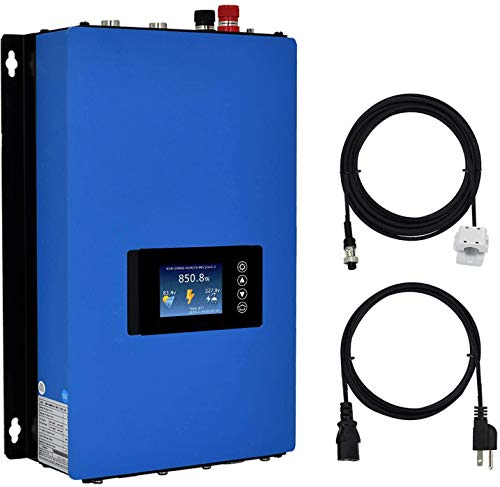
Y&H 1000W Grid Tie Inverter Power Limiter
Brand: Y&H
Features: Limiter-based control, DC input range 25-60V, output 110-240V AC, LCD display for system status, and a focus on delivering only the power needed by the load. Compatible with 48V and 60V battery setups.
Best for: Compact solar installations where grid stability and precise power delivery matter. Chosen for its straightforward limiter mechanism and clear status indicators.
Caution: Verify that your panel array voltage stays within MPPT-friendly ranges to avoid reduced efficiency.
Buying Guide
What is UL1741 and why does it matter?
UL1741 is a safety standard for inverters and other PV system components. Choosing UL1741-certified inverters helps ensure proper electrical isolation, anti-islanding features, and safer grid interaction. For residential solar, certification can simplify permitting and align with local codes.
How to choose based on system size
- Smaller homes or limited space: look for 1–2 kW grid-tie inverters or compact limiter-based models.
- Medium homes with everyday loads: consider 3–6 kW inverters with robust MPPT and LCD monitoring.
- Large homes or scalable builds: explore 8–12 kW units or multi-unit parallel configurations for higher total output.
What to consider in MPPT and efficiency
- MPPT speed and range determine how well the inverter harvests energy under varying light.
- High-efficiency MPPT (close to 99%) is beneficial in shaded or low-light conditions.
Monitoring and user interface considerations
- LCD displays and mobile app integration help track voltage, current, power, and frequency.
- Multiple working modes (grid-backfeed, battery mode, etc.) offer flexibility for different setups.
Safety and installation notes
- Ensure proper wiring diagrams and protective devices for high-current grid connections.
- Verify panel Voc and MPPT voltage ranges to avoid inefficiencies or damage.
FAQ
- What does UL1741 certification mean for my inverter? It indicates adherence to established safety standards for grid-tie inverters and reliability in grid interaction.
- Can I mix different inverters in one system? Mixing is possible in some setups, but performance and safety require careful planning and possibly a professional design.
- Is parallel connection safe for larger systems? Yes, when done with compatible inverters and proper junctions, parallel units can increase total output and surge capacity.
- Do grid-tie inverters require batteries? Some do not; battery-free designs feed excess energy back to the grid, while others integrate battery storage for backup power.
- What maintenance is required? Regular inspection of connections, wires, and protective devices; monitor display readings to catch anomalies early.
- Do these inverters support LiFePO4 batteries? Many models support multiple battery chemistries, but verify compatibility with your chosen battery type.