Best 2 Lamp T12 Ballast Solutions for Fluorescent Upgrades and Replacements
Find reliable 2 lamp T12 electronic ballasts that support 1 or 2 lamps and provide instant start, high efficiency, and solid protection for commercial and industrial lighting. This guide highlights top choices and explains who each ballast is best for, along with clear pros and potential limitations. The selections emphasize compatibility with 96W T12 lamps (F96T12) and similar configurations, aiming to minimize downtime and maximize energy savings for facilities managers, maintenance teams, and retrofit projects.
The following table compares the five recommended 2-lamp T12 ballasts, focusing on lamp compatibility, voltage range, and notable features. Use this as a quick reference when narrowing down candidates for maintenance and upgrades.
| Product | Lamp Options | Voltage | Key Benefit |
|---|---|---|---|
| Robertson ISL296T12MV | 1 or 2 lamps (F96T12, F96T12/ES, F72T12, F48T12) | 120–277V | Low THD, high PF, parallel operation for uptime |
| Robertson RSW234T12120 | 1 or 2 T8 or T12 lamps | 120V | Rapid start, energy efficiency, compact for retrofits |
| OHLECTRIC KTEB-220-1-TP-EMI | 2 lamp T12 | 120V | 0.88 ballast factor, data-center-friendly efficiency |
| OHLECTRIC KTEB-2110-UV-TP-PIC | 2 lamp T12 | 120–277V | 0.85 ballast factor, versatile input, instant start |
| Philips Advance ICN-2S40-N | 2 lamp T12 | 120/277V | Trusted brand with EMI/RFI compliance |
Robertson ISL296T12MV Ballast for 1 or 2 Lamp T12

The Robertson ISL296T12MV ballast supports 1 or 2 lamps including F96T12 and related configurations. It is rated for 120–277V and offers instant start with parallel operation, which keeps one lamp running if the other fails. This makes it suitable for high-traffic areas where uptime matters and a rapid restart is essential.
Best for: commercial spaces with 2-lamp T12 setups where uptime and safety are priorities. It is a strong pick for offices, warehouses, and hallways that require reliable operation and low harmonic distortion.
Caution: Ensure compatible lamp types are installed; mixing incompatible lamp types could affect performance and ballast protection.
Philips Advance RELB-2S40-N Electronic Ballast

The Philips Advance RELB-2S40-N is designed for 2-lamp T12 configurations and operates at 120V, offering dependable performance with a focus on commercial reliability. It is suitable for installations that require a trusted brand and standard 120V operation.
Best for: facilities that prefer a well-known, established ballast brand and standard 120V operation. Choose this if you value brand familiarity and straightforward installation.
Caution: This model is listed as a general industrial ballast; double-check availability and exact compatibility with your lamp types before purchase.
Robertson RSW234T12120 Fluorescent Ballast for 1–2 T8/T12
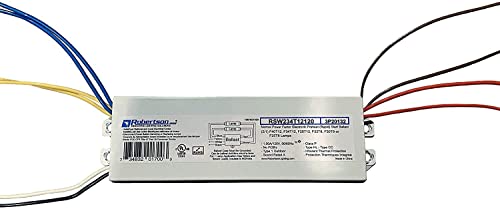
The Robertson RSW234T12120 ballast supports 1 or 2 lamps across T8 and T12 families, including rapid start operation and energy-efficient performance. Its compact form factor makes it suitable for space-constrained retrofits and installations.
Best for: repairs or upgrades in spaces with mixed lamp types or retrofits where space constraints matter. Opt for this when you need a versatile ballast with strong surge protection and end-of-lamp-life safety features.
Caution: Verify that the targeted lamps are within the 25–40W range and that wiring conforms to local electrical codes.
OHLECTRIC Replacement for Keystone KTEB-220-1-TP-EMI 2 Lamp T12

This replacement ballast from OHLECTRIC provides 2-lamp T12 operation with 120V input and an instant-start design. It features a 0.88 ballast factor aimed at energy savings, making it suitable for data center environments and space-constrained installations requiring efficient performance.
Best for: data centers or server rooms requiring steady, flicker-free operation with a moderate ballast factor for energy efficiency. Consider when you need a retrofit that aligns with EMI and regulatory expectations.
Caution: Confirm compatibility with the exact Keystone model and lamp types in your installation to avoid misfit or voltage issues.
Buying Guide: Key Purchase Considerations
What should you check before buying a 2-lamp T12 ballast?
- Lamp compatibility: Confirm that the ballast supports your lamp types (F96T12, F96T12/ES, and related 8-foot lamps).
- Voltage range: Ensure the ballast operates reliably within your supply voltage (common ranges include 120V and 277V).
- Start type and reliability: Instant Start ballasts reduce warm-up time, but verify that your ballast supports continuous operation and, if needed, parallel lamp operation for redundancy.
- Ballast factor and efficiency: Lower ballast factor often correlates with energy savings; check the rated ballast factor (e.g., 0.85–0.88) for your application.
- Safety and certifications: UL/cUL listings, RoHS compliance, and EMI/RFI performance help ensure regulatory alignment and safer operation.
- Physical footprint and mounting: Consider compact size, mounting dimensions, and lead lengths for retrofits or remote mounting.
- Installation and wiring: Look for pre-wired leads and standardized mounting patterns to simplify installation and reduce downtime.
FAQ
- What is the advantage of a parallel lamp operation ballast?
Answer: It keeps one lamp running if the other fails, improving visibility and safety in critical areas. - Can I use a T12 ballast with a T8 lamp?
Answer: No, T12 ballasts are designed for T12 lamps. Mixing lamp and ballast types can lead to improper operation and failure. - What does ballast factor mean for energy use?
Answer: Ballast factor indicates the ballast’s output relative to a standard lamp. A lower ballast factor typically yields energy savings but may affect light output. - Is instant-start better for all installations?
Answer: Instant-start is advantageous for applications requiring fast lamp ignition, including high-usage or critical spaces, but some setups may prefer rapid-start for smoother operation. - Are these ballasts suitable for data centers?
Answer: Some models target data-center environments with EMI considerations and stable performance; verify the exact model’s suitability for your data-center requirements.