Best 110 Volt Transfer Switches for Reliable Home Power Backup
When selecting a 110 volt transfer switch, the top priorities are fast switching, compatibility with two power sources, and clear mode options. This guide highlights five 110V transfer switches suited for homes, RVs, or small offices that rely on generators, inverters, or grid power. Each pick targets a different buyer type—from DIY installers to those needing DIN-rail mounting or dual-power reliability. The quick-reference table below helps compare who each product is best for.
| Product | Best For |
|---|---|
| IGEYAPA 100Amp 2P Automatic/Manual Transfer Switch (B0F1S5DQQV) | Large-load home backup with automatic fast transfer |
| YAURILO AC120V 15Amp Automatic Transfer Switch (B0FX4G8Q9Z) | Compact, indoor/outdoor use with simple 15A loads |
| IGEYAPA Mini 2P 63A 110V ATS (B0F1S1BFCM) | DIN-rail mounted, slim footprint for panel installs |
| Zgqmcgy 110V 2P 63A ATS (B0F9B1BF7Y) | Balanced auto/manual modes with broad safety protections |
| IGEYAPA 100Amp 4P 110V Automatic/Manual Transfer Switch (B0F1S7L1ZG) | Four-pole, high-amp resistance for multi-circuit setups |
IGEYAPA 100Amp 2P Automatic/Manual Transfer Switch

Functionality centers on two power sources with automatic and manual modes. In automatic mode, Power Source A is primary and B acts as backup, switching within 0.05 seconds if A fails. The unit supports input from mains, generator, or photovoltaic sources, with four wiring options. This makes it suitable for users seeking rapid automatic switchover and clear LED indicators. Best for 100A, two-source home setups that demand high reliability, like backup power for essential circuits.
Best for: Homeowners needing quick automatic switchover with two power inputs and visible indicators. Caution: Ensure correct wiring to prevent unintended source switching.
YAURILO AC120V 15Amp Automatic Transfer Switch

This 15A transfer switch is designed for simple, indoor or outdoor use with 120V inputs. It seamlessly transfers between two AC power sources, switching loads when the primary source fails. It’s suitable for small loads, AV setups, and light appliances where minimal switch time is desired. Best for: Apartments or small offices with modest power needs. Limitation: Lower current rating may limit high-draw equipment.
IGEYAPA Mini 2P 63A 110V ATS

Designed for DIN-rail mounting, this 2P 63A ATS supports automatic and manual switching between two power supplies with fast 0.05-second switching. It’s well-suited for panel installations in workshops, RVs, or home electrical panels. Best for: People who want a compact, panel-mounted solution with quick switching. Caution: Verify panel space and rail compatibility before purchase.
Zgqmcgy 110V 2P 63A CE ATS
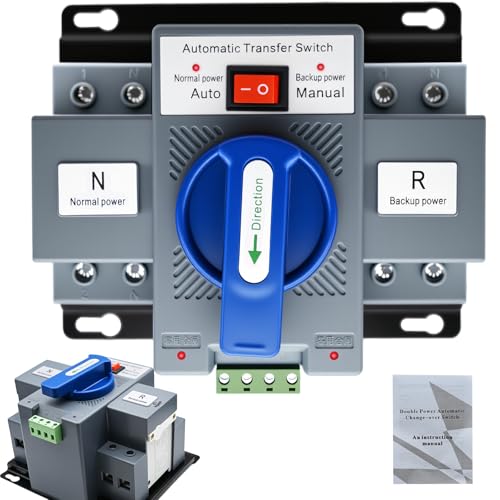
Offers a dual-mode automatic/manual operation with protections against short circuits, overloads, phase failures, and undervoltage. It detects anomalies in the primary or backup sources and transfers load circuits to maintain continuity. Best for: Users needing robust safety features and reliable performance across 50/60 Hz environments. Caution: Confirm compatibility with your specific load and wiring setup.
IGEYAPA 100Amp 4P 110V ATS

This four-pole unit extends the two-source switching concept to four poles, enabling more complex or higher-load configurations. It maintains automatic and manual modes with a similar 0.05-second transfer window. Best for: Multi-circuit setups or larger households with higher power demands. Caution: Four-pole installations require careful wiring and panel space planning.
Buying Guide
What should you consider when choosing an 110V transfer switch?
- Current rating: Match the unit to your load. Common values are 15A, 63A, and 100A. Higher amperage supports more devices but requires a sturdier panel setup.
- Number of poles: 2P handles two sources and two lines; 4P supports more complex circuits. Choose based on the number of inputs and connected loads.
- Automatic vs. manual: Automatic provides seamless switchover during outages. Manual offers emergency control when testing or in no-grid scenarios.
- Mounting style: DIN-rail mounting suits panel builders and retrofit installs; free-standing or wall-mount suits standalone setups.
- Response time: 0.05 seconds is common for critical systems; seconds-long delays can affect sensitive electronics. Verify transfer time specs.
- Safety features: Look for protections against short circuits, overloads, undervoltage, and phase issues to protect equipment and personnel.
Frequently Asked Questions
- What is a 110V transfer switch used for?
It automatically switches a load between two power sources, such as utility power and a generator or inverter, to maintain power continuity. - Can I install a 110V ATS myself?
Installation typically requires basic electrical knowledge. Follow manufacturer wiring diagrams and local electrical codes. - What is the typical transfer time?
Most units switch in under 0.05 seconds to 2 seconds, depending on model and mode. - Should I choose 2P or 4P?
Two-pole units are common for simple two-source setups; four-pole units support more complex or multi-load configurations. - Can these switches handle outdoor use?
Some models have weather-resistant housings; verify IP ratings and placement recommendations in product specs.