Best Natural Gas Leak Detection System for Home Safety and DIY Audits
When choosing a natural gas leak detection system, look for portable, easy-to-use detectors with rapid alarms, clear indications, and reliable sensors. This guide focuses on five versatile detectors that fit home and small-scale use cases, highlighting who they’re best for and why each stands out. Ideal buyers include homeowners monitoring kitchen appliances, RV enthusiasts checking gas lines, DIYers performing routine inspections, and professionals needing compact tools for quick checks.
| Product | Best For | Key Advantage | Limitations |
|---|---|---|---|
| TOPTES PT199 Natural Gas Leak Detector | Home use & quick sniffing | Fast 0.5-second alarm, red LCD on high risk | Requires batteries (included) and 30-second warm-up |
| ComStar Leak Bubbles Yellow | HVAC, pipes, and plumbing checks | Instant visual leak indication with bubbles | Needs manual application and cleanup; non-electronic |
| TOPTES PT177 Gas Detector | Pocket, on-the-go checks | Small, pocket-sized with bright LEDs and loud alarm | Auto-calibration required after warm-up |
| TopTes PT-356 Rechargeable Gas Detector | Professional-style home & small shop | Gooseneck 10-inch probe and dual display | Higher price point and more features to manage |
| Povlen Natural Gas Leak Inspection Tool | Hard-to-reach spaces and DIY checks | 11-inch gooseneck with multi-mode feedback | Basic indicators may require interpretation |
TOPTES PT199 Natural Gas Leak Detector
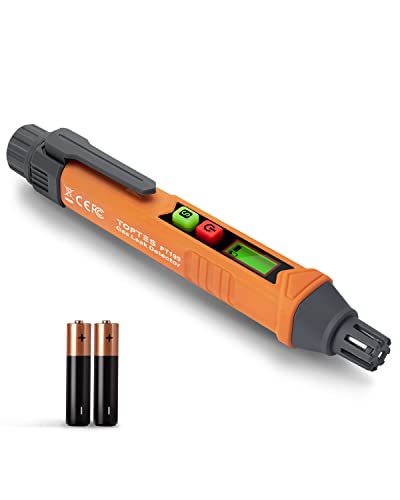
The PT199 detects natural gas, methane, propane, butane, LPG, and more, pinpointing leaks to reduce explosion risk. It’s best for homeowners who want a portable detector for quick spot checks around stoves, heaters, and gas lines. The device provides a visual and audio alarm within 0.5 seconds, with the LCD turning red as gas levels rise. It runs on two AAA batteries and includes a 30-second warm-up. A low-battery indicator appears below 2.4V, and the unit auto-powers off after five minutes without activity.
Best for immediate, on-demand alerts where a quick confirmation is needed. Choose this if you want a simple, reliable tool that’s easy for non-experts to operate. A potential limitation is the shorter run-time between battery changes due to frequent alarms in high-gas environments.
ComStar Leak Bubbles Yellow

Leak Bubbles Yellow is a visual leak detector spray designed to reveal micro-leaks in HVAC systems, propane lines, natural gas, and more. It’s best for professionals and DIYers who rely on visual confirmation rather than electronic alarms. The spray forms high-visibility yellow bubbles at the leak source, enabling precise pinpointing. It’s designed for year-round use and stays liquid in cold climates, making it a flexible option for exterior or winter testing. It is multi-gas compatible, working with natural gas, propane, nitrogen, air, CO2, and refrigerants.
Choose this if you prefer a chemical indicator over electronic sensors or need to verify leaks in tight spaces where a detector may not reach. Limitations include the need to wipe or rinse surfaces afterward and the fact that it requires manual application rather than continuous electronic monitoring.
TOPTES PT177 Gas Detector

The PT177 is a pocket-sized gas detector that pinpoints leaks of combustible gases, including LPG, methane, propane, butane, and natural gas. After powering on, a 30-second auto-calibration ensures accuracy. It delivers a rapid alarm within 0.5 to 3 seconds and uses five red LEDs plus a 75 dB audible alert that intensifies with concentration. The included storage bag and pocket clip make it ideal for RV enthusiasts, DIYers, and homeowners who need a portable tool for quick field checks.
Best for budget-conscious users who want a reliable, compact device. A limitation is the need to periodically auto-calibrate to maintain accuracy, which adds a minor maintenance step for infrequent users.
TopTes PT-356 Rechargeable Gas Detector

The PT-356 features an active sampling fan that pulls in air, enabling faster response times, and a detection range from 0 to 10,000 ppm (0% LEL to 20% LEL). It supports various gases, including methane, propane, butane, natural gas, LPG, and more. A full-color display shows real-time PPM values and a minute-long trend graph, while auto-sleep and brightness adjustments optimize power. It has a triple-alarm system: visual, audible, and vibrational alerts, plus a one-button mute for non-emergency use.
Best for users who want professional-like data visualization and adjustable alarms in a portable form. Holdbacks include a higher price point and the need to interpret more complex readings for non-professionals.
Povlen Natural Gas Leak Inspection Tool

The Povlen gas sniffer features an 11-inch gooseneck and three-mode indication: loud sound, bright visuals, and screen feedback. It detects methane, propane, butane, LPG, and other combustible gases, making it suitable for checking tight spaces behind appliances or along gas lines. It’s a practical choice for homeowners and DIY users who want fast, decisive feedback in hard-to-reach areas. The digital display helps users interpret readings without guesswork.
Choose this if you need reach into restricted areas and value multi-mode feedback. A caution is that it may rely more on user interpretation than automatic calibration, so ensure you understand the indicator signals for reliable results.
Buying Guide: Key Considerations For Selecting A Natural Gas Leak Detection System
What type of detector fits your environment? For quick, at-a-glance checks around kitchens and furnaces, handheld units like PT199 or PT177 are ideal. For professional-grade testing with data visualization, PT-356 offers more context through its display and trend graphs. If you regularly test hard-to-reach spots, a gooseneck sniffer such as Povlen or the 10–14 inch variants can be crucial.
How important are alarms versus indicators? Visual and audible alarms are essential for immediate alerts in active spaces. If you work in noisy environments, a device with a strong visual signal and vibration (like PT-356) can reduce missed warnings. For non-emergency confirmation, a chemical indicator spray like ComStar provides a clear, instant readout without electronics.
What gases should you monitor? The detectors listed here cover natural gas, methane, propane, butane, LPG, and related mixtures. If your usage includes propane tanks, burners, and outdoor lines, ensure the sensor supports propane and butane in addition to methane.
Battery life and maintenance matter. Battery-powered models are portable and convenient but require periodic replacement or charging. Some units include auto-off features to save power but may need reactivation after long pauses. Auto-calibration helps maintain accuracy but adds a maintenance step for occasional users.
Choose for your use-case: home stove and furnace monitoring, DIY RV and outdoor checks, or professional field testing with data logs. Each device offers a balance of portability, sensitivity, and ease of use. Consider owning a visual indicator spray as a supplementary method for confirming leaks in hard-to-reach areas.
FAQ
- What does a natural gas leak detector measure? It senses combustible gases such as methane, propane, butane, and LPG, and issues alarms or visual cues when detected.
- How quickly do these detectors alert? Most provide audible and visual alerts within 0.5–3 seconds of gas presence, with higher-end models offering real-time ppm readings.
- Do I need to calibration? Some models auto-calibrate on startup; others may require periodic manual calibration or warm-up to ensure accuracy.
- Can these detectors be used outdoors? Many are designed for indoor use; non-freezing formulas and weatherized options can be suitable for outdoor testing, but always check product guidelines.
- What is a gooseneck detector good for? A gooseneck allows access to tight spaces behind appliances, along fixtures, and inside cabinets where leaks often hide.
- Is a visual leak spray sufficient on its own? Visual sprays confirm a leak location but do not provide continuous monitoring. Use sprays in tandem with a detector for comprehensive safety.