Best Portable Natural Gas Inverter Generator Options for Reliable Power
When choosing a portable natural gas inverter generator, the goal is clear: quiet, efficient power that’s safe for electronics and ready for backup needs. The top picks below are tri-fuel or dual/fuel models designed to run on gasoline, propane, or natural gas, with inverter technology to stabilize power. They’re suited for home backup, RVs, cabins, and job sites where quiet operation and fuel flexibility matter. The following five models stand out for balance of power, runtime, and features.
| Product | Fuel Options | Max Output | Best For | Notes |
|---|---|---|---|---|
| Westinghouse 8200 Peak Watt Tri-Fuel | Gas, Propane, Natural Gas | Gas 6600/Peak 8200 W | Small homes, essential loads | Good balance of power and noise level |
| Westinghouse 12000 Peak Watt Tri-Fuel | Gas, Propane, Natural Gas | Gas 12000/Peak; Propane 11000/Peak; Natural Gas 9800/Peak | Whole-home backup | Large capacity with long runtime |
| DuroMax XP11000iHT 11,000-Watt Tri Fuel | Gas, Propane, Natural Gas | 11,000/Peak | RV and jobsite versatility | Remote start; compact for its power |
| Westinghouse 12500 Peak Watt Tri-Fuel | Gas, Propane, Natural Gas | Gas 12500/Peak; Propane 11200/Peak; Natural Gas 9500/Peak | Medium to large homes | Strong all-around performance |
| Westinghouse 14500 Peak Watt Tri-Fuel | Gas, Propane, Natural Gas | Gas 14500/Peak; Propane 13500/Peak; Natural Gas 12000/Peak | Backup power for larger homes | High-output with robust features |
Product snapshots above highlight models that balance tri-fuel flexibility with inverter reliability. The chosen list emphasizes different home and outdoor scenarios, from compact back-up to whole-house capability, while maintaining lower THD for electronics and CO safety features where available.
Westinghouse 8200 Peak Watt Tri-Fuel Portable Inverter Generator

Best for: small homes or essential loads during outages. This model runs on gasoline, propane, or natural gas with inverter power for clean output suitable for sensitive electronics. It includes a 50A outlet capable of handling home backup devices and a transfer switch-ready design. Paired with CO sensing, it helps monitor safety in generator use.
- Fuel flexibility: Gasoline 6600 running/8200 peak, Propane 5940 running/7380 peak, Natural Gas 5280 running/6560 peak.
- Inverter efficiency reduces fuel use and noise, helping with longer runtimes between refills.
- One 120/240V 14–50R 50A outlet, RV TT-30R, and standard outlets for diversified loads.
Best for: buyers who want a compact tri-fuel unit with home backup capabilities and quiet operation. Caution: higher continuous load may shorten runtime on natural gas compared to gasoline.
Westinghouse 12000 Peak Watt Tri-Fuel Portable Inverter Generator

Best for: whole-home backup with higher starting demands. This 12kW-class tri-fuel unit offers a large 50A transfer-capable outlet and inverter technology for safe electronics operation. It balances fuel economy with long run times, and includes a CO sensor for added protection.
- Power: Gasoline 12,000W peak/9,000W running; Propane 11,000W peak/8,100W running; Natural gas 9,800W peak/7,200W running.
- Quiet operation through Eco Mode and insulation to minimize neighborhood disruption.
- Long runtime on large fuel tank and low oil shutdown feature; CO sensor included.
Best for: buyers needing substantial output for home backup or a large RV setup. Caution: heavier than smaller models; ensure proper transport and storage space.
DuroMax XP11000iHT 11,000-Watt Tri Fuel
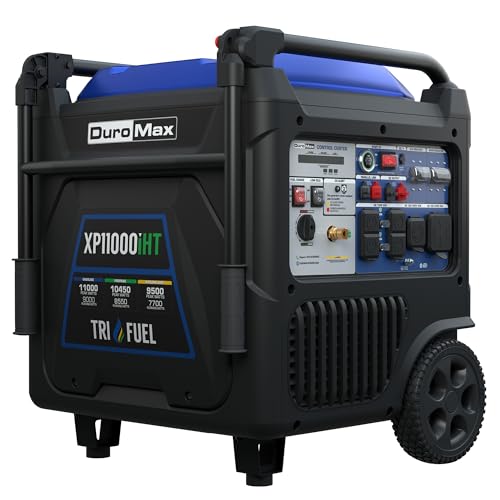
Best for: RV owners and job sites needing flexible fuel options. The XP11000iHT combines high output with portable design and remote electric start. It’s transfer switch ready and supports whole-home power backup for mid-size needs.
- Tri-fuel flexibility: Gas, Propane, or Natural Gas.
- Inverter power with low THD to protect electronics.
- Remote start and transfer-switch readiness for easier integration with backup systems.
Best for: choose this when you value remote starting convenience and multi-fuel capability in a portable package. Caution: some users may prefer a larger tank for extended outages.
Westinghouse 12500 Peak Watt Tri-Fuel Home Backup Portable Generator

Best for: mid-to-large homes needing dependable tri-fuel support with transfer switch readiness. This model handles greater loads with multiple outlets, a digital hour meter, and a long-running fuel tank with gauge for monitoring.
- Output: Gas 12500 peak/9500 running; Propane 11200 peak/8500 running; Natural gas 9500 peak/7500 running.
- Two GFCI outlets and a transfer switch-ready receptacle for seamless backup integration.
- Remote start plus a robust engine and safety features like automatic low oil shutdown.
Best for: buyers seeking substantial power with versatile outlet options. Caution: ensure the inverter’s load distribution aligns with household circuits during peak demand.
Westinghouse 13500 Peak Watt Tri-Fuel Home Backup Portable Generator

Best for: larger homes needing robust tri-fuel support and transfer switch readiness. It delivers higher peak watts and multiple outlets, designed for more demanding backup scenarios while maintaining safe electronics operation.
- Peak/running watts: Gas 13500/10500; Propane 12500/9500; Natural gas 10000/8500.
- Remote start with key fob, long run times on a large fuel tank, and multiple outlet options.
- Automatic safety features including CO shutdown and oil monitoring.
Best for: choose this if you require substantial power for a larger home or multi-appliance backup. Limitation: cost and size increase with higher output.
Westinghouse 18000 Peak Watt Tri-Fuel Home Backup Portable Generator

Best for: large homes, job sites, or emergency power with the highest capacity among listed options. The WGen14500TFc low-THD output supports sensitive electronics and a CO sensor enhances safety during extended outages.
- Output: Gas 18,000 peak/14,500 running; Propane 16,000 peak/13,000 running; Natural gas 14,400 peak/11,600 running.
- Long-running ability on a sizable 10.5 gallon gas tank with CO safety features and low idle mode.
- Low THD under 5% for electronics safety and durable copper windings for efficiency.
Best for: buyers needing maximum portable power with safety features for electronics. Caution: this model is heavier and larger to move and store.
Buying Guide
- Power needs and load planning: Estimate essential loads (refrigerator, HVAC, lights, outlets). For whole-home backup, aim for 9,000–12,000 running watts or higher; for smaller outages, 5,000–8,000 running watts may suffice.
- Fuel flexibility: Tri-fuel models offer the most options during outages or fuel shortages. Check availability of natural gas lines or propane containers for continuous operation.
- Inverter technology and THD: Inverter systems provide clean power (low THD) suitable for computers, TVs, and electronics. Look for models with modern inverter circuitry and stable voltage outputs.
- Transfer switch compatibility: If connecting to a home panel, verify a transfer switch or interlock kit compatibility and the availability of a 50A or 30A connection as required.
- Noise, runtime, and fuel efficiency: Inverter units typically run quieter and use less fuel than traditional open-frame generators. Consider Eco/Low Idle modes and fuel tank capacity for runtime expectations.
- Safety and maintenance: CO sensors, automatic low-oil shutdown, and hour meters help prevent hazards and simplify maintenance schedules.
- Portability vs. power: Heftier models deliver more power but require more transport effort. For frequent moves, consider weight, wheel kits, and handle design.
FAQ
What is the advantage of tri-fuel versus dual-fuel?
Tri-fuel generators can run on gasoline, propane, or natural gas, offering flexibility during shortages or outages and enabling longer operation without frequent refueling.
Is inverter power necessary for home backup?
Inverter power provides clean, stable electricity with low THD, protecting sensitive devices such as computers and TVs during outages.
Do these generators require professional installation for transfer switches?
Transfer switch installation is typically done by a licensed electrician. Many models are transfer switch ready but still require proper wiring for panel integration.
How important is run time on a full fuel tank?
Run time affects how often you must refuel. Larger tanks extend operation between fills, especially during extended outages.
What safety features should I look for?
CO sensors, automatic low-oil shutdown, and secure outlets with weather protection help reduce risk and protect equipment.
Which model should I choose for a larger home?
For larger homes, consider higher peak and running watts (around 12,000–18,000 peak) with multiple outlets and a robust fuel tank.