Best Rack Mount Terminal Block Solutions for Industrial Wiring
Answering your search for reliable rack-mount terminal blocks, this guide highlights five top DIN rail and screw-mount options suitable for industrial panels, control cabinets, and equipment racks. These selections are best for engineers and technicians seeking sturdy, easier wiring, quick installation, and clear organization in 24–30A, 300–400V ranges. The featured products emphasize safety, compactness, and scalable configurations for DIN rail systems and rack-mounted setups. Use the quick comparison table below to help narrow your choice before diving into detailed product sections.
| Product | Brand | Key Spec | Best For |
|---|---|---|---|
| Screw Mount 24A/400V 12 Position | OONO | 12 positions, 400V, 24A per position | Compact 12-channel distribution in a single block |
| JANDECCN 50 Pack DIN Rail Terminal Blocks | JANDECCN | DIN rail, 24–12 AWG, flame-retardant | Bulk wiring with fast, reliable rail mounting |
| Screw Mount 30A/300V 2×12 | OONO | 2×12 positions, 30A total | Higher current per block with dual-row layout |
| DIN Rail Mount 24A/400V 12 Position | OONO | 12 positions, 400V, 24A per position | DIN rail-ready, compact distribution |
| 30 Position 24Amp/400V (DIN Rail) | HCDC | 30 positions, 24A per position | High-density, modular rail distribution |
Screw Mount 24A/400V 12 Position Screw Terminal Block

Best for compact, single-rail distribution where multiple 26–12 AWG conductors must be organized in 12 isolated positions. Designed with a pitch of 5.0 mm and a 7 mm strip length, it supports 400V and 24A per position. The block uses M3 screws with steel, Cr3+ Zn plating and brass pin header/cage for solid connections. Choose this for lightweight panels and control boards needing reliable isolation across channels. Caution: Ensure total current does not exceed per-position ratings when stacking multiple blocks.
JANDECCN 50 Pack DIN Rail Terminal Blocks

Best for bulk wiring on DIN rails with flexible wire range from 24 AWG to 12 AWG. These blocks prioritize safety with insulated, flame-retardant materials and corrosion-aging resistance. They’re designed to reduce wiring time by 50–70% due to a new connection design and a robust locking mechanism on the DIN guide. Best for large control panels, machines, and appliances requiring high-density, modular connections. Limitation: Some users may need additional accessories for certain rail types or larger assemblies.
Screw Mount 30A/300V 2×12 Position

Best for higher current demands within a compact dual-row layout. Each position supports up to 20A with a total block rating of 30A and 300V, with A and B terminals offering structured grouping. The 7.62 mm pitch and 8 mm strip length facilitate clean wire management for 26–10 AWG conductors. Choose this when you need extra current capacity per channel without increasing board footprint. Limitation: Higher current blocks may require careful heat management in dense installations.
DIN Rail Mount 24A/400V 12 Position

Best for standard DIN rail environments needing dependable 12-channel distribution. Features include a 5.0 mm pitch, 7 mm strip length, M3 screws, steel Cr3+ Zn plating, and brass pin headers. Rated at 400V and 24A per position, it fits 26–12 AWG wire and maintains compact enclosure footprint. Suitable for control panels, power supplies, and automation equipment. Limitation: Compatibility with non-standard rails may require adapters.
30 Position 24Amp/400V DIN Rail Block (DIN Rail Mount)
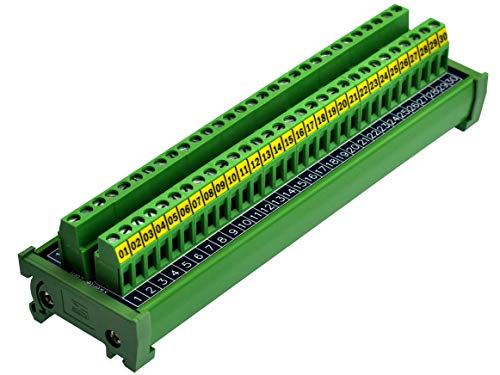
Best for high-density rack installations needing up to 30 positions in a single module. Each position supports 24A at 400V, with a consistent 5.0 mm pitch and 7 mm strip length. The block uses M3 screws and brass headers to ensure stable connections. This choice helps streamline large control cabinets and automation racks. Caution: Ensure proper ventilation around dense blocks to avoid overheating in hot environments.
Buying Guide
What should you consider when choosing rack mount terminal blocks?
- Current and voltage ratings: Match per-position current (A) and voltage (V) to your system’s requirements to avoid overheating or insulation failure.
- Wiring gauge and compatibility: Ensure the block accepts your wire size (e.g., 24 AWG to 12 AWG) and that the pitch (spacing) fits your panel.
- Mounting type: DIN rail vs screw-mount blocks determine installation practicality in labeled racks and enclosures.
- Modularity and expansion: For future upgrades, choose blocks that support additional positions or easy extension.
- Safety features: Look for flame-retardant materials, proper insulation, and clear labeling to reduce wiring errors.
- Environmental considerations: Consider corrosion and aging resistance for harsh industrial settings.
- Installation ease: Features like quick-lock mechanisms or shrouded headers can speed assembly and reduce risk.
Frequently Asked Questions
- What is a DIN rail terminal block?
A DIN rail terminal block is a modular connector mounted on a standardized rail used in control cabinets and automation equipment for organized, secure wiring.
- What is the difference between screw-mount and DIN rail terminal blocks?
Screw-mount blocks attach directly to a panel surface, while DIN rail blocks snap onto a DIN rail for quick, scalable mounting in cabinets.
- How many terminals does a 12-position block have?
It has 12 individual terminals or connections, one per position, allowing multiple circuit terminations in a single block.
- Which rating matters most for safety?
Rated voltage and rated current per position determine safe operation of each terminal under load conditions.
- Can these blocks support high-density applications?
Yes, high-density blocks exist (e.g., 30-position modules) designed for compact rack layouts, with attention to heat and wiring management.
- Do I need adapters for non-standard rails?
Some blocks are designed for standard rails; if your system uses non-standard rails, verify compatibility or use adapters as needed.