Best Controller for Solar Panels: Top Picks for Efficient, Dependable Battery Charging
Choosing the right solar charge controller is essential to protect batteries, optimize charging, and squeeze every watt from your panels. This guide compares five strong options, covering MPPT and PWM controllers suited to different battery chemistries and systems. Each product includes practical features and typical use cases for American off-grid, RV, marine, and backup applications.
Summary of selected products:
- Victron Energy SmartSolar MPPT Solar Charge Controller (Bluetooth) – 75V, 15A
- Renogy Wanderer Li 30A 12V PWM Negative Ground Solar Charge Controller
- ECO-WORTHY 200 Watts 12V/24V Solar Panel Kit with 30A PWM Controller
- Renogy Wanderer 10 Amp 12V/24V PWM Controller
- [Upgraded] 30A Solar Charge Controller by Depvko, 12V/24V PWM
Victron Energy SmartSolar MPPT Controller

The Victron Energy SmartSolar MPPT Solar Charge Controller is designed to maximize energy harvesting with MPPT tracking and intelligent charge algorithms. It supports 12/24-volt battery systems and handles up to 75V input with a 15-amp rating. A notable feature is Bluetooth connectivity, which enables monitoring and configuration from a mobile device, aiding in optimizing battery longevity and overall system health. This controller is well-suited for installations where panels experience partial shading, as it continually seeks the maximum power point to extract usable energy. Synchronization across multiple SmartSolar units can help large or modular systems behave as a single, cohesive network, enhancing system-wide efficiency.
Renogy Wanderer Li 30A PWM Controller

Renogy Wanderer Li 30A is a 12V PWM solar charge controller designed for lithium and other battery types. It features a full 4-stage charging profile (Bulk, Absorb, Float, and Equalization) and a low-profile, IP32-rated housing suitable for outdoor or compact RV and marine installations. The controller’s design emphasizes reliable protection against reverse polarity, overcharge, and short circuits, helping maximize battery life in rugged environments. It’s a compact option for smaller off-grid setups where space is at a premium and Li-based batteries are used, offering straightforward monitoring through indicator LEDs and a robust safety margin.
ECO-WORTHY 200W Solar Panel Kit With PWM Controller

This kit combines a 200-watt monocrystalline panel with a 30A PWM controller, designed for 12V or 24V systems. It’s positioned for RVs, campers, boats, and other off-grid applications. The kit’s high-efficiency panels are paired with a robust PWM regulator, offering a cost-effective path to reliable energy. The frame is corrosion-resistant and built to withstand outdoor conditions, with a weatherproof junction box and durable connectors. Ideal for users who want a complete, ready-to-install solution rather than purchasing components separately.
[Upgraded] 30A Solar Charge Controller, Depvko

The Depvko 30A solar charge controller supports 12V and 24V systems with automatic adaptation. It includes dual USB outputs for charging mobile devices and offers a robust protection suite including overcurrent, short-circuit, reverse connection, overcharge, and low-voltage protection. It is suitable for lead-acid batteries (open, sealed, GEL, etc.) and is designed to memorize user settings for automatic startup and operation, reducing setup effort for repeat installations. This model emphasizes safe operation and longevity in traditional DC off-grid configurations.
Renogy Wanderer 10A PWM Controller
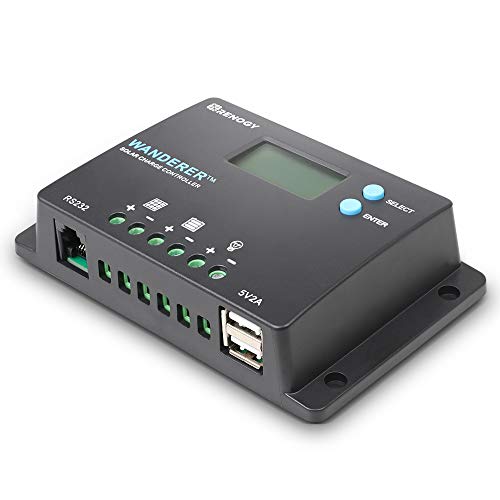
Renogy Wanderer 10A is a compact PWM solar charge controller designed for 12V and 24V systems. It features a 4-stage charging profile (Bulk/Boost/Float/Equalization) and accepts a negative-ground configuration, which is common in RV and marine setups. The controller provides basic protections, including overcharge and short-circuit safeguards, and is compatible with AGM, Gel, Flooded, and some Lithium batteries when used within the device’s ratings. Its small footprint makes it ideal for tight control panels and small solar installations where space savings matter.
Ghost Controls 30 Watt Solar Panel Kit

This kit focuses on a dedicated 30-watt solar panel designed to recharge main system batteries in automatic gate opener setups. It provides a compact solution for maintaining small battery banks and is best suited for gate automation or similar low-power, single-use systems. The kit includes mounting and wiring components to integrate quickly into compatible control boxes and post-mounted installations. It’s a specialized option rather than a general-purpose off-grid solar controller solution.
Buying Guide: Key Purchase Considerations
- System voltage and battery chemistry: Ensure the controller supports your battery type (lead-acid, AGM, GEL, flooded, lithium) and your system voltage (12V, 24V, or higher for MPPT models). Some PWM controllers are best for smaller systems, while MPPT units handle higher voltages and partial shading more efficiently.
- Charging algorithm and protection: Look for multi-stage charging (Bulk, Absorb, Float, and Equalization) and protections such as overcharge, short circuit, reverse polarity, and reverse current. These features extend battery life and improve safety.
- MPPT vs PWM: MPPT controllers optimize power extraction from panels, especially under varying light conditions or higher array voltages. PWM controllers are typically simpler and cost-effective for smaller systems or where panels are matched to the battery voltage.
- Bluetooth/monitoring capabilities: Some controllers include Bluetooth or app-based monitoring to track performance, voltage, current, and battery health. This is useful for ongoing system optimization and maintenance.
- Environmental and installation considerations: Check IP ratings, enclosure size, mounting options, and whether the unit is designed for negative-ground configurations common in RVs and boats.
- Expandability: If you anticipate adding more panels or separate strings, consider controllers that can synchronize with others or scale easily in a modular setup.
- Warranty and service plans: Durable solar controllers come with warranties and service options. Consider brands with established support networks for peace of mind.
When selecting a controller, align the choice with your use case: off-grid cabins and RVs often benefit from MPPT for higher efficiency, while compact or budget setups may be well-served by PWM controllers. For larger arrays, shaded environments, or higher panel voltages, MPPT becomes increasingly advantageous. Always verify compatibility with your battery type and system voltage to avoid charging mismatches.