Best 5-Bank Battery Tender Solutions for Autos and Marine Use
Find the right 5-bank battery tender to keep multiple batteries healthy without constant babysitting. This guide highlights top 5-bank options suited for automotive and marine setups, with clear pros, best-for notes, and practical cautions. Ideal buyers include boat owners needing multi-battery maintenance, car enthusiasts with several batteries, and small workshops seeking reliable 5-bank chargers/maintainers.
| Product | Best For | Key Benefit |
|---|---|---|
| Battery Tender 5 Bank Multibank Charger (021-0133-DL-WH) | Large vehicle fleets and marine applications | 4 amps per bank with selectable 12V/6V |
| Battery Tender Plus 4 Bank Multibank Charger (022-0148-DL-WH) | Small workshops and garages | 1.25 amps per bank with four stations |
| NOCO GENIUS2X4 6/12V 4-Bank | All-in-one maintenance for mixed battery types | Desulfator and temperature compensation |
| Battery Tender 15 AMP Charger/Maintainer (022-0234-DL-WH) | Rapid charging with long-term upkeep | Selectable 15/8/2 amps with LCD display |
| Battery Tender 5 AMP 12V Charger/Maintainer (022-0186G-DL-WH) | Everyday maintenance for cars and light trucks | Smart automatic charging with float mode |
Battery Tender 5 Bank Multibank Charger

Battery Tender 5 Bank Multibank Charger—A multi-battery maintainer designed for fleets and boats needing five independent charging channels. Each bank is switchable, supporting 12V and 6V configurations, with a total capability of 20 amps. Best for larger vehicle setups and marine installations where multiple batteries must be kept at peak readiness.
Best for: Fleet operators and boaters with several 12V or 6V batteries. Why selected: The 5-bank design consolidates charging tasks while offering separate channels to avoid cross-interference between batteries.
Caution: Data notes per-bank output; ensure wiring and space accommodate the unit’s dimensions and power needs.
Battery Tender Plus 4 Bank Multibank Charger

Battery Tender Plus 4 Bank Multibank Charger provides four charging stations at 1.25 amps each. It automatically switches from full charge to float mode to maintain long-term health. This unit includes four separate clips and a two-year warranty plus lifetime customer service.
Best for: Small workshops or garages needing compact, lightweight 4-bank maintenance. Why selected: It balances modest per-bank current with multi-battery capability and easy operation.
Caution: Four banks, not five; plan expansion if a fifth battery is added later.
NOCO GENIUS2X4 6/12V 4-Bank

NOCO GENIUS2X4 6/12V 4-Bank Battery Charger serves as a four-bank charger, maintainer, trickle charger, and desulfator. It supports lead-acid and lithium batteries (LiFePO4) and includes temperature compensation for precision charging.
Best for: Users with mixed battery chemistries who want an all-in-one solution. Why selected: The integrated desulfator and thermal regulation help optimize battery life in variable climates.
Caution: More features may be unnecessary if you only need basic maintenance; ensure compatibility with LiFePO4 if used in that battery family.
Battery Tender 15 Amp Charger/Maintainer

Battery Tender 15 Amp Charger and Maintainer offers a rapid charge with selectable output: 15, 8, or 2 amps. It maintains charge with float mode and features an LCD display for status.
Best for: Vehicles requiring faster charging with long-term maintenance, such as trucks or boats with larger batteries. Why selected: The higher amp option accelerates charging while still protecting battery health through float mode.
Caution: Higher current output demands careful cable sizing and power source adequacy.
Battery Tender 5 AMP 12V Charger/Maintainer
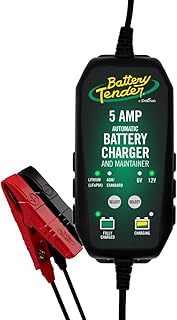
Battery Tender 5 AMP 12V Charger/Maintainer provides smart automatic charging for 12V lead-acid, AGM, gel, and some lithium batteries. Best for: Daily use in cars, SUVs, and light trucks with a need for dependable maintenance. Why selected: The 5-amp rate suits standard daily drivers while staying gentle on battery chemistry.
Caution: Ensure the connection type and space fit the unit’s dimensions for optimal airflow and safety.
Buying Guide
What matters most in a 5-bank battery tender?
Look for per-bank amperage, compatibility with your battery chemistries, and whether the unit maintains or charges. Higher amp per bank charges faster but may require robust electrical supply. Consider whether you need LiFePO4 support, desulfation, and temperature compensation for outdoor use.
How many banks do you actually need?
Five banks are ideal for fleets or boats with multiple batteries. Four banks suffice for smaller setups. If you plan to expand, choose a model with room to grow or modular options.
Which features improve long-term battery health?
- Float or maintenance mode to prevent overcharge
- Temperature compensation to adjust charging with climate
- Desulfator functions for lead-acid batteries
- Automatic switching between charge and maintenance
Common limitations to watch for
- Per-bank current may be low on some models, prolonging charging time
- Size and power cord length can restrict placement in tight spaces
- Compatibility with lithium battery chemistries varies by model
FAQ
- Q: Can I use a 5-bank tender on boats with different battery types? A: Yes, if the unit supports multiple chemistries and offers a desulfator or temperature compensation, but verify each battery’s spec.
- Q: Is higher per-bank current better for maintenance? A: Not always; higher current charges faster but may stress smaller batteries. Match to battery size and chemistry.
- Q: Do these devices come with warranties? A: Warranty details vary by model; check the product listing for coverage terms.
- Q: Can I run these chargers indoors and outdoors? A: Most are designed for automotive and marine use; confirm IP rating and weather resistance before outdoor installation.
- Q: Do I need separate cables or adapters for each bank? A: Many include individual clips or cables for each bank; ensure you have enough clearance for all connections.
- Q: Will these prevent battery sulfation in stored batteries? A: Proper maintenance charging and desulfation (where available) help reduce sulfation risk across battery types.