Best Low Impedance Electric Fence Solutions for Reliable Livestock Containment
| Product | Type | Best For | Key Benefit |
|---|---|---|---|
| Zareba 10 Mile AC Low Impedance | AC Powered | Small to mid-size farms with mixed livestock | Maintains performance in weedier conditions |
| Zareba 25 Mile AC Low Impedance | AC Powered | Medium to larger containment needs | High coverage with weed tolerance |
| Zareba ESP5M-Z Solar | Solar Powered | Remote locations without AC power | 360-degree rotation for sun exposure |
| Zareba ESP10M-Z Solar | Solar Powered | Remote, larger or irregular fencing | Up to 10 miles; durable mounting |
| Parmak MAG12-SP | Battery/Hybrid | Locations with intermittent sun or backup power | Up to 30 miles of fence with battery support |
Answer: This guide helps buyers pick reliable, low impedance electric fence chargers tailored to different farm sizes, power access, and weed conditions. It highlights top picks for small, mid, and large properties, plus solar and battery alternatives to maximize livestock containment and safety.
Zareba 10 Mile AC Low Impedance Fence Charger

The Zareba 10 Mile AC Powered Low Impedance Electric Fence Charger delivers 0.5 joules with up to 10,500 volts, suitable for cattle, horses, pigs, and goats. Its low impedance design helps maintain fence performance when weeds contact wires, making it a solid choice for farms with moderate weed pressure. Compatible with high tensile, polywire, and polytape fencing, it works well for temporary or permanent setups and is best for smaller to mid-sized operations that want reliable AC power.
Best for: small to midsize farms seeking simple AC operation and steady performance in weedy conditions. Caution: weed-infested sites may reduce effective range to around one mile; plan fencing length accordingly.
Zareba 25 Mile AC Low Impedance Fence Charger

This AC-powered charger covers up to 25 miles in ideal conditions and up to 6 miles in heavy weed scenarios. It supports all fence types and is designed for larger containment needs where weed pressure is variable. Its low impedance design helps maintain voltage when vegetation contacts the fence, which is critical for keeping livestock contained over long runs.
Best for: larger properties or farms with diverse fencing layouts. Better for: longer fence runs with occasional weed growth. Caution: optimum performance assumes minimal weed contact; heavy weed density reduces effective range.
Zareba ESP5M-Z Solar Electric Fence Charger

The ESP5M-Z solar charger energizes up to 5 miles of fencing and includes a 360-degree rotating mounting bracket for optimal sun exposure. The unit supports continuous operation by storing energy for cloudy periods, making it a practical choice for remote or off-grid locations. It’s compatible with standard fence types like high tensile wire, polywire, and polytape, and includes a post-mounting design for flexible installation.
Best for: remote or off-grid locations needing dependable solar power. Choose this if you want adjustable sun exposure and a compact solar solution. Caution: 5 miles is a moderate range; larger operations may require additional units or a connected system.
Zareba ESP10M-Z Solar Powered Fence Energizer
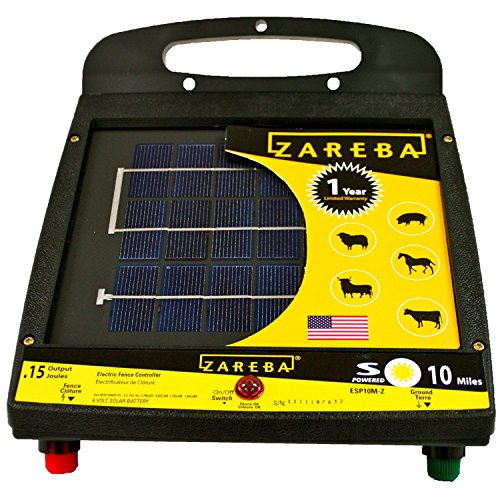
This solar charger powers up to 10 miles of fencing in ideal conditions, using an internal rechargeable battery to bridge periods without sunlight. It offers versatile mounting on posts and supports a broad range of fence types. Its 2-week solar-friendly operation under cloudy weather makes it a strong choice for farm owners who lack consistent AC access.
Best for: larger or irregular properties where solar capability and mounting flexibility matter. Better for: ongoing containment in sun-challenged locations. Caution: performance depends on sun exposure; plan for seasonal sun variation.
Zareba 50 Mile AC-Powered Low Impedance Fence Charger

The 50 Mile AC-powered charger offers high coverage for extensive properties, with a weed tolerance range that supports large-scale livestock containment. It maintains performance across all fence types and is designed to withstand heavy weed conditions. This option is best for farms that require long fence runs and robust, long-term reliability in challenging vegetation.
Best for: large operations needing broad coverage and weed resilience. Caution: consider power availability and installation complexity for very long fence runs.
Parmak Magnum Solar-Pak 12 Low Impedance

The Parmak Magnum Solar-Pak 12 uses a solar source with a 12-volt battery backup, offering around 30 miles of fence coverage in ideal conditions. It combines low impedance design with battery-backed power for extended operation. It’s suitable for larger or off-grid settings where long-duration power stability is critical.
Best for: farms needing long-range solar power with backup battery support. Choose this if you require substantial fence reach and consistent power beyond sunny days. Caution: ensure battery maintenance and sun exposure for peak performance.
Buying Guide: Key Considerations For Low Impedance Electric Fences
What size is your fence system? Match the charger’s range to your total fence miles, considering weed density and grass growth, which can reduce effective range.
Power source availability matters. If you have reliable AC access, a high-mileage AC model often provides straightforward operation. For remote sites, solar or battery options offer flexibility.
Fence type compatibility is important. Look for chargers that support high tensile, polywire, and polytape to avoid compatibility issues on existing fencing.
Weed management affects performance. Low impedance units help maintain voltage when weeds touch wires, but heavier weed growth still reduces range; plan for weed control or multiple energizers on long fences.
Installation and mounting flexibility should suit your layout. Rotating solar brackets, post mounts, and weather-resistant housings can improve long-term reliability in varying conditions.
Frequently Asked Questions
- What is low impedance in an electric fence charger? It refers to a design that maintains voltage and power output when vegetation contacts the fence, improving reliability in weed-prone areas.
- How do I choose between AC and solar chargers? Consider power availability at the fence site. Use AC for consistent power and longer runs; use solar for remote or off-grid locations and seasonally variable sun.
- Can these chargers handle all fence types? Most of the models listed support high tensile wire, polywire, and polytape, but always verify compatibility with your specific fencing.
- What maintenance is required for solar-powered units? Check batteries and solar panel cleanliness; ensure mounting points stay secure and unobstructed by debris or shade.
- Is 50 miles of coverage necessary for a small farm? Not usually; larger range is beneficial for long perimeter fences, but for compact operations, 10–25 miles often suffices with weed management and fencing configuration.
- What safety considerations exist? Always follow manufacturer guidelines, keep livestock away from energizer housing, and ensure proper grounding and earth connections where applicable.