Best 220V AC Voltage Regulators for Home, Workshop, and Appliances
Looking for a reliable 220V AC voltage regulator to protect and power your devices? This guide highlights five top options, each suited to different needs—from high-wattage heaters and motors to delicate electronics. Best for heavy-duty industrial use, best for compact home setups, best for variable-speed control, and more, these selections help you choose with confidence. The table below compares key specs to help you decide at a glance.
| Product | Best For | Max Power | Voltage Range | Notes |
|---|---|---|---|---|
| GRDM 10000W High Power SCR Voltage Regulator | Heavy-duty motors and heaters | 10,000W peak (8,000W resistive) | 10-220V | Digital LED display; robust cooling |
| QUGURLID Voltage Stabilizer 6800W | Household appliances | 6800W | ~220V | Six protection functions; compact |
| SIPYTOPF 2000W PWM AC Regulator | Small to mid-size devices | 2000W | 50-220V | PWM speed control; 25A |
| Teyleten Robot SCR Controller Board | High-power motor control | 10000W | AC 110-220V | Thermoregulation and voltage regulation |
| SICWEDIM 20000W Stabilizer | Large appliances and HVAC | 20000W | 220V | High-power automatic stabilization |
GRDM 10000W High Power SCR Voltage Regulator
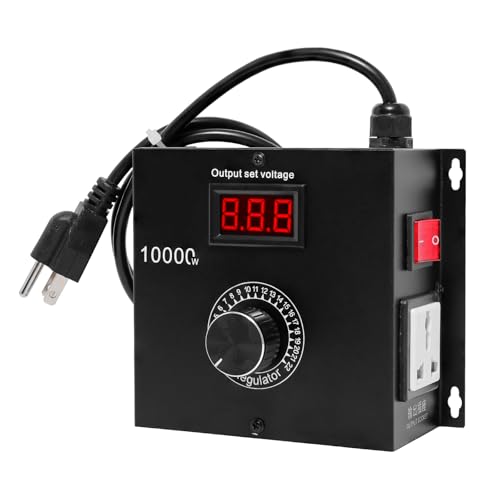
Best for demanding equipment, this unit delivers up to 10,000W peak power with a 8,000W resistive limit. It is ideal for water heaters, electric stoves, and tungsten lighting where stable voltage is crucial. The included high-accuracy digital LED display enables precise monitoring of output from 10V to 220V. A thick metal shell and heat sink support long-term industrial use without overheating.
Who it’s for: buyers operating high-wattage tools or heating appliances who need robust, precise control. Caution: do not exceed recommended continuous load—typical practical use sits well below max peak power.
Voltage Stabilizer 6800W for 220V Single Phase

This 6800W stabilizer focuses on comprehensive protection with six functions: over/under voltage, overcurrent, high/low temperature, internal overtemperature, delay, and lightning protection. It offers a compact design with fast response and no waveform distortion, making it suitable for refrigerators, TVs, and other household appliances. LCD display helps monitor voltage quickly.
Who it’s for: homeowners seeking reliable, all-around protection for common 220V appliances. Caution: adequate ventilation is recommended to prevent heat buildup over time.
SIPYTOPF 2000W PWM AC Motor Speed Controller

With input voltage from 110V to 220V and a maximum output of 2000W, this PWM controller provides smooth voltage scaling for AC motors. It supports a voltage range of 50-220V, ensuring compatibility with a variety of devices. It is a practical choice for hobbyist projects or small industrial applications where speed control and voltage regulation are needed.
Who it’s for: users needing moderate power control for motors or dimming contexts. Caution: rated maximum output is 2000W; running near the limit for extended periods can cause overheating.
Teyleten Robot SCR Controller Board

This board supports voltage from AC 110-220V with a maximum resistive load rating of 10,000W and a frequency-compatible regulation range from 10V to 220V. It is positioned for high-power motor control and customizing voltage delivery to meet various performance needs. It’s a suitable choice for enthusiasts integrating SCR-based regulation into sophisticated setups.
Who it’s for: users who require a high-widelity SCR-based regulator for large motors or complex setups. Caution: installation requires electrical knowledge due to high voltage and current handling.
SICWEDIM 20000W Automatic Voltage Stabilizer
This high-power stabilizer is designed for heavy appliances and environments where voltage stability matters. It claims a 20,000W capacity and uses automatic stabilization with a focus on quick response and efficiency. It is suitable for refrigerators, air conditioners, and other large loads that demand steady voltage in fluctuating supply conditions.
Who it’s for: households or small businesses needing strong, automatic voltage regulation for large equipment. Caution: ensure electrical wiring and breakers can safely handle high current, and verify compatibility with all connected devices.
Buying Guide: Key Considerations for 220V AC Voltage Regulators
What matters when choosing a 220V AC regulator? Consider these practical questions and guidelines to match a unit to your needs.
- What is the expected load? Match the regulator’s continuous operating wattage to the total load. Peak ratings may exceed continuous use, but continuous loading should stay well within recommended limits.
- What devices will be powered? Heaters and motors benefit from higher wattage regulators, while electronics tolerate tighter regulation with precise displays.
- Voltage range and regulation type: Some devices offer simple automatic regulation, others provide manual or PWM-based control for finer adjustment. PWM can deliver smooth speed control for motors but may introduce complexity in wiring.
- Protection features: Look for protection against overvoltage, undervoltage, overcurrent, temperature, and short circuits. Additional protections like lightning or delay features improve reliability in variable power conditions.
- Installation considerations: High-wattage regulators demand proper enclosure, cooling, and safe wiring. Where possible, consult a qualified electrician for installation.
- Size and cooling: Larger units with higher power outputs require effective heat dissipation. Evaluate enclosure requirements and ventilation.
- Accuracy and display: A clear LED or digital readout helps you monitor output voltage precisely, which is especially important for sensitive equipment.
FAQ
- What voltage range do these regulators support? Most listed units regulate from around 10V–220V, with some models optimized for 120V–220V inputs and outputs depending on design.
- Can I use these regulators for critical electronics? Yes, but choose models with precise regulation and protection features. For sensitive devices, ensure the unit provides stable output and low ripple.
- Are there safety considerations when using high-wattage regulators? Yes. Ensure proper enclosure, cooling, and wiring rated for the load. Avoid overloading and follow manufacturer guidelines for continuous use.
- What’s the difference between a voltage stabilizer and a voltage regulator? A voltage stabilizer maintains a stable output under fluctuating input conditions, while a regulator controls output voltage to a desired level, sometimes with speed or torque controls for motors.
- Do these units require professional installation? For high-wattage and high-current models, professional installation is advised to ensure safety and compliance with electrical codes.
- Will these work with 220V household outlets? Most listed models are designed for 220V single-phase systems, but verify input compatibility and wiring requirements before installation.