Best X-Ray Wall Scanners for Home Projects and Pros
Whether you’re hanging art, installing shelving, or planning remodels, the right wall scanner helps you avoid hidden hazards. This guide highlights five top x-ray style wall scanners that reveal studs, pipes, and live wires behind walls. These tools are best for DIYers, homeowners, and professionals who need precise locating before drilling or cutting. Below you’ll find quick-cue sections for each product, a buyer’s table, and a practical buying guide to compare capabilities side by side.
| Product | Best For | Key Benefit |
|---|---|---|
| Walabot DIY 2 – Visual Stud Finder | Homeowners and DIY enthusiasts new to wall scanning | Visual center identification for wood/metal studs and embedded pipes/wires |
| Walabot DIY 2 – Advanced Wall Scanner | Mobile users who want cross-device compatibility | See-through-wall capability with iOS/Android support |
| SHGMEET Stud Finder Wall Scanner | Multi-function tool users | 3-in-1 with laser distance meter and digital level |
| Triplett WS230 | Users needing clear color display | Color LCD with multi-mode detection including AC voltage |
| Franklin Sensors ProSensor M210 | Pro-level accuracy seekers | 13 sensors for precise stud centers and edges |
Product selections are based on the ability to reveal hidden structures, versatility, and practical guidance for accurate placement. The table above provides at-a-glance recommendations to help you decide which tool aligns with your project type and skill level.
Walabot DIY 2 – Visual Stud Finder & Wall Scanner

Best for visualizing wall contents rather than listening for beeps. Walabot’s core feature is seeing into walls: it visually identifies the center of wood and metal studs, plus pipes and wires. The device connects to a phone via internal Wi‑Fi, enabling real-time wall imaging. This makes it a strong choice for builders or hobbyists who prefer a visual reference over traditional beeps. Limitations include reliance on compatible devices and Wi‑Fi connectivity within the Walabot ecosystem.
Walabot DIY 2 – Advanced Wall Scanner

Better for smartphone users who want a broader compatibility footprint. This model emphasizes “see it, don’t hear it” with enhanced center-finding for studs and the ability to track pipes and wires up to 4 inches (10 cm) inside drywall. It expands support to iOS alongside Android, making it a practical option for households with mixed devices. A caveat is that some users may rely on the companion app’s features, so prepare to manage smartphone integration during projects.
SHGMEET Stud Finder Wall Scanner with 5 in 1

Selected for its multifunction approach. This unit fuses advanced stud detection with a laser distance meter and a digital level, offering a compact 5‑in‑1 package. It detects wood/metal studs, pipes, and live wires, and provides distance data with a center marker on the LCD. Best for DIYers who want one tool to handle measurement and alignment tasks. One limitation is the complexity of multiple features, which may require a learning curve for precise usage.
Triplett WS230 Wall Scanner

Best for users who prefer a clear color display and straightforward alerts. The WS230 features a vibrant 2.4″ color LCD with audio alerts and visual indicators. It has three detection modes: stud detection (center and edges), metal detection (pipes and wires), and AC voltage detection. Depth ranges vary by mode, with practical readability in real-world walls. Limitations include depth restrictions within thicker or multi-layered constructions, where deeper targets may be harder to detect.
Franklin Sensors ProSensor M210
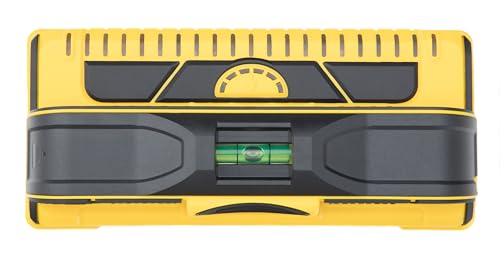
Chosen for high-accuracy needs. The ProSensor M210 uses 13 sensors to locate stud centers and edges with greater precision. It includes a live wire meter for safety awareness before drilling. The wide LED display shows both the center and edges, helping you place fasteners accurately. A potential limitation is the higher price point and slightly larger form factor, which may not suit tight spaces or quick tasks.
JAXWQ Stud Finder Wall Scanner

Best for buyers seeking a compact 5‑in‑1 tool with a practical display and alerts. It uses an intelligent micro-sensor chip to quickly locate edges and centers of metal, studs, joists, pipes, and live wires. The bright LCD shows location data and battery status, and it supports multiple detection modes. Limitation notes include potential sensitivity to wall material variations, which can slightly affect depth readings.
FNIRSI 6-in-1 Wall Stud Finder

Best for multi-surface detection. FNIRSI combines six detection modes: center/edge locating for wood and metal studs, non-ferrous and ferrous metal scans, AC live wire detection, and copper wire detection. Depth readings vary by mode, offering substantial versatility for complex wall assemblies. A consideration is that more modes can mean a steeper learning curve for new users.
Buying Guide: How To Choose Your Wall Scanner
What should you consider before buying? Target depth, wall composition, and required features drive the decision.
- Target depth and material: Thicker walls (like multi-layer constructions) may require devices with deeper sensing or multiple layers detection.
- Display and alerts: Color LCDs and visual markers improve accuracy, especially in cluttered spaces. Audio alerts are helpful in loud environments.
- Multi-function needs: If you need a laser distance meter or digital level, consider 3-in-1 or 5-in-1 models to consolidate tools.
- Device compatibility: Some Walabot models connect to smartphones via Wi‑Fi or apps. Ensure your phone is compatible.
- Ease of use: Calibrations and modes vary. Look for models with minimal setup and clear center/edge indicators.
FAQ
- What is the main advantage of a visual wall scanner over a traditional beep tester?
Answer: A visual wall scanner shows exact locations of studs, pipes, and live wires, reducing guesswork and increasing placement accuracy. - Do these tools work with drywall and plaster walls?
Answer: Yes, most models detect studs and services behind drywall and plaster, though depth and performance vary by model. - Is it necessary to connect a Walabot to a phone?
Answer: Some Walabot models use built-in Wi‑Fi to stream wall data to a phone, while others may operate standalone or with mobile apps. - Can I detect live electrical wires with all models?
Answer: Most models include live wire detection, but depth and sensitivity differ; always treat the wall as live and drill with caution. - Which model is best for a beginner?
Answer: A model with clear LCD indicators and simple center/edge markers, such as the Triplett WS230 or FNIRSI, is typically beginner-friendly.