Best 20 Amp Battery Chargers for Fast, Safe Vehicle Charging
Need a 20A battery charger that can handle LiFePO4, AGM, GEL, and other lead-acid batteries across cars, boats, RVs, and farm equipment? This guide highlights five top options designed for fast charging, smart maintenance, and long battery life. The right charger depends on your battery type, vehicle size, climate, and whether you want desulfation or winter maintenance features. Below you’ll find concise, comparison-friendly details to help you choose.
Summary of selected products
| Product | Best For | Key Benefit |
|---|---|---|
| YONHAN Battery Charger 20A | General automotive and large batteries | 7-stage charging with winter mode and repair function |
| E-FAST 20A Battery Charger | All-in-one solution for diverse fleets | 7-stage smart charging with desulfation and protections |
| Haisito 20-Amp Smart Charger | High-current speed and LiFePO4 safety | Large LCD, fast 20A charging with LiFePO4 mode |
| AeternaSol 20A Smart Charger | Heavy-duty batteries and 12/24V dual voltage | 200s booster mode and multiple current settings |
| VEVOR 20A Smart Charger | Versatile modes and desulfation | LCD display, four modes, configurable current |
YONHAN Battery Charger 20A 12V/24V

Best for: Car owners with mixed battery types and seasonal storage needs. This charger supports 12V at 20A and 24V at 10A, designed to charge, maintain, and repair lead-acid and LiFePO4 batteries. The 7-stage process includes a repair mode and winter mode to protect batteries during cold months. Use this if you want a single device that covers diverse battery chemistries and provides safety protections. Caution: It’s not a jump starter and must be plugged into an outlet.
E-FAST 0-20A Battery Charger

Best for: Fleets or multi-vehicle setups needing an all-in-one charging solution. The E-FAST device acts as a charger, maintainer, trickle charger, and desulfator, with a seven-stage process that adapts to battery status. It provides multiple protections including reverse polarity and overcurrent/overvoltage safeguards. Choose this if you want a single unit that can manage both lead-acid and LiFePO4 batteries across various vehicle types. Limitation: If the device displays dE5 during charging, it will auto-adjust after a few minutes.
Haisito 20-Amp Smart Battery Charger
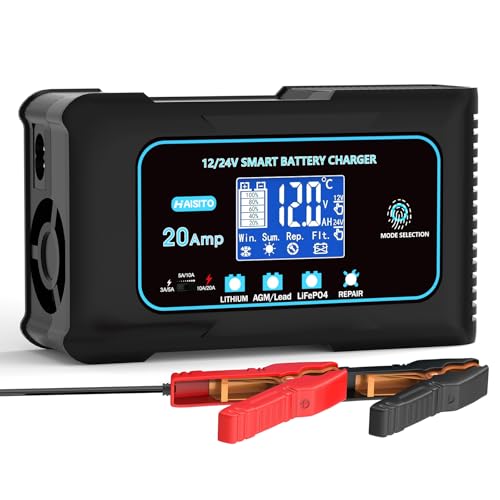
Best for: Vehicle owners needing rapid charging with safety for LiFePO4 and other lead-acid chemistries. This charger delivers 20A for 12V and 10A for 24V, claims faster charging than standard options, and includes a large LCD to monitor current, voltage, temperature, and battery percentage. It features a dedicated LiFePO4 mode to guard BMS protection. Caution: It emphasizes performance speed, so monitor battery temperature to avoid overheating on larger banks.
AeternaSol 20A Smart Car Charger
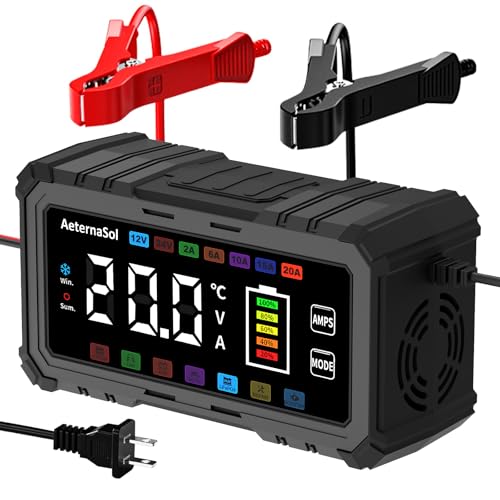
Best for: Heavy-duty applications and batteries up to 400Ah, including LiFePO4 and multiple lead-acid types. It automatically recognizes 12V/24V and offers five current selections (2A, 6A, 10A, 15A, 20A) to tailor charging. The 200-second booster mode is designed for targeted quick charging in emergencies. Use this if you need precise current control and a booster option for a surface charge in a pinch. Limitation: Booster mode is not a full jump-start function.
VEVOR Smart Battery Charger 20A

Best for: Users needing a versatile four-mode charger with a clear LCD readout. It supports lead-acid, LiFePO4, and lithium batteries across 6/12/24V, with settings for charging, maintain, desulfation, and supply mode. This allows ongoing maintenance and desulfation for older batteries. Caution: Like many smart chargers, full capabilities depend on battery status; some deeply discharged batteries may require repair mode before charging begins.
Buying Guide: Key Considerations For 20A Battery Chargers
What battery chemistry will you charge most often? If you work with LiFePO4, ensure the charger has a LiFePO4-specific mode to protect the battery management system. Lead-acid users should confirm compatibility with AGM, GEL, SLA, and flooded varieties to avoid overcharging.
Do you need 12V or 24V support? A dual-voltage charger with selectable current is ideal for mixed applications like cars and boats, or fleets with large deep-cycle batteries. Look for automatic recognition with manual override options.
Is desulfation or a repair function important? Desulfation helps extend the life of older or idle lead-acid batteries but may not revive completely dead cells. If repair is a priority, verify the device explicitly offers desulfation/repair modes and clear indicators.
What safety features matter? Choose chargers with reverse polarity protection, overcurrent/overvoltage protection, short-circuit protection, temperature compensation, and a cooling system. Fireproof materials add an extra safety margin for prolonged charging in hot environments.
What about size, display, and usability? A large LCD display helps monitor voltage, current, and battery temperature in real time. A compact form factor with an intuitive control panel improves daily use, especially in garages or service bays.
FAQ
- Do these chargers jump-start cars? No. They are designed for charging and maintaining batteries; some offer a booster mode for a surface charge, but not a jump-start function.
- Can I use a 20A charger for LiFePO4 batteries? Yes, if the charger has a LiFePO4-specific mode or settings designed for LiFePO4 chemistry to prevent overcharging.
- Will charging take longer on 24V batteries? Typically the charger delivers lower current at 24V (often 10A) compared to 12V (20A). Time varies with battery capacity.
- What maintenance features should I expect? Look for trickle/float charging, desulfation, temperature compensation, and automatic switching to maintenance mode when fully charged.
- Are these chargers safe to leave plugged in overnight? When they include proper protections (overcurrent, overvoltage, reverse polarity), they can be safe for extended use, but always follow manufacturer instructions and monitor the setup during initial use.
- Do these chargers require professional installation? Most are plug-in devices that do not require professional installation; they connect to standard outlets and battery terminals as directed in the manual.