Best Low Temperature Data Logger Guide for Accurate Cold-Chain Monitoring
Answering the need for precise, reliable temperature tracking in laboratories, pharmacies, and cold-chain logistics, this guide highlights five top low temperature data loggers. Each option is evaluated for who it’s best for, what makes it reliable, and practical considerations like memory, connectivity, and ease of reporting. Readers will find clear, comparison-friendly details to help choose the right data logger for cold environments and strict storage requirements.
| Product | Best For | Key Benefit |
|---|---|---|
| Freshliance Ultra Low Temperature Data Logger | Researchers and food-safety-conscious developers | High temp range with external probe and up to 35,000 readings |
| Elitech Bluetooth Ultra Low Digital Data Logger (GSP-6 successor) | Pharmaceutical storage and CDC/VFC-compliant setups | Bluetooth transfer and up to 100,000 points |
| Tzone Low Temperature Data Logger USB | Lab and freezer environments needing PDF/CSV reports | USB reports with password protection and Windows software |
| Elitech RC-5 USB Temperature Data Logger | General purpose data logging with clear display | 32000 points with built-in USB access |
| Tzone Bluetooth Temperature Data Logger with Probe | Mobile monitoring and compact installations | Bluetooth with external probe and 32,000 recordings |
Freshliance Ultra Low Temperature Data Logger

The Freshliance model targets users who need external sensing with high accuracy across a broad temperature span. Best for researchers and facility managers who require precise readings and extensive data points. The external probe supports -196°C to 200°C, with a precision of +0.5°C. It also features alarm and mark functions and a large memory for up to 35,000 readings, aiding trend analysis and event logging.
Best for: labs requiring high-precision monitoring and customers needing detailed PDF/CSV reporting. Choose this if you need up to 6 alarms and 9 event marks to annotate critical temperature events. A potential limitation is the focus on external-probe accuracy over on-board sampling versatility.
Elitech Bluetooth Ultra Low Digital Data Logger (GSP-6 Series)
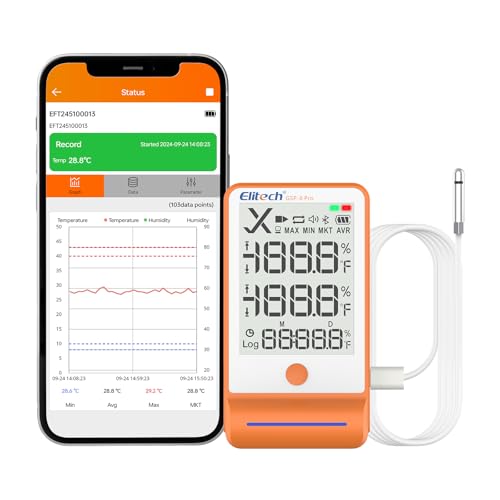
This Elitech model is ideal for pharmaceutical storage and vaccine programs needing CDC/VFC-aligned documentation. Key advantages include Bluetooth data transfer to the iCold app, a large data capacity of up to 100,000 points, and compliance features like calibration certificates. It supports wide temperature ranges and high-precision measurement (±0.3°C). It suits environments where wireless data access and formal exportable reports are essential.
Best for: facilities requiring wireless data access and formal calibration documentation. Better for users who want app-based parameter control and easy PDF/CSV report exports. Caution: Bluetooth depends on app compatibility and may require pairing steps in clinical settings.
Tzone Low Temperature Data Logger USB

This Tzone model emphasizes USB-based data delivery, with automatically generated PDF and CSV reports when connected to a PC. It includes password-protected reports and a calibration certificate, and supports parameter settings such as alarm ranges, logging intervals, and startup modes. It’s well-suited for cold-chain monitoring in labs, freezers, and pharmaceutical storage, especially when Windows software is available for detailed data analysis.
Best for: users who want streamlined Windows software, password-protected reporting, and easy comparison across devices. Choose this if you favor USB reporting and formal calibration documentation. Limitation: Windows-only software may restrict cross-platform use.
Elitech RC-5 USB Temperature Data Logger

The RC-5 provides a straightforward USB data-logging solution with a 32,000-point capacity and a wide -30°C to 70°C range. It has a built-in USB connector, enabling direct data download without separate readers. A clear LCD display helps monitor current, min/max, and alarm status. This model is best for general-purpose monitoring where simplicity and reliable data export are priorities.
Best for: general labs and storage rooms needing a simple USB data logger with easy access and dependable operation. Choose this if you want no-fuss USB downloads and a visible display. Caution: It may not include Bluetooth or cloud/ mobile reporting features found in more advanced units.
Tzone Bluetooth Temperature Data Logger with Probe

This Tzone model combines Bluetooth connectivity with an external probe, offering mobile monitoring and easy report downloads. It records up to 32,000 readings and has IP65 weather resistance, suitable for humid or refrigerated environments. The detachable probe and magnetic backing facilitate flexible placement and quick setup in warehouses or transport scenarios.
Best for: users who want mobile access to temperature data and space-saving mounting. Choose this if you need Bluetooth-enabled reporting to a phone app and want to monitor multiple loggers simultaneously. Limitation: Bluetooth requirement may be less reliable in environments with poor connectivity or dense metal surroundings.
Buying Guide: Key Purchase Considerations
- Data capacity and sampling interval: Consider how many readings you need and how often to sample. Higher capacity is better for long storage runs; shorter intervals provide finer trend data.
- Connectivity: USB-only devices are simple for local data export. Bluetooth or app-based logging is convenient for mobile monitoring and remote access, but may require software compatibility and pairing steps.
- Memory readout and display: Built-in LCDs help quick checks; larger onboard memory supports longer monitoring without downloads.
- Calibration and certificates: For pharma and regulated environments, models offering calibration certificates and traceability help meet compliance requirements.
- Temperature range and accuracy: Match the logger’s range and precision to your application, from freezer storage to high-temperature test chambers.
- Durability and environmental rating: IP ratings and rugged construction suit humid or refrigerated environments; consider sealing and mounting options (magnetic backs, probes, and adapters).
- Software and data export: Look for formats like PDF/CSV and compatibility with popular software; ensure export paths align with your data workflow.
Frequently Asked Questions
- What is the typical memory capacity I should look for in a low temperature data logger?
Aim for 32,000 points as a baseline for many models; 100,000 points is preferable for longer runs or high-frequency logging. - Is Bluetooth connectivity necessary for cold-chain monitoring?
Not always. Bluetooth is convenient for mobile access and quick checks, but USB or offline logging may be more reliable in certain facilities. - Do all data loggers require calibration certificates?
No, but regulated settings (pharmacy, vaccines, CDC guidelines) often require formal calibration certificates to prove traceability. - Can I use a data logger for both freezers and refrigerators?
Yes, provided the device supports the appropriate temperature range and accuracy for both environments. - What should I consider when choosing between USB-only and Bluetooth-enabled models?
USB-only devices are often simpler and more robust in stationary setups; Bluetooth models offer mobility and remote reporting advantages but rely on wireless stability. - Are external probes always necessary?
External probes expand sensing flexibility for dynamic environments or hot/cold zones, but some applications work well with built-in sensors.