Best Dual Fuel Generators for Diesel and Natural Gas Power Backup
The best dual fuel generators provide reliable backup power by running on multiple fuel sources such as gasoline, propane, or natural gas. This article highlights five top options and explains who each is best for, with clear compare-ready details to help you decide quickly. These models are suitable for home backup, remote camping, or job sites where fuel flexibility matters. Below is a quick summary table of the featured products to compare at a glance.
| Model | Fuel Options | Best For | Key Benefit |
|---|---|---|---|
| DuroMax XP13000HXT | Gas, Propane, Natural Gas | Whole-home backup during outages | High power with CO alert |
| Westinghouse 14500 Peak | Gas, Propane | Larger homes, transfer-switch ready | Long runtime on big tanks |
| ERAYAK 4500W Dual-Fuel | Gas, Propane | Portable power for emergencies and camping | Compact, auto-switch, CO sensor |
| Westinghouse 13500 Peak | Gas, Propane | Mid-to-large backup with RV/garage ready | Remote start and multiple outlets |
| WEN DF480iX | Gas, Propane | RV and quiet residential use | Inverter clean power, ultralight |
DuroMax XP13000HXT Dual Fuel Tri Fuel Generator

The DuroMax XP13000HXT is a 13,000-watt tri-fuel model that runs on gasoline, propane, or natural gas. It features a robust 500cc OHV engine and CO alert for fumes safety. This unit is best for homeowners who want the flexibility to fuel from multiple sources during storms or outages. Choose this if you want a large-capacity backup capable of powering essentials across the home. A limitation is that fuel switching and setup can be more involved than smaller units, requiring careful fuel line management and maintenance. Suitable for: households seeking strong entire-home backup with fuel versatility.
Westinghouse Outdoor Power 14500 Peak Dual Fuel Generator

This Westinghouse dual-fuel model delivers up to 14,500 peak watts (gas) and 13,500 peak watts (propane) with 11,500 running watts on gasoline and 10,500 on propane. It’s ideal for larger homes and transfer-switch-ready setups, with long runtimes on big tanks. Best for: homes needing substantial, dependable portable power with ease of expansion via transfer switches. Limitation: higher power output comes with greater size and weight, impacting portability.
ERAYAK 4500W Dual-Fuel Portable Inverter

ERAYAK offers dual-fuel capability with 4500W peak and 3500W running on gasoline, plus 4050W peak and 3150W running on propane. It includes a gas-priority auto-switch and is portable at about 54 pounds. It’s best for campers, small homes, or construction sites needing reliable short-term power with smooth auto-switching. Caution: while portable, the unit’s output is modest compared to full-house backup systems.
Westinghouse 13500 Peak Dual Fuel Backup Generator

This model provides 13,500 peak watts (gas) and 12,500 peak watts (propane) with 10,500 running watts (gas) and 9,500 (propane). It includes remote start, a 9.5-gallon tank with fuel gauge, and multiple outlets suitable for home backup and RV setups. Best for: users who want a robust, transfer-switch-ready option with versatile outlets. Limitation: a larger unit may require more storage space and heavier handling.
PowerSmart 4400-Watt Dual Fuel Inverter

This dual-fuel inverter starts at 4400W (gas) with 3600W running, and 4050W peak (propane) with 3150W running. It offers a long runtime on a modest fuel tank and is comparatively quiet for an outdoor generator. Best for: home backup or camping where noise and fuel flexibility matter. Limitation: higher wattage models may not handle a full home load on propane alone.
PowerSmart 3800 Watt Dual Fuel Inverter
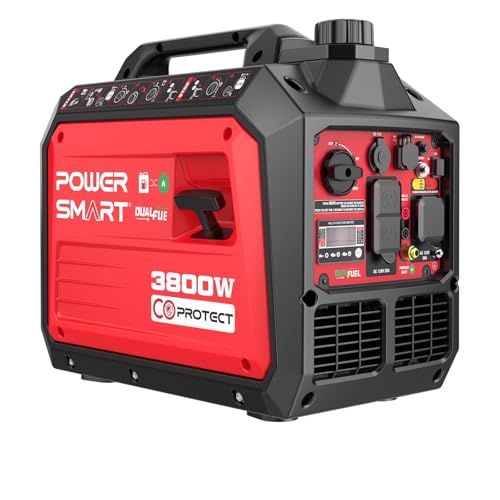
This model delivers 3800 starting watts and 3300 running watts on gasoline and 3500 starting watts and 3100 running watts on propane, with up to 25 hours runtime on propane. It includes a clean power inverter suitable for sensitive electronics and RV-ready outlets. Best for: light-to-moderate home backup and outdoor activities where quiet operation is valued. Limitation: lower peak output compared to larger units.
Buying Guide: How To Choose Your Dual Fuel Generator
Fuel flexibility matters for reliability. When assessing dual fuel generators, consider power needs, fuel availability, runtime, and portability. For whole-home backup, prioritize higher running watts and a larger fuel tank. For camping or RV use, prioritize portability, inverter technology, and quiet operation. Always check for CO sensors or shutdown features for safety.
- Power requirements: List essential devices and total wattage to ensure the model can handle your load.
- Fuel availability and cost: Consider which fuels are readily available in your area and the long-term cost.
- Run time and fuel capacity: A larger tank extends runtime between refuels, especially in outage scenarios.
- Portability versus capacity: Heavier, higher-watt units offer more power but require more storage space and handling.
- Safety features: CO shutdown, UFC sensors, and automatic transfer switch compatibility matter for safe operation.
Frequently Asked Questions
- What is a dual-fuel generator?
It can run on two different fuels, typically gasoline and propane, with some models also supporting natural gas.
- Which fuel lasts longest for emergency backup?
Propane has a long shelf life and can be sourced from tanks in storage, which is advantageous for long outages.
- Do dual-fuel generators require special maintenance?
Maintenance is similar to single-fuel units, with additional checks for the secondary fuel system and fuel lines.
- Is inverter technology important for dual fuel?
Yes, inverter technology provides clean power suitable for sensitive electronics and improves efficiency.
- Can I parallel these units for more power?
Some models are parallel-ready, allowing you to increase capacity by connecting multiple units, but verify compatibility for each model.